Skip to content

Step-by-step plan · Visa required

The step-by-step plan for South Korea

From "we want this" to being settled, in 43 steps. Read phase 1 in full here. Test your departure date along the way. Then you'll know whether you want the rest.

43 steps5 phases163 official sources16 only for your situationchecked on 26 October 2026

Phase 1 starts below ↓The whole plan: € 399 one-off, no subscription.

A plan that keeps track of what needs to happen now.

Every step sits in its place in the order, with the lead time, the counter and the official source. You and your partner tick off what is done. The plan counts back from your departure date and shows what has to start when and what is running now.

Below is phase 1, exactly as it appears in the plan.

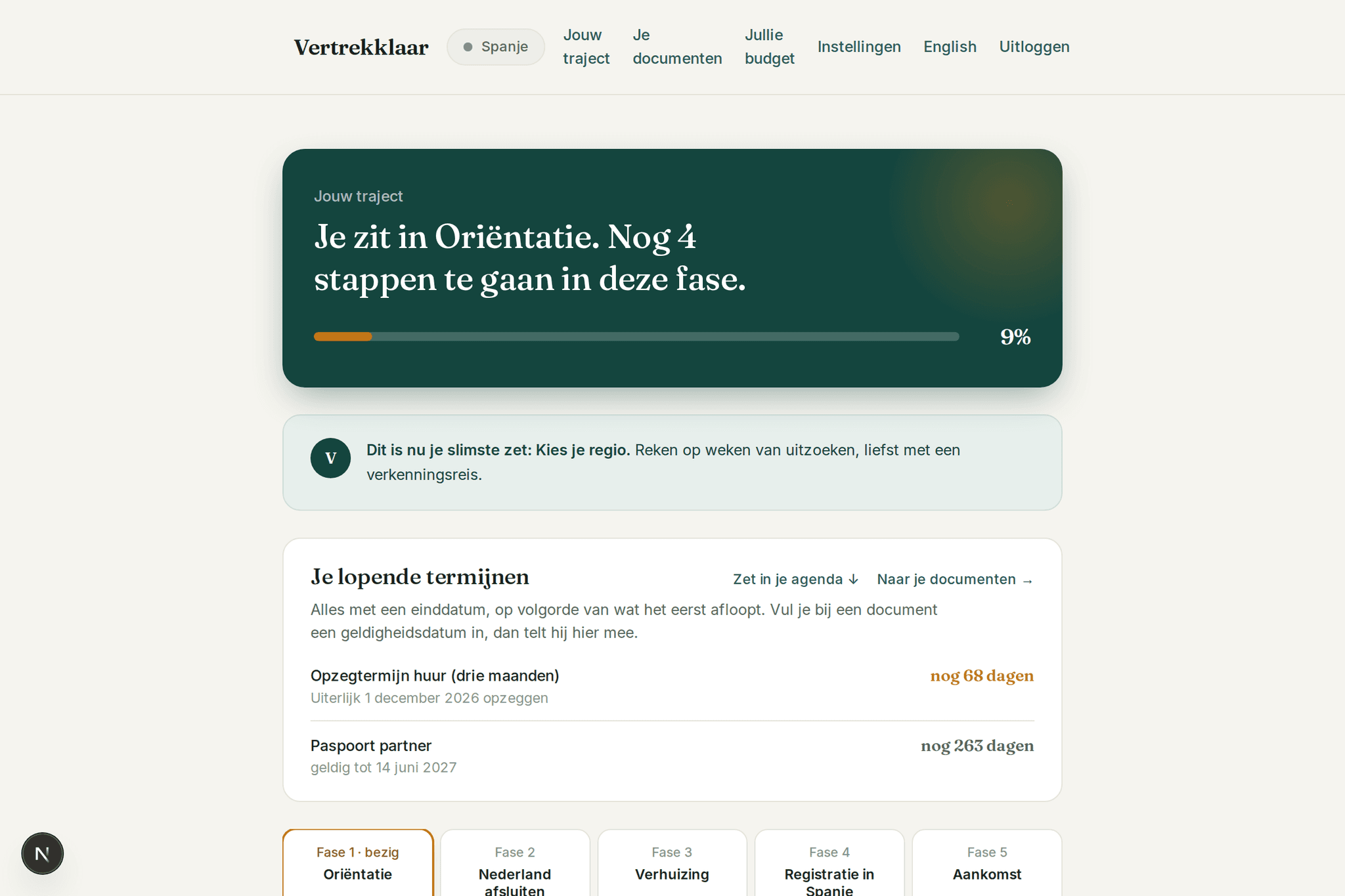
The dashboard of the step-by-step plan for South Korea: the current phase, the open steps, the next step and the deadline bar.

The route

  1. Orientation

    6 steps

    Open · You are here

  2. Your visa

    9 steps

    In your plan

  3. Closing the Netherlands

    13 steps

    In your plan

  4. The move

    5 steps

    In your plan

  5. Arrival in South Korea

    10 steps

    In your plan

Phase 1 is the question "can we, and do we want to?". From phase 2 the arranging begins.

Phase 1 · Orientation

6 of 6 steps open

South Korea is a country with its own rules and its own language. You may be there for ninety days without a visa; whoever wants to stay needs a visa, and a retirement visa doesn't exist. Your AOW goes along in full. For healthcare there's no treaty, so no CAK.

At the end of phase 1 you know whether there is a route for you, what happens to your income and your healthcare, and the family is behind the decision.

Doing this together?

Invite your partner with a link. You then each tick your own steps, on your own phone or laptop, and see at every step whether the other has already done it. No account needed.

We only store which step numbers you ticked, under a random code. No name, no email. Anyone with the link can see the ticks. After six months without use we delete it.

Step 1.1

Understand the system: ninety days without a visa, and five routes to stay

Lead time:
reading step
Costs:
none

In this step you learn how you may come to live in South Korea. With a Dutch passport you need no visa to enter. You may then stay ninety days. Working isn't allowed during that time.

If you want to stay longer, you need a visa. You apply for it before departure, at the Korean visa centre in The Hague. There are five routes:

  • Work. The E-7 visa, with a contract with a Korean employer.
  • A Korean spouse. The F-6 visa, for whoever is married to a Korean.
  • Korean descent. The F-4 visa, for whoever was Korean at birth, like many adoptees, and their children.
  • Digital nomad. The F-1-D visa, for whoever works remotely for a foreign company.
  • Working holiday. The H-1 visa, for whoever is 18 up to and including 30.

A retirement visa doesn't exist. That's the most important thing to know now. The Korean list of residence statuses has no status for whoever wants to live on a pension or their own money. If you're 65 and have no Korean partner, no Korean descent and no work in Korea, you can only be there for ninety days at most each time. Living there isn't possible then. There is a permanent status for people over 60 with a foreign pension of about 105 million won a year, about 70,700 euros. But you apply for it in Korea, as a change of a status you already have. How you get there from a stay without a visa isn't stated anywhere. Don't count on it without checking with the immigration service.

What also counts: the language. Forms are in Korean, sometimes in English. Outside the big cities English gets you less far than you think.

Step 1.2

Know what happens to your income, your AOW and your healthcare

Lead time:
an evening of research
Costs:
none

In this step you see what emigrating to South Korea does to your AOW, your tax and your healthcare.

The AOW. The Netherlands and Korea have a social security treaty, which has applied since 1 October 2003. Because of it, Korea is one of the countries where the full AOW goes. Whoever goes alone also keeps the AOW for a single person. The survivor's benefit (the Anw) and a WIA benefit go along too. Allowances, the AIO supplement, the WW and child benefit stop.

The tax. There is a tax treaty from 1978. The Netherlands may keep taxing your AOW. A government pension from ABP too. Your company pension goes to the country where you live: Korea. How that works out, you read in phase 3.

Healthcare. Korea isn't on the list of treaty countries for healthcare. So there's no CAK. Your Dutch basic insurance stops when you deregister. In Korea you're compulsorily insured with the state insurance, the NHIS, after six months of residence. If you work for a Korean employer, from your first working day. Until then you need a policy of your own.

Your AOW build-up stops. The treaty arranges the payment, not the build-up. Whoever lives in Korea and doesn't work in the Netherlands is usually no longer insured. Every year until your AOW age then costs 2 percent of your later AOW. You can insure yourself voluntarily with the SVB. The application must be in within one year.

Step 1.3

Choose where you live

Lead time:
weeks, preferably with a scouting trip
Costs:
a scouting trip is a serious expense

In this step you choose where you want to live. Most Dutch people think of Seoul, but Busan, Daejeon, Daegu, Gwangju and the island of Jeju are very different: quieter, cheaper and less English.

First read the travel advice of NederlandWereldwijd. This is what it says:

  • Green for almost the whole country. South Korea is for the most part a safe country.
  • Red for the border with North Korea, the demilitarised zone (DMZ), and the sea next to it.
  • Yellow just south of the DMZ. You only go there with an organised tour from an official tour operator.
  • Typhoons. Tropical storms come between July and October.

So look at four things for every place:

  • Healthcare. In Seoul, large hospitals have their own centre for foreign patients. Outside Seoul that's less a given.
  • Your route. A digital nomad has a lower income requirement outside the Seoul region. With the F-6 you live at the address of your Korean partner.
  • Buying. In all of Seoul and in parts of Incheon and Gyeonggi you need a permit as a foreigner to buy land or a house, up to and including 25 August 2027.
  • The air. Fine dust is a topic of conversation in Korea. On the AirKorea site you see per place what the air is like.

South Korea is eight hours ahead of the Netherlands in winter, and seven hours in summer. So you call family in their morning and your evening.

Live for a few weeks in the place you choose. With a Dutch passport you may stay ninety days.

Step 1.4

Map out what it will cost

Lead time:
1-2 hours with the calculator
Costs:
none

In this step you see what the move will cost you. The visa costs themselves are low:

  • The visa costs 54 euros at the visa centre in The Hague for a single visa for more than ninety days, or 81 euros for a multiple visa. On top of that comes 60 euros in service fees.
  • The residence card in Korea costs 35,000 won, about 24 euros.
  • An extension costs 60,000 won, about 40 euros.

The money is in other items:

  • Healthcare. The first six months a policy of your own. After that the NHIS premium, which depends on your income and assets.
  • The home. In Korea you often pay a high deposit when renting. You get it back at the end, but you have to be able to pay it first.
  • The move by sea. A container is weeks on its way.
  • The car. Bringing it costs about a quarter of its value in tax. Count on selling it.

We convert the amounts in won at the ECB rate of 23 October 2026: one euro is about 1,482 won. So a thousand won is about 67 euro cents.

Step 1.5

The family conversation

Lead time:
three evenings, and weeks to let it sink in
Costs:
none

In this conversation you decide together whether South Korea fits, and when. You write down what each of you needs to say yes.

Going alone? Then have this conversation with the people you leave behind. The questions below work for them too.

Take three evenings for it. One conversation is too short for such a decision. Plan three evenings, with a week in between:

  • Evening 1, why. What do we hope to find in South Korea? What do we leave behind here? Would that really be different there?
  • Evening 2, what we give up. Who and what will we miss? What do we dread most? What do we do if it's disappointing?
  • Evening 3, the conditions. What must be arranged for each of us to say yes? When do we check together whether it's going well, for example after six and after twelve months? And what is a reason for us to go back?

Write the conditions down. On the kitchen-table card everything fits on one A4.

With South Korea come two things you have to look at together on those evenings:

  • The route and the duration. Every visa is temporary and has to be extended. With a job your stay depends on that job; a working holiday lasts a year. Discuss what you'll do if the ground to stay falls away.
  • The distance and healthcare. You no longer see family in the Netherlands in passing: it's a long flight and eight hours of time difference. Agree on what you'll do if one of you becomes seriously ill.

Divide the work. Agree on who takes on which part of this plan: the papers for your residence, the house and the cancellations, the school, the move. That way not one of you carries everything. Invite your partner into your plan; then you both see what's done.

Is one of you coming along without an income of their own? Whoever lives in Korea and doesn't work in the Netherlands usually no longer builds up AOW. For every year that you aren't insured, you later get 2 percent less AOW. You can insure yourself voluntarily with the SVB. For that you have a year, counted from the moment you're no longer insured. Also discuss whether that partner keeps an account and money of their own, and how you decide together on large expenses.

Married, registered or living together? That makes a big difference in Korea. The F-6 only exists for whoever is married to a Korean, with a marriage that is valid in Korea. Simply living together doesn't count. Whether a Dutch registered partnership or a marriage between two people of the same sex counts isn't in the manual; ask beforehand. On the other routes too, a partner comes along as a spouse. Check under your route further on in your plan what applies to you.

Are children coming along? How you tell them depends on their age:

  • Up to about four. Tell them shortly before the move and keep fixed habits, like the bedtime ritual and the cuddly toy in the hand luggage.
  • Primary school. Tell them well in advance and let them look along: photos of the school, the neighbourhood and the house. Let them choose something, like their room.
  • Teenagers. Involve them in the decision itself. For them saying goodbye to friends weighs heaviest. Agree on how they keep in touch and when they see their friends again.

How school in Korea works, and when the school year starts, you read in the article about school with this step.

Who learns the language, and when? Daily life happens in Korean: the rental contracts, the letters from the municipality, the doctor. For permanent residence the law later asks for basic knowledge of the language and society. Agree on who will learn Korean, and whether you'll start before departure. The script, Hangul, you learn in a few weeks.

Step 1.6

Choose your target date

Lead time:
decision point
Costs:
none

Choose the day on which you want to leave. The plan counts back from that date: when the papers from the Netherlands must be in, when you apply for your visa and when you deregister.

Take five clocks into account:

  • You apply for your visa in the Netherlands, before departure. With a job, your employer first requests a confirmation from the immigration service in Korea.
  • Your certificate of conduct is usually at most six months old at the application. For the F-6 at most three months.
  • Within ninety days after arrival you collect your residence card.
  • If you travel from 1 January 2027, you need a K-ETA without a visa, unless Korea extends the exemption once more.
  • With a pet: the blood sample for the blood test is at most 24 months old on arrival.

Is your situation slightly different?

A partner who stays in the Netherlands, work that carries on, a house you keep, children who stay at school here: I'm happy to talk those through, even before you have the plan. Email me what's going on for you. I read it myself and reply within two working days.

If you then take the plan, I'll work what we discussed into your personal plan.

Email me about your situation → info@vertrekklaar.nl

You know what you're getting into. Now the arranging begins.

You've read phase 1 of the step-by-step plan for South Korea. The full plan has another 37 steps ready for you: Your visa, Closing the Netherlands, The move and Arrival in South Korea.

The plan counts everything back from your departure date and watches your deadlines and documents. You only see the steps that apply to you.

The step-by-step plan for South Korea

€ 399

one-off · no subscription · instant access

Also included: deadlines watched · documents with expiry dates · only your steps · your partner ticks along · all cancellation letters · questions to me.

✎ I read along

Stuck somewhere? Ask your question at the step. I read it myself and answer within two working days. Or talk to me for fifteen minutes. Usually within a day of that call your situation is in the plan.

Not ready yet? Send yourself your date and phase 1 →

Phase 2 · Your visa0 of 9 steps open

Without a visa you may stay ninety days, but not live there and not work. You choose your route first, because the requirements differ greatly. You apply for the visa in The Hague, before departure. Your papers get an apostille and a translation.

  1. 2.1Choose your route: work, partner, descent, nomad or working holidayreading step
  2. 2.2Work: the E-7 visa, and the side routesonly if this applies to you
  3. 2.3A Korean spouse: the F-6 visaonly if this applies to you
  4. 2.4Korean descent: the F-4 visa, also for adopteesonly if this applies to you
  5. 2.5Digital nomad: the F-1-D visaonly if this applies to you
  6. 2.6Working holiday: the H-1 visa, from 18 up to and including 30only if this applies to you
  7. 2.7The papers: certificate of conduct, certificates, apostille and a translation3-5 weeks
  8. 2.8The application in The Haguesubmit on a working day between 10:00 and 11:00; the visa centre doesn't state a fixed processing time
  9. 2.9Partner and children: who can come along on your routeonly if this applies to you
Phase 3 · Closing the Netherlands0 of 13 steps open

This phase is where the money of this journey is. Your AOW goes along in full, thanks to the treaty, and stays taxed in the Netherlands. Under the tax treaty your company pension goes to Korea. Without a healthcare treaty there's no CAK: your policy runs until the Korean insurance starts.

  1. 3.1Arrange your healthcare before you deregister: no CAK, and after six months the Korean insuranceacceptance takes weeks; start three months before departure
  2. 3.2Know where you pay tax: the treaty of 1978one good conversation with a tax adviser
  3. 3.3Know the Korean side: when Korea taxes your incomea conversation with a tax adviser in Korea, if you have income there
  4. 3.4Deregister and tell the SVB: your AOW goes along in fullderegistering is possible from 5 days before departure; the whole takes 4-8 weeks
  5. 3.5Are children coming: child benefit stops, and the schoolonly if this applies to you
  6. 3.6Partner comes along without a job of their ownonly if this applies to you
  7. 3.7The house in the Netherlands, and what it does to your tax liabilityonly if this applies to you
  8. 3.8Annuity or private company: the protective assessment without automatic deferrala conversation with your tax adviser, before departure
  9. 3.9Inheritance tax: ten more years Dutch, and the Korean inheritance taxa conversation with your tax adviser or notary
  10. 3.10Cancel what stops: work, rent, energy, subscriptions and schoolstart three months before departure; most notice periods are one month
  11. 3.11Prepare your child for the moveonly if this applies to you
  12. 3.12Stay reachable: DigiD, your bank and your postarrange it before your departure; afterwards it takes weeks
  13. 3.13Student debt, remote work or a business of your own: what moves along with youreport it before your departure; the consequences run on for years
Phase 4 · The move0 of 5 steps open

In this phase you arrange what comes along. Your household goods are free if you stay at least a year. The car can come, but costs about a quarter of its value in tax: sell it. Your pet needs a chip and a blood test.

  1. 4.1Choose how you move and request quotesonly if this applies to you
  2. 4.2Household goods: free if you stay at least a yearonly if this applies to you
  3. 4.3The car: sell it in the Netherlandsonly if this applies to you
  4. 4.4Taking a pet: chip, blood test and the certificateonly if this applies to you
  5. 4.5The travel day: K-ETA, the arrival card and your papersthe week before departure
Phase 5 · Arrival in South Korea0 of 10 steps open

After landing one clock runs: within ninety days you collect your residence card. With it you open a bank account, get a phone and exchange your driving licence. After six months the Korean health insurance starts. You report a move within fifteen days.

  1. 5.1The residence card: to the immigration office within ninety dayswithin ninety days after arrival; make an appointment right away
  2. 5.2Housing: renting with a deposit, and buying with a permitweeks to months
  3. 5.3Your healthcare: the NHIS after six months, and 119the NHIS starts after six months, or from your first working day
  4. 5.4If you work in Korea: tax, the NPS and healthcare through your employeryour employer arranges it from your first working day
  5. 5.5The bank and your phonea few days after your residence card
  6. 5.6The driving licence: exchanging without an examhalf a day at a test centre, after the RDW statement
  7. 5.7Registering your dog, and the way back for your petonly if this applies to you
  8. 5.8Keeping your residence up to date: extending, your address and re-entryevery year, and before your period of stay ends
  9. 5.9Help your child settle in: the first monthsonly if this applies to you
  10. 5.10Landedthe moment itself

16 of these 37 steps only appear when your answers call for them: a pet, a car, a partner without a job, children staying in the Netherlands.

Every step on one list, free

Not ready to start yet? Then you get the departure checklist for South Korea: every step in order, to print and tick off. With it, five mails in a week and a half about the pitfalls and the real costs. If the rules for South Korea change, you'll hear about it. After that we ask once where your plans stand, send one offer, and now and then one thing that fits your moment. No newsletter, and you can switch it off at any time.

Then we count back to when you need to start at the latest, and you get a nudge at that moment. And one more, a month before you leave.

We use your address, and your departure date if you fill it in, only for the checklist, the guide and the mails after it. You can unsubscribe under every mail.

Three questions

Can't I find all this for free?

Yes. Everything in the plan comes from official sources, and they're listed at every step. You can check that yourself in phase 1 above. What you buy is the work around it: which of the 37 following steps apply to you, in which order, with which deadline, and a nudge when something needs doing.

Does this apply to my situation too?

The plan first asks who is coming along, what is coming along and how you're leaving the Netherlands. It then leaves out what doesn't apply to you, and adds what only fits your situation. Is your situation slightly different from what's written? Ask your question at the step. You'll get an answer within two working days.

What if the rules change after I buy?

Then your plan changes with them. Twice a month we check every source. Whatever changes is in your plan the same week, with the date. Your access lasts for your whole departure.

Ready to begin?

The step-by-step plan for South Korea: 43 steps, with your documents and your costs in one place. For each step you see the latest date to start. You pay once and it's yours.