Leaving from Belgium?To the Belgian plan →See the plan for Belgians moving to Croatia →This plan is for people leaving the Netherlands.
Croatia · No visa required
Emigrating to Croatia
For Croatia you first arrange the OIB, your personal identification number. You can do that from the Netherlands. Then come the home and your registration with the police. It feels familiar: euro, Schengen, two days' drive. One thing almost nobody sees coming: there's no relocation exemption for your car. And your municipality sets your tax rate.
€ 199 one-off · 35 steps · no subscription
- Kind of journey
- EU country: no visa, but you do register
- The chain
- OIB, then home, then police (form 1b), then healthcare with HZZO
- Note
- Your car: no exemption from the PPMV, the Croatian car tax
Last updated: 14 October 2026
Will your departure date work? Check it in the free step-by-step plan →
Five phases, from the coast choice to the Croatian plates
This journey is about a fixed order and one big sum for the car. First the identification number (the OIB). You apply for it online and free of charge, already from the Netherlands. Then the rental contract: it only counts once a notary has looked at it. Then the registration with the police, with a clock of three months plus eight days. And the PPMV, the special Croatian car tax. You also pay it on your own relocation car: Croatia has no exemption for a move.
- Orientation
Coast or continent, and your municipality sets your tax rate
In this phase you choose where in Croatia you'll live. Croatia has had the euro and been part of Schengen since 2023. The first choice isn't which city, but which side of the country. On the coast the summer is overwhelming and the winter empty. Continental Zagreb has a full year of life. There's a tax side to it too. Since 2024 municipalities set their own tax rate, and between a coastal municipality and Zagreb that's real money. Also have the honest conversation about the wage level, the language and the season.Read more
- Closing the Netherlands
Your AOW stays Dutch, your pension becomes Croatian and half taxed
In this phase you work through the familiar list: healthcare, benefits, deregistration, documents. The tax treaty turns out surprisingly. Under the treaty from 2000 only Croatia may tax your company pension, and Croatia halves the tax on pension income. Your AOW does stay taxed in the Netherlands, and so does an ABP pension. One extra paper also goes into the folder: the coverage statement from your health insurer. Do you pay your own premium at HZZO, the Croatian public health insurance? Then that statement saves you a back-charge of twelve months' premium.Read more
- The move
Two days' drive without border control, and the PPMV sum for your car
In this phase you move your household contents and decide about the car. Zagreb is about 1,400 kilometres away, without border control and without customs for your household contents. The car deserves a decision of its own. Here sits the big sum of this journey. There's no exemption from the special motor vehicle tax (PPMV) for a move. Many EU countries do have that exemption, Croatia doesn't. With an old car the PPMV is bearable. With a young one, selling in the Netherlands can be cheaper. On moving day itself one weather rule applies: in a bura, the cold downslope wind along the coast, the A1 and the bridges close.Read more
- Registration in Croatia
OIB online, form 1b at the police, HZZO within eight days
In this phase you arrange your number, your home, your registration and your healthcare. You arrange the OIB free and from the Netherlands. That's the biggest time saving of this journey. Then the home. The counter only accepts your rental contract once it's notarially certified. After that you register at the MUP office (the police) with form 1b. You do that at the latest eight days after the end of your first three months. There you can also apply for the biometric residence card of € 13.27. Finally you enrol with HZZO. That can be via the S1 form from the CAK, via your employer, or as a self-payer with the coverage statement.Read more
- Arrival
Fifteen days for the PPMV, and the dopunsko everyone has
In this phase you put the car in your name and settle into daily life. The car has the tightest clock of the journey. Within fifteen days the PPMV declaration has to be with customs. After that, homologation (the technical approval of your car), inspection and plates follow at one address. Alongside, there are the things that make the difference. The dopunsko, a supplementary insurance of € 15 a month, covers the Croatian co-payments. Your municipality sets your tax rate. Whoever is entitled to it gets the halving of the tax on pension. And in winter the coast closes, while Zagreb simply carries on.Read more
This is what one step of your plan looks like
This is the real thing: one of the steps of the Croatia journey, exactly as it appears in your personal step-by-step plan, with the deadlines, the offices and the sources.
Step 3.2 of your plan
The car: do the PPMV sum first
- Lead time
- the sum is an evening; the decision belongs before the move
- Costs
- see the cost indication
In this step you decide whether the car comes along. It's the biggest sum of this journey.
Many EU countries have an exemption from registration tax on relocation. Croatia explicitly states that there is none. Whoever brings their own car pays the PPMV: the special tax on motor vehicles. That applies also when you move from an EU country. The amount depends on the value, the CO₂ emissions and the age of the car.
So do the sum before you book:
- With an older car the PPMV is modest.
- With a young or expensive car it can be cheaper to sell it in the Netherlands and buy a car in Croatia.
If you bring the car, a clock of fifteen days for the declaration starts on arrival. That declaration is in phase 5.
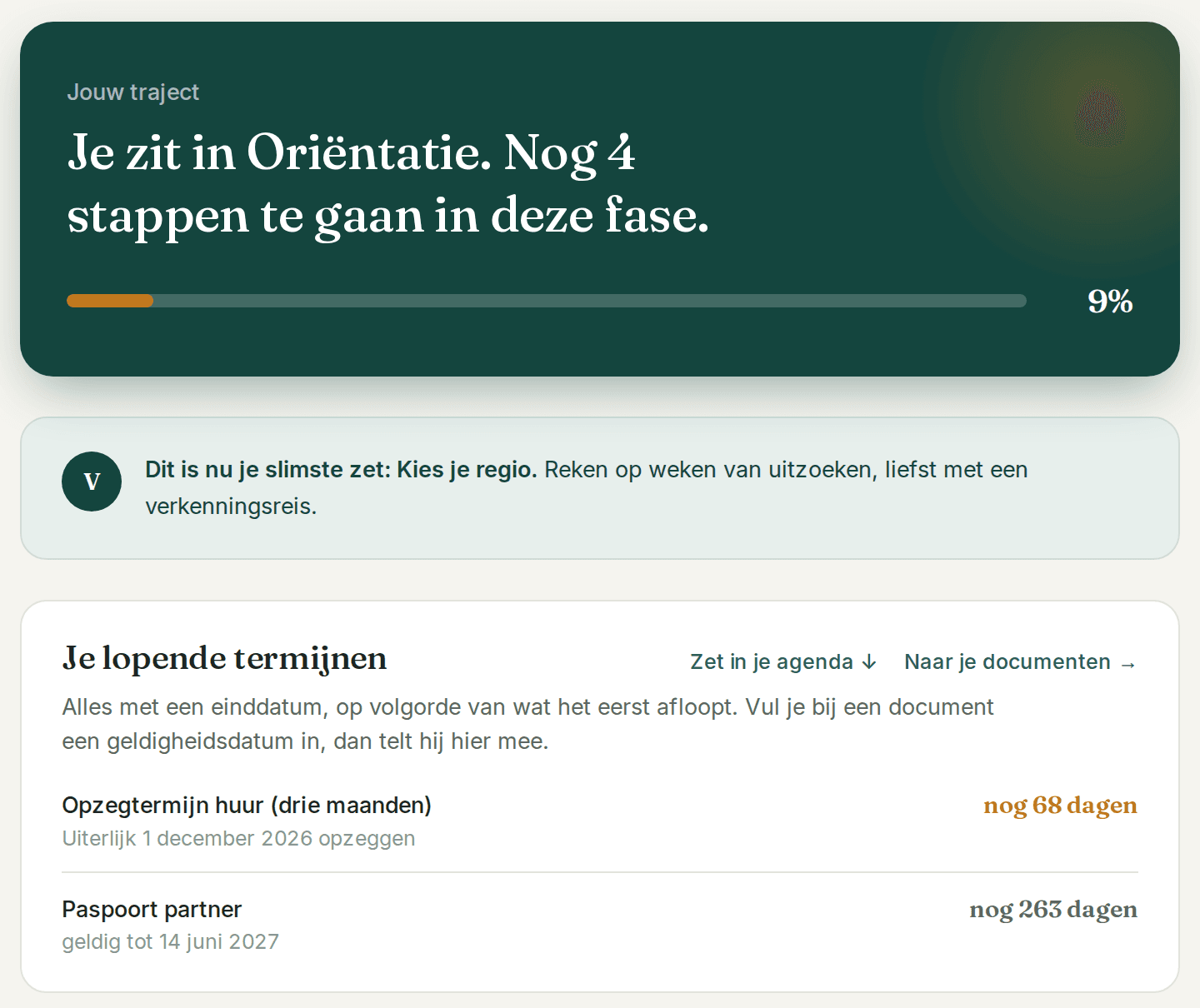
And this is the dashboard that step lives in. The example shows the plan for Spain; your dashboard shows the plan for Croatia.
This is step 3.2 of 37. The other 36 are ready for you, each with the same sources, the same offices and a schedule that keeps track of your dates.
See all 37 steps for CroatiaWhat you get for € 199
All 37 steps to Croatia, for your situation
In order, with the office and the official source at every step. Steps that don't apply to you don't appear.
Your deadlines in one place
For each step you see the latest date to start, and you get a heads-up before something is due or expires. Your documents sit in the vault, with their dates.
A plan that stays right
Twice a month we check the sources. If something changes, it's in your plan and you get a message.
The step-by-step plan for Croatia
€ 199
one-off · 37 steps
- Pay once, no subscription
- Destination changes? Within 30 days I switch your plan to another country free of charge
- Stuck on a step? You get a personal answer within two working days
What will your move to Croatia cost? Work it out →
Know someone moving to Croatia? Give this plan as a gift →
Every step on one list, free
Not ready to start yet? Then you get the departure checklist for Croatia: every step in order, to print and tick off. With it, five mails in a week and a half about the pitfalls and the real costs. If the rules for Croatia change, you'll hear about it. After that we ask once where your plans stand, send one offer, and now and then one thing that fits your moment. No newsletter, and you can switch it off at any time.
That was the move. And once you live there?
Which country may tax your pension once you live in Croatia? Is there a favourable regime, a scheme that lowers your tax? And how do you get insured? That depends on where your income comes from. Tick it and you'll see which rules apply to you, with the source.
See the financial conditionsClosing down the Netherlands: all your letters in one go
Moving to Croatia starts with leaving the Netherlands properly. That's why the plan includes the letter tool: you enter your details once and every cancellation and notification letter is ready.
Just the letters, without the plan? That works too, for € 49
- Health insurance, rent, energy, subscriptions, GP, school, bank and pension fund: 16 kinds of letters. You enter your details only once.
- A sending list that counts back from your departure date and your notice period, even when that's three months.
- Also what you need to ask for as an emigrant: your no-claims years in English, your medical file and the school report (the report on your child for the new school).
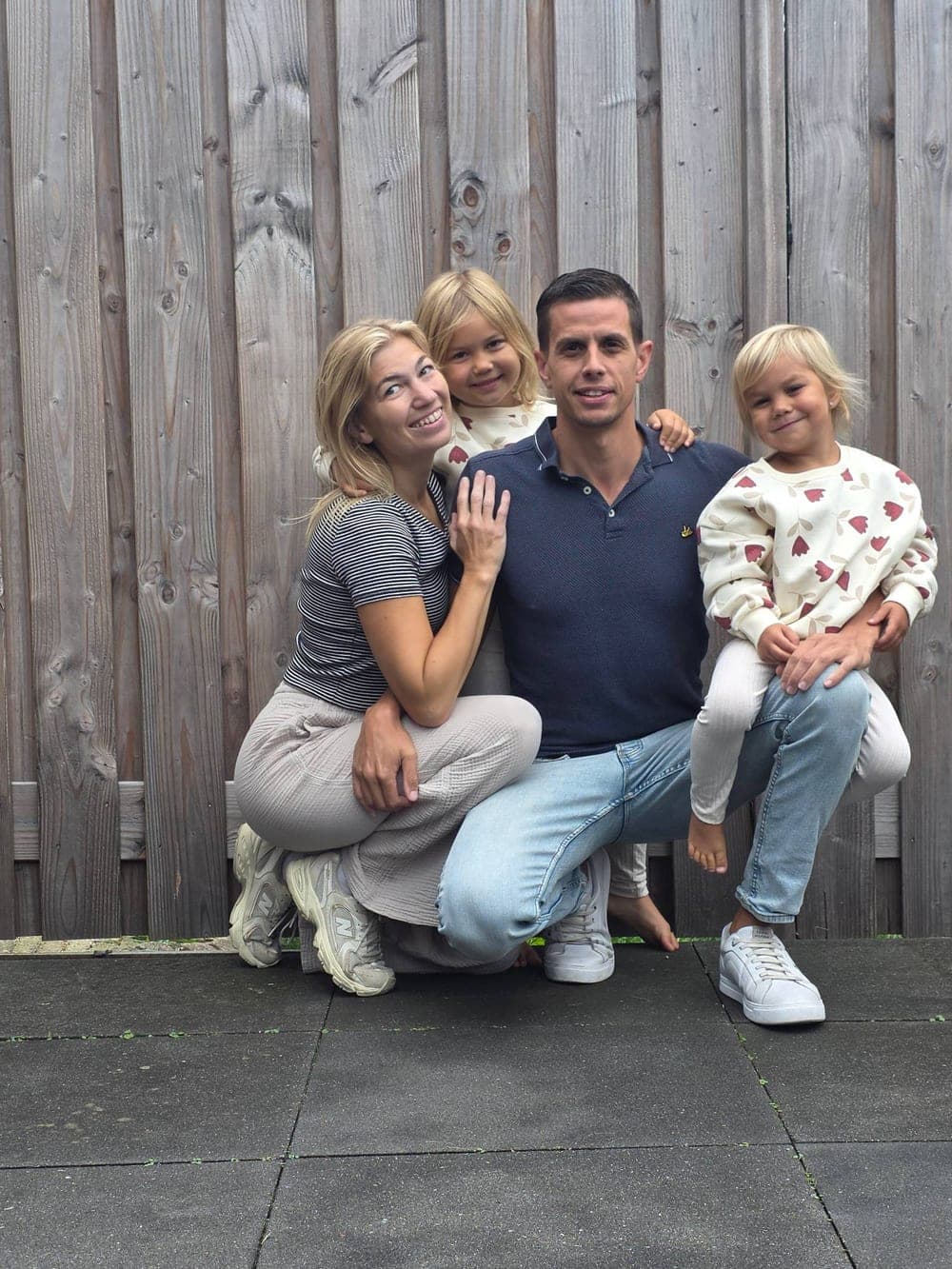

Auke, maker of Vertrekklaar
On 2 January we're leaving ourselves, on a trip around the world with our family. What I put here, I'm arranging for my own family too.
On 20 September 2026 a customer wrote that the CAK rule for early retirement was missing from his plan. He was right. That evening the step was in thirteen plans, with the source attached.
The knowledge base on Croatia
Per phase, the articles that are already there. They're written from the same journey and go deeper than what fits above.
- AOW, pension and tax in Croatia: the treaty divides, and Croatia halvesThe treaty from 2000 pulls your income apart: the AOW stays taxed in the Netherlands, your occupational pension becomes exclusively Croatian — and Croatia halves the tax on pension income. Plus the peculiarity that almost nobody knows: since 2024 your municipality sets your rate.
- Your car to Croatia: the tax for which no exemption existsMost EU countries waive the registration tax if you move with your own car. Not Croatia — gov.hr says it explicitly: you pay the PPMV on your removal car too. That's why this corridor starts with a sum, and with a clock of fifteen days that runs from the border.
- Taking your pet to Croatia: chip, rabies jab, 21 days' wait and the EU passportA dog, cat or ferret travels within the EU to Croatia on three things: a chip, a rabies vaccination completed at least 21 days before departure, and the EU pet passport. No tapeworm treatment, no quarantine, no Croatian extras. At most five animals, and the owner travels within five days of the animal.
- Your household goods to Croatia: no customs, no declaration, and one exception with a fifteen-day clockWithin the EU your household goods move to Croatia without customs formalities: no declaration, no exemption needed, no inspection. The one exception is on gov.hr in black and white: a motor vehicle must be declared to customs within fifteen days for the PPMV. What the journey costs in tolls on the Croatian motorways, and which rules do apply if you come from a country outside the EU.
- Banking and paying in Croatia: an account with your OIB, a basic account as a right, and the bank as key to e-GrađaniFor a Croatian account you need an OIB, an identity document and usually proof of address. If a bank refuses, as an EU resident you have the right to a basic account in euro: deposits, withdrawals, card payments, direct debits and transfers, without an overdraft. And that account is more than money: your internet banking is often at once your login for e-Građani.
- OIB, form 1b and registering with the police: the Croatian orderCroatia doesn't ask for a permit but for an order, and it begins with one number: the OIB, which you arrange free of charge and from the Netherlands. Then the home, and then the registration — not at the municipality but at the police, with form 1b and a clock of three months plus eight days.
All 12 articles about Croatia
- Living and renting in Croatia: the coastal market that vanishes in summer
- Your first weeks in Croatia: five clocks, and the order in which they do not collide
- Driving licence in Croatia: nothing to exchange until it expires, and then no longer through the RDW
- School in Croatia: six on 1 April, a catchment area per address and an interview before first grade
- Working in Croatia: without a permit, with a minimum wage of € 1,050 and a rate your municipality sets
- Healthcare in Croatia: HZZO, the twelve-month back-charge and the dopunsko
Also applies to your move
Ready to begin?
The step-by-step plan for Croatia: 37 steps, with your documents and your costs in one place. For each step you see the latest date to start. You pay once and it's yours.