Leaving from Belgium?To the Belgian plan →See the plan for Belgians moving to Austria →This plan is for people leaving the Netherlands.

Austria · No visa required
Emigrating to Austria
For Austria you arrange three things on time: your registration within three days, your car within one month and your residence document within four months. That last one already counts from the border. The country is eight hours' drive away, in the same time zone. This page shows how the chain runs and why it pays: two monthly salaries taxed at six percent.
€ 199 one-off · 35 steps · no subscription
- Kind of journey
- EU: register, no visa
- The chain
- Meldezettel (3 days) → ÖGK → ID Austria → Anmeldebescheinigung (4 months)
- Note
- As a resident the car may only be on Dutch plates for one month
Last updated: 14 October 2026
Will your departure date work? Check it in the free step-by-step plan →
Five phases, from orientation to being settled
You need no permit and there's no language test. But there are real deadlines: three days for the registration, one month for the car and four months for the residence document. That last one already counts from your entry. Whoever knows the deadlines is settled in weeks.
- Orientation
Three deadlines, one order
In this phase you get to know the three deadlines that shape your planning. Austria asks for no permit, but it does ask for punctuality. The Meldezettel, your registration at your home address, is due within three days of moving into your home. The car has to be on Austrian plates within one month. The relocation exemption you read about online doesn't exist: the NoVA (the Austrian tax at a car's first registration) also applies when you move. The Anmeldebescheinigung, your EU residence document, you apply for within four months of entry. Also have the family conversation, because it's different here from elsewhere: the school choice falls at age ten.Read more
- Closing the Netherlands
A treaty from 1970 like they don't make them anymore
In this phase you close the Netherlands. Your health insurance, your benefits and your AOW accrual stop, as with every emigration. What stands out is the tax treaty from 1970. It gives what no modern treaty gives anymore: your company pension is taxed only in Austria. There's no threshold and no withholding tax (tax the Netherlands deducts up front), and no renegotiation is in sight. Also get to know the small print in time: the country-of-residence factor of 0.9177, which sets your health contribution via the CAK, and the deadline of November 2026 for those leaving on early retirement.Read more
- The move
A short drive, with two sharp edges
In this phase you make the drive and arrange the car and the dog. The drive is nine hundred and fifty to twelve hundred kilometres, with one vignette of € 12.80 and no customs. The sharp edges are the car and the dog. Time the export of your car at the RDW so that the Austrian registration is done within the one month. Then you get the BPM refund (the Dutch car tax you get back on export) automatically. Your dog has to go into the national register within a month. From July 2026 there's also a compulsory course for new dog owners.Read more
- Registration in Austria
One signature carries the whole chain
In this phase you register and arrange what follows from it. The registration itself is free and done in ten minutes. But you do it within three days of moving into your home, and your landlord signs the form. After that everything follows in a fixed order. First the social insurance, which your employer arranges before day one. Then ID Austria, the Austrian digital identity, on your Dutch passport. Then the Anmeldebescheinigung. Since 2026 it costs € 44, not the € 15 the internet still mentions, and it's often ready right at the counter. Last comes the bank account.Read more
- Arrival
Fourteen salaries, and winter as a system
In this phase you finish the car and settle into living and working. Take the car through the chain within the month. After that Austria becomes generous. You get two extra monthly salaries, taxed at six percent. Child benefit (Kindergeld) comes with five years' retroactive effect. The Familienbonus, a tax credit, is € 2,000 per child. In healthcare the panel doctor (a doctor with a contract with the statutory health insurance) is free, provided you know the difference with the Wahlarzt (a doctor without such a contract). Then winter: tyres, chains and a membership of the Alpenverein (the Austrian alpine club). It covers a helicopter rescue, which the health insurance doesn't.Read more
This is what one step of your plan looks like
This is the real thing: one of the steps of the Austria journey, exactly as it appears in your personal step-by-step plan, with the deadlines, the offices and the sources.
Step 4.5 of your plan
The Anmeldebescheinigung: the clock was already running
- Lead time
- application by appointment; with a complete file often ready straight away
- Costs
- € 44 per person
The Anmeldebescheinigung is the document that records your right of residence as an EU citizen. Your right of residence itself is never in question: this paper only confirms it. Still, there's a deadline.
You apply within four months of your entry. So that clock was already running while you were looking for a home.
How to go about it:
- Make an appointment at the Bezirkshauptmannschaft, the district authority. In Vienna that's the MA 35.
- If you work, bring your employment contract or a payslip.
- If you don't work, show that you have enough means plus healthcare cover. The guideline is about € 1,308 a month for a single person.
- The fees are € 44 as of 2026, not the € 15 the whole internet still mentions.
Applying late costs € 50 to € 250.
Good news: the notorious Viennese backlogs have been cleared for EU cases. With a complete file you nowadays often get the document handed over straight away at the counter.
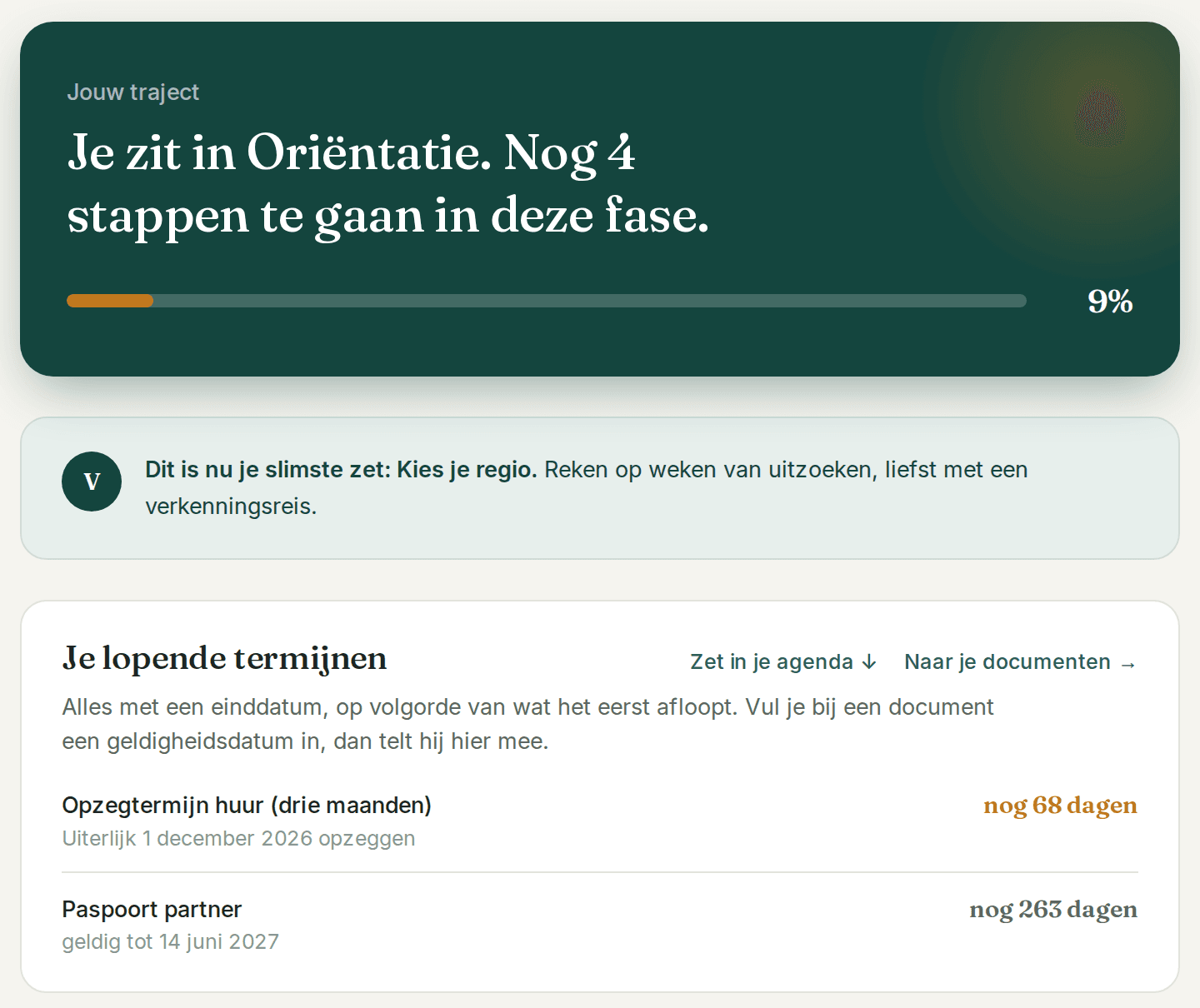
And this is the dashboard that step lives in. The example shows the plan for Spain; your dashboard shows the plan for Austria.
This is step 4.5 of 37. The other 36 are ready for you, each with the same sources, the same offices and a schedule that keeps track of your dates.
See all 37 steps for AustriaWhat you get for € 199
All 37 steps to Austria, for your situation
In order, with the office and the official source at every step. Steps that don't apply to you don't appear.
Your deadlines in one place
For each step you see the latest date to start, and you get a heads-up before something is due or expires. Your documents sit in the vault, with their dates.
A plan that stays right
Twice a month we check the sources. If something changes, it's in your plan and you get a message.
The step-by-step plan for Austria
€ 199
one-off · 37 steps
- Pay once, no subscription
- Destination changes? Within 30 days I switch your plan to another country free of charge
- Stuck on a step? You get a personal answer within two working days
What will your move to Austria cost? Work it out →
Know someone moving to Austria? Give this plan as a gift →
Every step on one list, free
Not ready to start yet? Then you get the departure checklist for Austria: every step in order, to print and tick off. With it, five mails in a week and a half about the pitfalls and the real costs. If the rules for Austria change, you'll hear about it. After that we ask once where your plans stand, send one offer, and now and then one thing that fits your moment. No newsletter, and you can switch it off at any time.
That was the move. And once you live there?
Which country may tax your pension once you live in Austria? Is there a favourable regime, a scheme that lowers your tax? And how do you get insured? That depends on where your income comes from. Tick it and you'll see which rules apply to you, with the source.
See the financial conditionsClosing down the Netherlands: all your letters in one go
Moving to Austria starts with leaving the Netherlands properly. That's why the plan includes the letter tool: you enter your details once and every cancellation and notification letter is ready.
Just the letters, without the plan? That works too, for € 49
- Health insurance, rent, energy, subscriptions, GP, school, bank and pension fund: 16 kinds of letters. You enter your details only once.
- A sending list that counts back from your departure date and your notice period, even when that's three months.
- Also what you need to ask for as an emigrant: your no-claims years in English, your medical file and the school report (the report on your child for the new school).


Auke, maker of Vertrekklaar
On 2 January we're leaving ourselves, on a trip around the world with our family. What I put here, I'm arranging for my own family too.
On 20 September 2026 a customer wrote that the CAK rule for early retirement was missing from his plan. He was right. That evening the step was in thirteen plans, with the source attached.
The knowledge base on Austria
Per phase, the articles that are already there. They're written from the same journey and go deeper than what fits above.
- The Zuzugsbegünstigung: Austria's tax advantage for researchers, and for whom it isn'tAustria has one tax scheme for newcomers, and it is narrow: scientists and researchers can leave 30% of their income from research untaxed for five years. You apply within six months of your move, and according to the ministry a doctorate alone is not enough. For anyone not working in research, nothing comparable exists.
- Staying in Austria: three routes, four months and the right after five yearsAs a Dutch citizen you need no permit in Austria, but you do need a right of residence that rests on one of three grounds: work, your own means with health cover, or education. Within four months of entering the country you record it in the Anmeldebescheinigung, which costs € 44. If you don't work, you have to show that you won't need a top-up to the minimum pension.
- Working in Austria: the fourteenth month and the six percentAn Austrian salary can't be compared one-to-one with a Dutch one: many salaries include a thirteenth and fourteenth month, and those are largely taxed at six percent. How that adds up, why the collective agreement is your minimum wage, what you arrange as self-employed and with a diploma, and how your Dutch unemployment-insurance years count.
- AOW and pensions in Austria: the treaty of 1970The tax treaty with Austria is the oldest and the friendliest of the classic pension destinations: your occupational pension is taxed exclusively in Austria — no threshold amount, no withholding at source, and no renegotiation in sight. What does and doesn't travel with you, and why the country-of-residence factor here nudges up against one.
- Your car to Austria: no exemption, but an old rateThe most stubborn myth of this route: "as removal goods your car is NoVA-free". Incorrect — but there are three real softeners: the 0% rate for electric, the old NoVA regime for older cars, and the Dutch BPM refund. Plus the clock that decides everything: one month on Dutch plates.
- Your pet to Austria: passport, one month for the dog, and the new courseWith an EU pet passport, a microchip and a valid rabies vaccination, dogs and cats travel into Austria without inspection. Then the Austrian part begins: the dog must be in the national Heimtierdatenbank within a month, since 1 July 2026 there is a compulsory Sachkundenachweis, and the municipality levies a dog tax, in Vienna € 72 for the first dog.
All 15 articles about Austria
- Your household goods to Austria: no customs, but a vignette, tolls and a parking ban
- Banking and payments in Austria: your right to an account, and why your IBAN can stay
- The Meldezettel and the four-month clock: how the Austrian chain works
- Your first weeks in Austria: three days, one signature and the bills that arrive on their own
- Living in Austria: Richtwert, Befristung and the six-month deposit
- Buying a house in Austria: clear percentages — and you only own it at the Grundbuch
- Your driving licence in Austria: exchanging is optional, renewing happens there
- School in Austria: enrolling, learning German and the choice at age ten
- Healthcare in Austria: e-card, contract doctor or Wahlarzt, and which route is yours
Also applies to your move
Ready to begin?
The step-by-step plan for Austria: 37 steps, with your documents and your costs in one place. For each step you see the latest date to start. You pay once and it's yours.