Leaving from Belgium?To the Belgian plan →See the plan for Belgians moving to Malta →This plan is for people leaving the Netherlands.
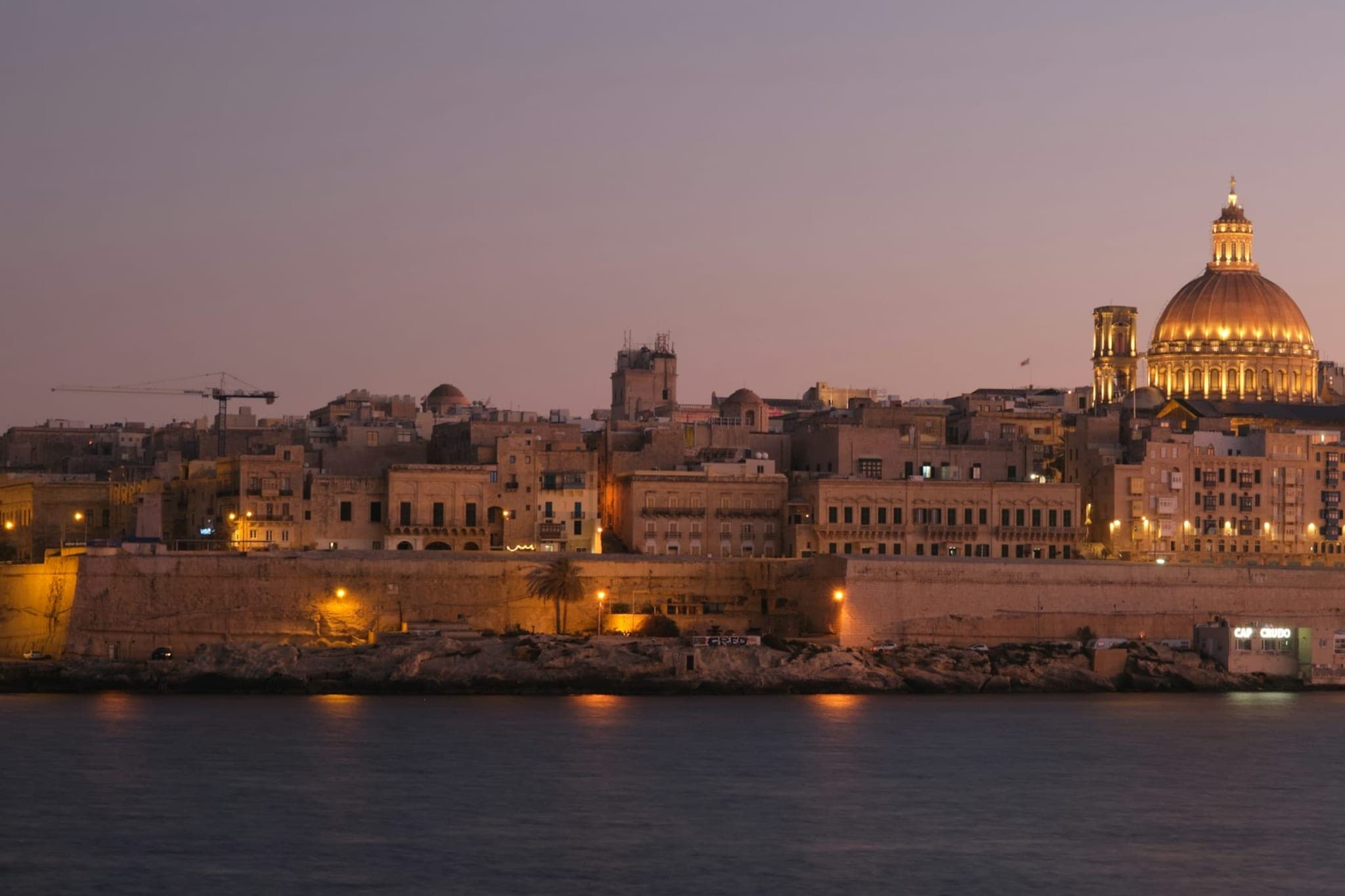
Malta · No visa required
Emigrating to Malta
As an EU citizen you register on Malta with Identità, the identity agency. It's three hours' flight and English is spoken. But a rental contract without registration is void. And the 1977 tax treaty has a catch. If Malta only taxes your pension when you bring it over, the Netherlands may tax what you leave behind.
€ 199 one-off · 35 steps · no subscription
- Kind of journey
- EU citizen: register, no visa
- The chain
- Home → file → biometrics → residence card → eID
- Note
- What you don't remit to Malta, the Netherlands may tax
Last updated: 14 October 2026
Will your departure date work? Check it in the free step-by-step plan →
Five phases, from the island choice to the remittance bookkeeping
This journey is about complete files and honest sums. If you lodge a complete file with Identità, you get an appointment within 48 working hours. Your rental contract has to be registered within thirty days, otherwise it's void. The car comes with twice twenty-four months of conditions. And then the tax lesson the brochures skip: if Malta taxes you on the remittance basis, the Netherlands may tax what you don't remit.
- Orientation
316 km² of English-speaking EU, and the busiest in Europe
In this phase you choose where on Malta you'll live. You also learn what the remittance rule means for your income: Malta only taxes foreign income to the extent that you remit it to Malta. You do all this before anything is signed. Malta is small, English-speaking and close. That's exactly why the downsides deserve an honest look. It's the most densely populated country in the EU, there's construction noise, and you feel the winter indoors. That's because houses there have no heating and no insulation. You choose between the expat heart Sliema/St Julian's, the Maltese south and slow Gozo.Read more
- Closing the Netherlands
The sum of what you remit, and one letter from your bank
In this phase you work through the familiar list: healthcare, benefits and deregistration. Two Maltese peculiarities come on top. The big one is in the tax treaty. If Malta taxes you on the remittance basis, article 2 paragraph 5 ties the Dutch exemption to what you actually remit to Malta. The AOW and the ABP pension stay taxed in the Netherlands regardless. The small but expensive one: ask your Dutch bank now for a reference letter, a statement that you're a customer there. Maltese banks ask for it. Without that letter your account takes weeks to months longer.Read more
- The move
Flying for you, sailing for the rest, and the tapeworm clock
In this phase you move, with the household contents, the car and the dog. You fly, in three hours. The car and the household contents go overland to Sicily or Salerno, and then by boat. The car needs its own sum. The relocation exemption, which spares you the Maltese registration tax, asks 24 months' ownership and 24 months outside Malta. On top of that, the island drives on the left. So a left-hand-drive car stays awkward there. The dog has the tightest clock of the move. It gets a tapeworm treatment in a window of 24 to 120 hours before arrival. A pre-notification is compulsory as well.Read more
- Registration on Malta
Complete file or no appointment, and the card everything hangs on
In this phase you arrange your home on Malta, your residence card and everything that hangs on it. First the home. The landlord has to register the contract within thirty days of the start date. Otherwise it's void, and you can't use it at Identità or at the utilities. Then you send the complete file to the Expatriates Portal, Identità's online application. After that come the biometrics appointment, where your photo and fingerprints are taken, and the card. Next you arrange the eID (your digital key to the government) and your tax number. Then the bank account: count on weeks, the reference letter speeds it up. Finally healthcare. You email the S1, the CAK's healthcare form, to the Entitlement Unit and then get the Certificate of Entitlement.Read more
- Arrival
Thirty days for the car, bookkeeping for the tax office
In this phase you wrap up the last deadlines and daily life begins. Send the ToR file, the application for the car's relocation exemption, to Transport Malta within the deadline. The ferry ticket is your proof. For your tax return you keep remittance bookkeeping: separate accounts for capital from before the move and for income after. Daily life has its Maltese sides. Public transport is free with the personal Tallinja card. For school you choose between state, church and international. You put water and electricity in your own name, at the ARMS rate. And the dehumidifier wins the winter.Read more
This is what one step of your plan looks like
This is the real thing: one of the steps of the Malta journey, exactly as it appears in your personal step-by-step plan, with the deadlines, the offices and the sources.
Step 2.2 of your plan
Pension and the remittance rule: the sum the brochures skip
- Lead time
- the sum is an evening; the exemption statement takes weeks
- Costs
- none
In this step you work out which country will tax your pension, and what transferring money to Malta costs or yields you. This is where the biggest tax trap of this plan lies.
Malta taxes whoever lives there but isn't domiciled only on income that is transferred to Malta. That's called the remittance basis. Not domiciled means, in short, that Malta isn't your permanent home country.
That sounds like zero per cent for whoever leaves their pension in the Netherlands. That's exactly where the trap is. Article 2 paragraph 5 of the tax treaty ties the Dutch exemption to that same transfer:
- If you don't transfer your pension, the Netherlands grants no exemption and simply keeps taxing.
- If you do transfer it, Malta taxes: at the ordinary brackets, or under a special regime.
Two incomes don't take part anyway:
- Your AOW, the Dutch state pension, the Netherlands may keep taxing under article 19 paragraph 3.
- A government pension (ABP, the pension fund for government and education) stays Dutch via article 20.
Work out before departure which part of your income can go to the Maltese regime, and what transferring costs or yields you on balance. This is the sum par excellence for a tax adviser who knows both countries.
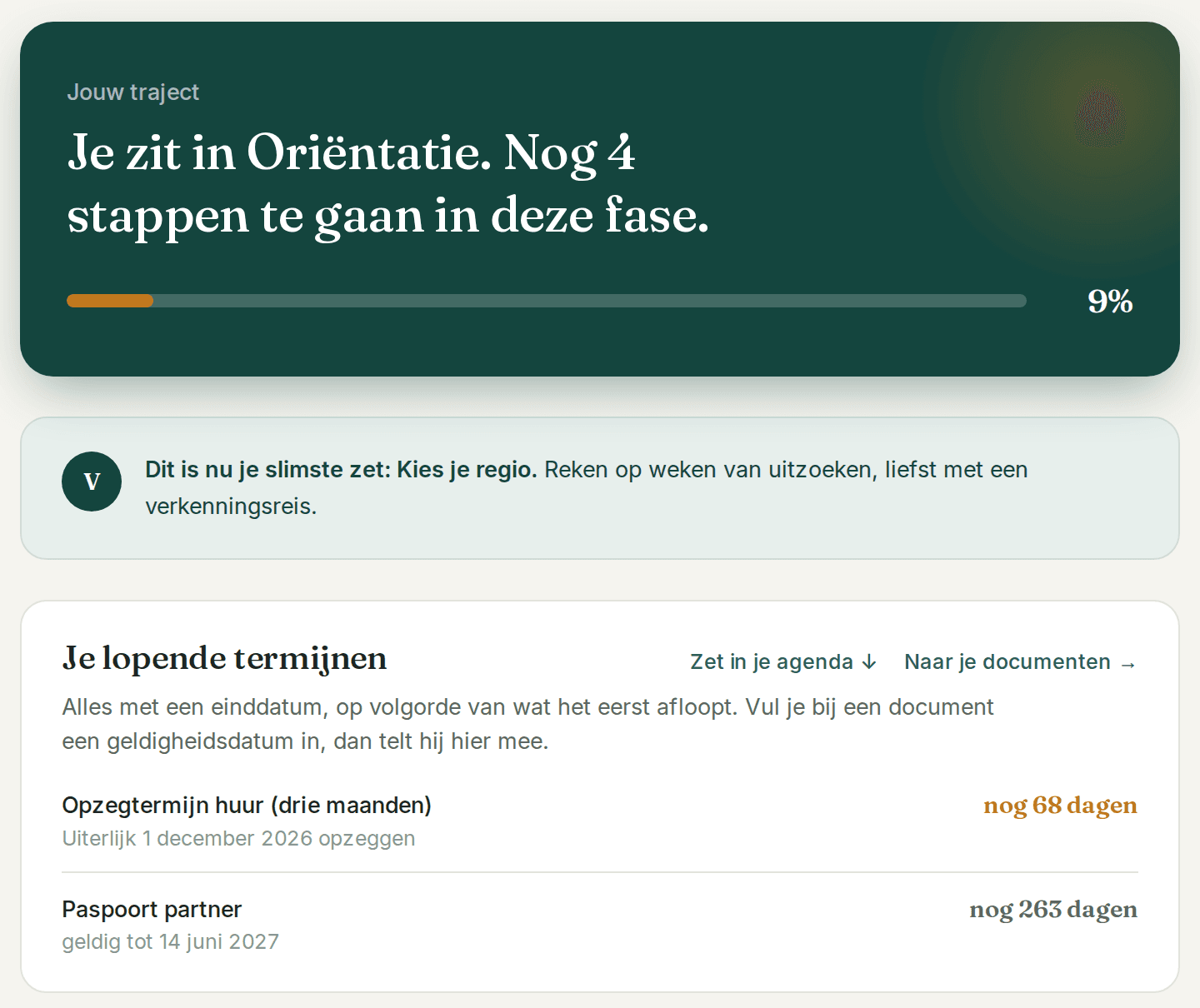
And this is the dashboard that step lives in. The example shows the plan for Spain; your dashboard shows the plan for Malta.
This is step 2.2 of 37. The other 36 are ready for you, each with the same sources, the same offices and a schedule that keeps track of your dates.
See all 37 steps for MaltaWhat you get for € 199
All 37 steps to Malta, for your situation
In order, with the office and the official source at every step. Steps that don't apply to you don't appear.
Your deadlines in one place
For each step you see the latest date to start, and you get a heads-up before something is due or expires. Your documents sit in the vault, with their dates.
A plan that stays right
Twice a month we check the sources. If something changes, it's in your plan and you get a message.
The step-by-step plan for Malta
€ 199
one-off · 37 steps
- Pay once, no subscription
- Destination changes? Within 30 days I switch your plan to another country free of charge
- Stuck on a step? You get a personal answer within two working days
What will your move to Malta cost? Work it out →
Know someone moving to Malta? Give this plan as a gift →
Every step on one list, free
Not ready to start yet? Then you get the departure checklist for Malta: every step in order, to print and tick off. With it, five mails in a week and a half about the pitfalls and the real costs. If the rules for Malta change, you'll hear about it. After that we ask once where your plans stand, send one offer, and now and then one thing that fits your moment. No newsletter, and you can switch it off at any time.
That was the move. And once you live there?
Which country may tax your pension once you live in Malta? Is there a favourable regime, a scheme that lowers your tax? And how do you get insured? That depends on where your income comes from. Tick it and you'll see which rules apply to you, with the source.
See the financial conditionsClosing down the Netherlands: all your letters in one go
Moving to Malta starts with leaving the Netherlands properly. That's why the plan includes the letter tool: you enter your details once and every cancellation and notification letter is ready.
Just the letters, without the plan? That works too, for € 49
- Health insurance, rent, energy, subscriptions, GP, school, bank and pension fund: 16 kinds of letters. You enter your details only once.
- A sending list that counts back from your departure date and your notice period, even when that's three months.
- Also what you need to ask for as an emigrant: your no-claims years in English, your medical file and the school report (the report on your child for the new school).


Auke, maker of Vertrekklaar
On 2 January we're leaving ourselves, on a trip around the world with our family. What I put here, I'm arranging for my own family too.
On 20 September 2026 a customer wrote that the CAK rule for early retirement was missing from his plan. He was right. That evening the step was in thirteen plans, with the source attached.
The knowledge base on Malta
Per phase, the articles that are already there. They're written from the same journey and go deeper than what fits above.
- The Malta Retirement Programme: 15 per cent, at least 7,500 euros, and an end at permanent residenceMalta has two schemes with a flat rate of 15 per cent on foreign income you bring into Malta: the Malta Retirement Programme for pensioners and The Residence Programme for EU citizens. They cost a minimum tax, an application through an authorised mandatary and an expensive home — and they end as soon as you apply for permanent residence. For most Dutch pensions the ordinary system is cheaper.
- Staying in Malta: five grounds of residence, and a partner who must prove two yearsAs a Dutch national you need no permit in Malta, but you do need a ground of residence: work, your own business, own means, study or family. Whoever stays longer than three months registers with Identità. Registration is free, but the burden of proof is yours: means at least at social assistance level, insurance that is not an EHIC, and for an unmarried partner two years of proof of the relationship.
- Working in Malta: free as an EU citizen, a weekly minimum wage, and your employer registers you with JobsplusAs a Dutch national you work in Malta without a permit, but your employment must always be registered with Jobsplus — and your employer does that on your first working day. The minimum wage in 2026 is 229.44 euros a week, with four fixed bonuses a year on top. Whoever starts as self-employed goes past four counters.
- AOW, pension and tax in Malta: what remitting really meansMalta taxes non-domiciled residents only on what they transfer to Malta — but article 2(5) of the treaty also ties the Dutch exemption to that transfer. "Zero percent by not remitting" therefore doesn't exist: then the Netherlands keeps taxing. And the AOW and the ABP pension remain taxed in the Netherlands anyway.
- Your car to Malta: the ToR clocks and driving on the leftThe relocation exemption demands twice twenty-four months — the car in your name, you outside Malta — and has a declaration window with a 30-day deadline inside it. Without the exemption you pay registration tax on value and CO₂. You need not exchange your Dutch driving licence, but when it expires you renew it in Malta. And then there is driving on the left.
- Your dog or cat to Malta: the tapeworm clock of 24 to 120 hoursMalta is one of Europe's five tapeworm-free destinations. On top of the ordinary EU requirements — chip, rabies vaccination and pet passport — a dog must therefore be treated against the tapeworm by a vet between 24 and 120 hours before the journey, and that must be in the passport. A puppy that is not yet fully vaccinated may not enter Malta.
All 14 articles about Malta
- Your household goods to Malta: no customs, but the sea in between and an inventory that protects you
- Bank account in Malta: a right to a basic account, and your Dutch IBAN keeps working
- The e-Residence document and the eID: the Maltese chain
- Your first weeks in Malta: a registered lease, a complete file and a collection letter
- Living and renting in Malta: the contract that must be registered
- Buying a house in Malta: no permit for your main residence, and 3.5 per cent on the first 200,000 euros
- School in Malta: state, church or private, and compulsory schooling from age five
- Healthcare in Malta: the Certificate of Entitlement and the S1 route
Also applies to your move
Ready to begin?
The step-by-step plan for Malta: 37 steps, with your documents and your costs in one place. For each step you see the latest date to start. You pay once and it's yours.