Leaving from Belgium?To the Belgian plan →See the plan for Belgians moving to France →This plan is for people leaving the Netherlands.
France · No visa required
Emigrating to France
As a Dutch citizen you needn't apply for anything to live in France: no visa, no registration, no residence card. That is the pitfall, the opposite of the Spanish one. No counter forces you, so people only find out at the healthcare office or the bank that months were lost. This page shows which clocks you start yourself.
€ 199 one-off · 30 steps · no subscription
- Kind of journey
- No visa, no registration duty
- The clock that counts
- Healthcare enrolment (CPAM): count in months
- Lead time
- Three to nine months (indicative)
Last updated: 14 October 2026
Will your departure date work? Check it in the free step-by-step plan →
Five phases, from orientation to being settled
Nowhere in this journey do you wait for permission, but the order still matters. Without proof of address nothing moves in France. The sécurité sociale, which covers your healthcare, is the longest clock. Whoever knows those two is settled months earlier.
- Orientation
Living there is simply allowed; that doesn't make you settled
In this phase you learn what you do have to arrange, and you choose your region. As an EU citizen you live in France without a single form: no registration, no residence card. But healthcare and the tax office only know you once you report yourself, and healthcare enrolment takes months. Choosing a region here is about more than climate. In parts of the countryside GPs take no new patients. Outside the cities English is no safety net: the language weighs heavier than in Spain or Portugal.Read more
- Closing the Netherlands
No number to get in advance, but paperwork with a shelf life
In this phase you get paperwork and healthcare ready, and you close the Netherlands. France has no NIE or NIF (the number you get in advance for Spain or Portugal). You gain your head start differently here. Certified documents: officially they don't need to be recent. Healthcare cover that bridges the long wait for French healthcare. The tax conversation. And closing the Netherlands neatly: deregistering, benefits, and the tax return for your year of emigration.Read more
- The move
Close by, so cheaper, but the carte grise is waiting
In this phase you arrange transport, pets and the car. France is close by: a day's drive, and the removal bill shows it. Pets simply come along with an EU pet passport. If you bring your car, it has to go on French plates within a month: the carte grise. That's fully digital via ANTS, the French registration portal, with a tax certificate (quitus fiscal) and an inspection. What that conversion costs depends heavily on your car. Work that out before the lorry drives.Read more
- Getting the basics in order in France
Without proof of address nothing moves
In this phase you arrange home, healthcare, tax office and bank. No registration counter, but an order. First the home: your rental contract and the energy bill in your name are your justificatif de domicile, the proof of address every French counter asks for. Then immediately start your enrolment with the sécurité sociale (CPAM). That's the longest clock of this journey: count in months. After that the tax office and the bank. If a bank is difficult, you have a legal right to a basic account.Read more
- Arrival
A school via the mairie, a médecin traitant, your carte Vitale
In this phase you arrange school and a GP, and you complete your healthcare. School for the children runs via the mairie, the town hall, and your home address decides the allocated school. Choose a médecin traitant, your regular GP, before you need one. Without a declared GP, healthcare reimburses structurally less. Does the carte Vitale, your French health card, land on the doormat? Then the longest clock has run out, and you haven't just arrived, you're settled.Read more
This is what one step of your plan looks like
This is the real thing: one of the steps of the France journey, exactly as it appears in your personal step-by-step plan, with the deadlines, the offices and the sources.
Step 4.2 of your plan
Start your registration with the sécurité sociale (CPAM)
- Lead time
- the application is an afternoon; the processing counts in months
- Costs
- none
With this step you get into French health insurance. It's the longest clock of this route. So start it first, even before the boxes are unpacked.
You apply at the CPAM of your place of residence: the fund of French health insurance in your area. You do that with form S1106.
Here's how to go about it:
- Hand in the form with your identity document, your IBAN, your birth certificate and your proofs of residence.
- The birth certificate has to be certified. Whether a translation is needed, the fund itself says.
- If you work, the application can be made right away.
- If you don't work, it's possible after three months of residence. Your rent receipts and bills are then your proof.
- If you're retired, this is where you hand in the S1 form from the CAK.
What happens next shouldn't surprise you. First a provisional number, the NIA, comes by letter. With it, healthcare costs can already be reimbursed. A carte Vitale (the French health card) and an online account aren't possible with it yet.
For the definitive number a legal maximum of nine months' processing time applies. That's an upper limit for that procedure, not a period without cover.
In practice you're done sooner. But count on several months, and claim on paper in the meantime. Every week started earlier is a week done earlier.
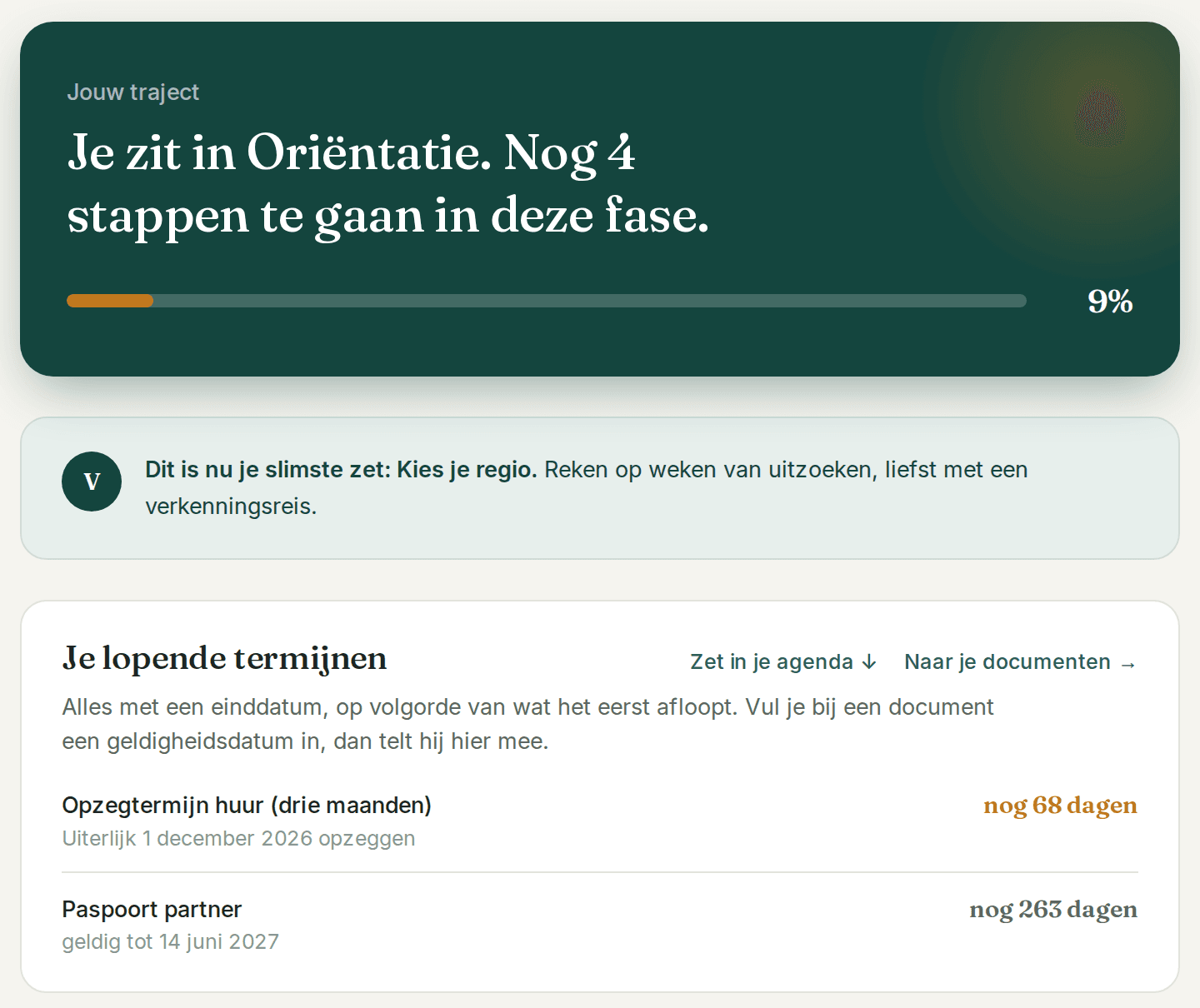
And this is the dashboard that step lives in. The example shows the plan for Spain; your dashboard shows the plan for France.
This is step 4.2 of 32. The other 31 are ready for you, each with the same sources, the same offices and a schedule that keeps track of your dates.
See all 32 steps for FranceWhat you get for € 199
All 32 steps to France, for your situation
In order, with the office and the official source at every step. Steps that don't apply to you don't appear.
Your deadlines in one place
For each step you see the latest date to start, and you get a heads-up before something is due or expires. Your documents sit in the vault, with their dates.
A plan that stays right
Twice a month we check the sources. If something changes, it's in your plan and you get a message.
The step-by-step plan for France
€ 199
one-off · 32 steps
- Pay once, no subscription
- Destination changes? Within 30 days I switch your plan to another country free of charge
- Stuck on a step? You get a personal answer within two working days
What will your move to France cost? Work it out →
Know someone moving to France? Give this plan as a gift →
Every step on one list, free
Not ready to start yet? Then you get the departure checklist for France: every step in order, to print and tick off. With it, five mails in a week and a half about the pitfalls and the real costs. If the rules for France change, you'll hear about it. After that we ask once where your plans stand, send one offer, and now and then one thing that fits your moment. No newsletter, and you can switch it off at any time.
That was the move. And once you live there?
Which country may tax your pension once you live in France? Is there a favourable regime, a scheme that lowers your tax? And how do you get insured? That depends on where your income comes from. Tick it and you'll see which rules apply to you, with the source.
See the financial conditionsClosing down the Netherlands: all your letters in one go
Moving to France starts with leaving the Netherlands properly. That's why the plan includes the letter tool: you enter your details once and every cancellation and notification letter is ready.
Just the letters, without the plan? That works too, for € 49
- Health insurance, rent, energy, subscriptions, GP, school, bank and pension fund: 16 kinds of letters. You enter your details only once.
- A sending list that counts back from your departure date and your notice period, even when that's three months.
- Also what you need to ask for as an emigrant: your no-claims years in English, your medical file and the school report (the report on your child for the new school).


Auke, maker of Vertrekklaar
On 2 January we're leaving ourselves, on a trip around the world with our family. What I put here, I'm arranging for my own family too.
On 20 September 2026 a customer wrote that the CAK rule for early retirement was missing from his plan. He was right. That evening the step was in thirteen plans, with the source attached.
The knowledge base on France
Per phase, the articles that are already there. They're written from the same journey and go deeper than what fits above.
- Taking your car to France: the carte grise is manageable, the malus isn'tWithin a month your car has to be on French plates, fully digital. The procedure is doable — a free quitus fiscal, an inspection less than six months old, a regional tax of at most € 60 per fiscal horsepower — but unlike in Spain and Portugal there is no relocation exemption for the CO2 levy. So do the sum before the lorry moves, not after.
- The CPAM and the number you wait months for: start the clock on day oneFrench healthcare only knows you once you report. For non-workers the entitlement begins after three months of residence, and after that the processing runs on for weeks to months. Whoever starts the registration straight away suffers least from it.
- Working in France: no permit, no compulsory card — but the smic, the micro-entreprise and the diplomaAs a Dutch national you work in France without a work permit, employed or for yourself, and the residence card you may apply for is free but not compulsory. What you need to know: the smic of € 1,867 gross a month, the micro-entrepreneur regime in which your contributions are a fixed percentage of turnover, and the € 120 attestation de comparabilité that translates your degree to a French level — for a regulated profession more is needed.
- Tax in France: no favourable regime, but a system that helps familiesFrance has no little tax paradise for newcomers — the only favourable regime is for employees brought in by a French company. What there is: a system that counts per household, five brackets from 0 to 45%, a treaty that assigns your occupational pension to France without a threshold, and a first return that only comes the year after your arrival — usually on paper.
- Your dog or cat to France: the passport for the journey, and to I-CAD within seven daysWithin the EU your dog or cat simply comes along to France: a chip, a rabies vaccination that becomes valid three weeks after a first jab, and the EU pet passport. What the Dutch checklist misses is on Service-Public: the animal must be registered with I-CAD within seven days of arrival, through the vet, for € 12 — and category-one dogs do not get into the country.
- Your household goods to France: no customs, one day's drive, and the car as the only thing with a clockWhoever moves to France from an EU country has, according to French customs, "no formality at all" and nothing to pay. That makes the move the shortest and cheapest of all destinations — one day's drive, in two trips if need be. What does count: the car has to be on French plates within a month, with a free quitus fiscal and without a relocation exemption for the malus.
All 14 articles about France
- Bank account in France: identity document and proof of address, and the droit au compte if the bank says no
- The justificatif de domicile: the paper all of France asks for
- Renting in France: one month's deposit, a three-year lease, and the file the landlord may ask for
- Your first weeks in France: nobody registers you, so you build the chain yourself
- Buying a house in France: the notaire arranges almost everything — these are the three differences
- Your driving licence in France: nothing to register, exchange only when it expires — for € 40
- Médecin traitant and mutuelle: the two choices that keep your French healthcare affordable
- School in France: compulsory from three, enrolling via the mairie, and the class for those who don't yet speak French
Also applies to your move
Ready to begin?
The step-by-step plan for France: 32 steps, with your documents and your costs in one place. For each step you see the latest date to start. You pay once and it's yours.