Uruguay · Visa required
Emigrating to Uruguay
You travel to Uruguay without a visa. Your residence permit, the residencia, you then apply for in Uruguay itself at the Dirección Nacional de Migración. Whoever wants to stay applies straight away for the residencia permanente, also with a pension or capital, and there's no fixed income amount in the rules. The treaties each turn out differently: no tax treaty, so the Netherlands keeps taxing your AOW and your pension; a social security treaty, so even a single person keeps the full AOW; and no healthcare treaty, so no CAK.
€ 399 one-off · 37 steps · no subscription
- Kind of journey
- In without a visa, then the residencia at the Dirección Nacional de Migración and the cédula at the DNIC
- The clock
- 90 days as a visitor, with at most 90 on top; a marriage certificate at most a year old; the household goods up to six months after you
- Note
- No tax treaty, so the Netherlands keeps taxing; but the full AOW, also for a single person; no CAK, but ASSE or a mutualista after arrival
Last updated: 15 October 2026
Will your departure date work? Check it in the free step-by-step plan →
Five phases, from the file in the Netherlands to your first return
This journey turns on one reversal and three treaties. The reversal: you apply for nothing in advance. You enter as a visitor, with 90 days and at most 90 on top, and file your application in Uruguay. So your papers must be complete before you leave, because you can't easily get an apostille from Montevideo. The three treaties each turn out differently. There's no tax treaty: the Netherlands keeps taxing your AOW and your pension, and Uruguay doesn't tax that pension. There is a social security treaty: the full AOW goes along. And there's no healthcare treaty: no CAK.
- Orientation
No visa in advance, no income threshold, and three treaties that each turn out differently
In this phase you learn how living in Uruguay works, and what it does to your income and your healthcare. With a Dutch passport you enter without a visa, for 90 days. In that time you apply for your residencia at the Dirección Nacional de Migración: permanent if you stay, also with a pension or capital, or temporaria for work and study. The rules name no fixed income amount. There's no tax treaty, so the Netherlands keeps taxing your AOW and your pension. There is a social security treaty: even whoever goes alone keeps the full AOW. And there's no healthcare treaty, so no CAK.Read more
- Your visa
Choosing a route and a file that's complete before you leave
In this phase you choose your route and prepare your file. The routes are the residencia permanente with a pension or capital, with a notarial statement about your income; work in Uruguay, with at least one minimum wage for the temporaria; remote work as a digital nomad, with the hoja de identidad provisoria of twice 180 days; or a Uruguayan partner. Your certificate of conduct, your birth certificate and your marriage certificate get an apostille and a translation by a Uruguayan sworn translator. The fee is 557.30 UI, about 82 euros, per person.Read more
- Closing the Netherlands
The Netherlands keeps taxing, Uruguay not on your pension, and the full AOW
In this phase you work through the familiar list for closing down in the Netherlands. Without a tax treaty the Netherlands keeps taxing your AOW, your government pension, your occupational pension and your annuity, and you get no tax credit. Uruguay doesn't name a Dutch pension as taxable income, but does tax your foreign interest, dividend and rent at 12 percent. For whoever comes from 2026 there's a new regime that can change that for eleven years. The AOW goes along in full, also for a single person. There's no CAK: arrange a bridging policy before you deregister.Read more
- The move
Household goods without import duties, and no used car
In this phase you move the household goods, the car and the pet. Your household goods go along free of import duties, if they arrive between three months before and six months after you, with a list the Uruguayan embassy in The Hague stamps in advance. For the car the answer is short: Uruguay bans the import of used cars, since 2013 without an end date. You sell it here and buy another one there. The pet needs a certificate from the NVWA, with a vet check within ten days and deworming within fifteen days, and a valid rabies vaccination.Read more
- Arrival in Uruguay
Check-up, application, cédula, and then healthcare, licence and home
In this phase you file your application and arrange what follows. First you get the carné de salud and the vaccination record at a recognised healthcare provider. Then you file online at the DNM and make an appointment. With the DNM certificate and your registered birth certificate you get the cédula at the DNIC, for 456 pesos. After that you join ASSE or a mutualista, convert your driving licence at the intendencia, and find a home: with a guarantee of at most five months' rent, or buying through an escribano with 2 percent transfer tax. After 183 days you're a resident for tax.Read more
This is what one step of your plan looks like
This is the real thing: one of the steps of the Uruguay journey, exactly as it appears in your personal step-by-step plan, with the deadlines, the offices and the sources.
Step 3.3 of your plan
Know the Uruguayan side: capital income from abroad, and the 2026 regime for new residents
- Lead time
- a conversation with a Uruguayan contador
- Costs
- advisory hours
In this step you see what the Uruguayan tax office, the DGI, does with your income. Read this with the brochure beside it, because the brochure lags behind.
When you're a resident. You're a tax resident if you're in Uruguay for more than 183 days in a calendar year. Short trips of up to 30 days count as days in Uruguay, according to the DGI. Whoever has the centre of their interests in Uruguay is a resident too. The law assumes that if your spouse and minor children live there.
What Uruguay taxes. Income from Uruguay, such as wages for work you do there and rent from a home there. Of income from abroad only capital income. Since 1 January 2026 that's, according to the DGI, interest, dividend and rent, and the gain when you sell investments or real estate. That foreign capital income is taxed at 12 percent. Tax you already paid on it abroad you may credit, up to the Uruguayan amount.
The regime for new residents. Whoever came to live there before 2026 could choose the tax for non-residents on foreign interest and dividend for eleven years: the year of arrival and the ten years after. According to the law that choice was open until 31 December 2025. Whoever still reads it that way is reading an old rule. Since 1 January 2026 there's a new one, the régimen de impatriados (Ley 20.446 of 16 December 2025):
- You choose once whether you put your foreign capital income under the IRNR, the tax for non-residents. That only taxes income from Uruguay.
- That applies to the year you become a resident and the ten years after.
- If you're in Uruguay for more than 183 days every year, you don't have to invest anything for it. Otherwise the law asks for real estate of more than 12,500,000 UI, about 1.8 million euros, or 625,000 UI a year in funds for productive projects. Real estate only counts if you bought it from 1 September 2025; urban real estate in a department without a coast counts for 200 percent.
- You may not have been a resident of Uruguay in the two years before.
The regulation came in August 2026 (Decreto 188/026, with an amendment in September). It works out the investments, but doesn't say how you record the choice with the DGI. Have a contador work out before your first return whether the choice pays off for you, and how you record it.
What this step rests on
- T.O. 2023, Título 7, article 2 — resident after more than 183 days in a calendar year, or with the centre of your interests in Uruguay
- DGI — the grounds for tax residence, with short absences of up to 30 days
- T.O. 2023, Título 7, articles 24-Bis, 25 and 37 — the régimen de impatriados since 1 January 2026, the credit for foreign tax, 12 percent on foreign capital income
- T.O. 2023, Título 8, article 1 — the IRNR only taxes income from Uruguay
- DGI — taxed since 1 January 2026: interest, dividend, rent and capital gains from abroad
- Decreto 148/007, article 5-SEXIES, added by Decreto 188/026 and amended by Decreto 225/026 — the regulation of the régimen de impatriados
- DGI — the value of the Unidad Indexada: 6.6653 pesos on 15 October 2026
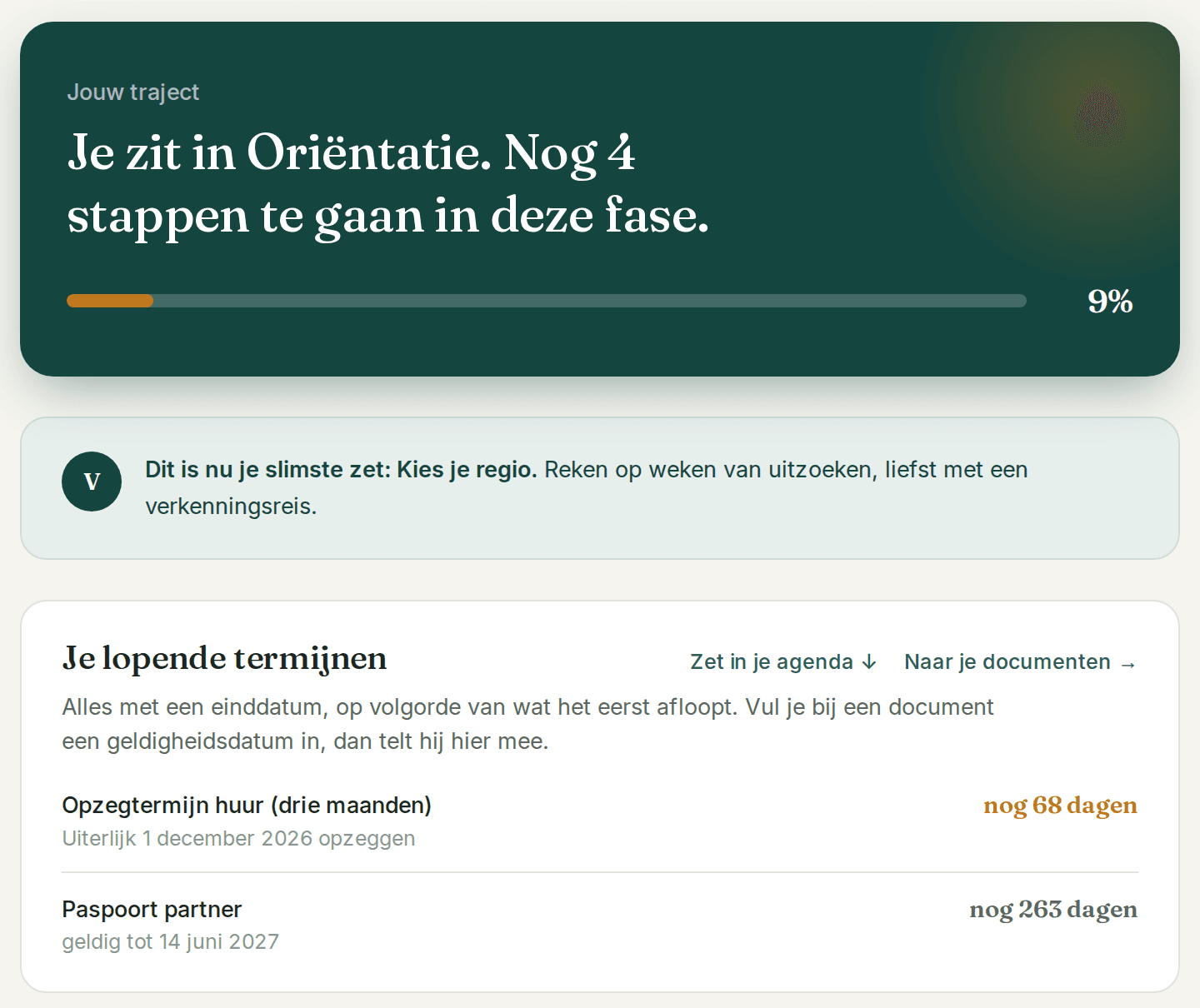
And this is the dashboard that step lives in. The example shows the plan for Spain; your dashboard shows the plan for Uruguay.
This is step 3.3 of 37. The other 36 are ready for you, each with the same sources, the same offices and a schedule that keeps track of your dates.
See all 37 steps for UruguayEvery step on one list, free
Not ready to start yet? Then you get the departure checklist for Uruguay: every step in order, to print and tick off. With it, five mails in a week and a half about the pitfalls and the real costs. If the rules for Uruguay change, you'll hear about it. After that we ask once where your plans stand, and now and then we send one thing that fits your moment. No newsletter, and you can switch it off at any time.
What will your move to Uruguay cost? Work it out →Also want to know whether your departure date is feasible? Take the departure scan: seven questions, and you see your whole plan in miniature →
That was the move. And once you live there?
Which country may tax your pension once you live in Uruguay? Is there a favourable regime, a scheme that lowers your tax? And how do you get insured? That depends on where your income comes from. Tick it and you'll see which rules apply to you, with the source.
See the financial conditionsClosing down the Netherlands: all your letters in one go
Moving to Uruguay starts with leaving the Netherlands properly. That's why the plan includes the letter tool: you enter your details once and every cancellation and notification letter is ready.
Just the letters, without the plan? That works too, for € 49
- Health insurance, rent, energy, subscriptions, GP, school, bank and pension fund: 16 kinds of letters. You enter your details only once.
- A sending list that counts back from your departure date and your notice period, even when that's three months.
- Also what you need to ask for as an emigrant: your no-claims years in English, your medical file and the school report (the report on your child for the new school).

Auke, maker of Vertrekklaar
In December we're leaving ourselves, on a trip around the world with our family. What I put here, I'm arranging for my own family too.
On 20 September 2026 a customer wrote that the CAK rule for early retirement was missing from his plan. He was right. That evening the step was in thirteen plans, with the source attached.
The knowledge base on Uruguay
Per phase, the articles that are already there. They're written from the same journey and go deeper than what fits above.
- Healthcare in Uruguay: no CAK, but FONASA for those who work and ASSE for those who do notThe social security treaty with Uruguay covers your AOW, but not your healthcare: Uruguay is not on the CAK's list. Anyone working in Uruguay falls under FONASA, the national health fund run through the BPS, and pays 3 to 8 % of their wage. Anyone not working chooses the public provider ASSE or a private mutualista.
- Residence routes to Uruguay: temporaria, permanente or digital nomadYou travel to Uruguay without a visa, and then apply for your residence permit at the Dirección Nacional de Migración. If you want to stay, you can apply for the residencia permanente straight away. There is no fixed income amount: your income has to cover your costs in the country. The fee is 557.30 UI.
- Working in Uruguay: your residence permit lets you work, your diploma you have recognisedIn Uruguay you do not need a separate work permit: a residence permit gives the right to work. Anyone coming for a Uruguayan employer gets a residencia temporaria with a wage of at least the minimum wage, 25,383 pesos a month in 2026. You pay 15 % pension contribution and your health contribution through the BPS. You have a university diploma recognised by the Ministry of Education.
- AOW, pension and tax in Uruguay: full AOW, but no tax treatyFor the AOW, Uruguay is a treaty country: even a single person receives the full AOW. There is no tax treaty, so the Netherlands simply keeps taxing your AOW and your pension, without tax credits. Uruguay does not list a foreign pension among what it taxes, but since 2026 it does tax interest, dividends and capital gains from abroad, unless you opt for the scheme for newcomers.
- Car and driving licence in Uruguay: a used car may not enter the countryUruguay prohibits the import of used cars, motorcycles and commercial vehicles, since 2013 without an end date. So if you settle in Uruguay, you generally cannot bring your car permanently. You have your Dutch driving licence converted at the Intendencia of your department, once you have a Uruguayan identity card. The older you are, the shorter the new licence is valid.
- Pet to Uruguay: chip, rabies, deworming and an NVWA stampA dog or cat may go to Uruguay with a valid rabies vaccination, a deworming shortly before departure and a vet's statement, or with the EU pet passport, provided an official vet has stamped it. In the Netherlands that is the NVWA. Dogs need a microchip and, as a rule, a negative leishmaniasis test at most 60 days old.
All 13 articles about Uruguay
- Household goods to Uruguay: duty-free, but with a guarantee until you are permanent
- Bank and payments in Uruguay: two identity documents, proof of address and limits on cash
- The first weeks in Uruguay: first the residence application, then the identity card, then the rest
- Buying a house in Uruguay: 2 % transfer tax and a notary who carries it all
- Renting in Uruguay: the garantía decides which contract you get
- Registration and numbers in Uruguay: your birth certificate first, then the identity card
- School in Uruguay: free public education, compulsory from age four
Also applies to your move
Ready to begin?
The step-by-step plan for Uruguay: 37 steps, with your documents and your costs in one place. For each step you see the latest date to start. You pay once and it's yours.