Leaving from Belgium?To the Belgian plan →See the plan for Belgians moving to China →This plan is for people leaving the Netherlands.

China · Visa required
Emigrating to China
To work in China you need an employer, and you have to clear a threshold: a bachelor plus two years' experience, or sixty points. Clear it and you're in. The visa then takes days of work, not months. The real decision lies elsewhere: do you want a life in Chinese, behind a filtered internet?
€ 399 one-off · 39 steps · no subscription
- Kind of journey
- Work visa through an employer: a threshold, not a contest
- Lead time
- About 6 months. After the job, it goes in weeks
- Note
- No healthcare treaty, no full AOW export, and a filtered internet
Last updated: 14 October 2026
Will your departure date work? Check it in the free step-by-step plan →
Five phases, from the threshold to the three clocks
The selection sits before the application: finding an employer, and being honest about life there. After that comes a series of short deadlines. Twenty working days for the notification (the advance permission to work in China), four for the visa, and after landing 24 hours, 15 days and 30 days.
- Orientation
A threshold, not a contest, and the honest conversation
In this phase you count your points, calculate the journey and have the two conversations the recruitment stories skip. China has no pool and no ranking: you don't compete with other candidates. Class B, the standard route, asks for a bachelor plus two years' experience, or sixty points. Whoever gets over it is in. The first conversation is about language and internet. Google and WhatsApp don't work there, and life runs on WeChat (the Chinese app for messaging and paying). The second conversation is about the family. On an S1 family visa your partner may not work. And a single person gets the married rate of the AOW (the Dutch state pension) there, the lower amount for married people, for as long as you live there.Read more
- Job and visa
The selection is the job application, then it goes in weeks
In this phase you find an employer and get the visa. Your employer applies online for the work permit notification, the advance permission to work in China. It's free and legally takes twenty working days. Then you get the Z visa (the work visa) in The Hague: four working days, € 111.55 per person. One paper has a clock: your certificate of conduct may be no older than six months when you apply. So only request it once there's a job offer. The good news: since November 2023 one apostille (a stamp that makes your Dutch document valid abroad) suffices where there used to be two counters. The PU letter from the corona years no longer exists. If you have a pet, start the titre route here too. With a titre test (a blood test for rabies antibodies) your animal can skip quarantine.Read more
- Closing the Netherlands
The treaty country where the treaty arranges the least
In this phase you close things off in the Netherlands, and get to know the gaps you have to cover yourself. China is on the treaty-country list, but the treaty arranges no export. So a single person gets the married rate of the AOW: 50 instead of 70 percent of the net minimum wage, for as long as you live there. It is the mirror image of Japan. There's no healthcare route via the CAK, the scheme that lets you stay Dutch-insured when you retire abroad. The protective assessment (a tax assessment imposed on departure that stays open) may require security outside the EU. And the tax treaty lets the Netherlands tax AOW and facilitated pension alike, the pension whose contributions you could deduct from tax. There's good news too. Posted workers stay Dutch-insured for up to five years. And the apostille replaced the double legalisation.Read more
- The move
The border is strict on paper and on numbers
In this phase you move your belongings, your medicines and your pet, and sell the car. Your container can only go in once work permit and residence permit are done. So you go first, and the things follow. The first shipment is called "exempt", but you still pay tax on twenty categories, from computers to furniture and lamps. Medicines count in days: of methylphenidate you bring at most three to fifteen days' supply, and amphetamine preparations aren't a medicine there at all. Your pet can come without quarantine, via the titre test at the recognised lab in Lelystad. The car you sell at home. Ordinary employees may not import one, and a plate is drawn by lottery or auctioned.Read more
- Arrival in China
Three clocks, one order, and the slip that opens everything
In this phase you arrange your residence and then your daily life. First there are fixed deadlines. Within 24 hours you register with the police; you'll need the registration slip you get there everywhere afterwards. Within 15 days you arrange the work permit. It's digital: a card no longer exists. Within 30 days comes the residence permit, for which your passport stays behind briefly. After that everything builds in one order: a SIM card in your own name, then the bank account, then WeChat Pay and Alipay, the Chinese payment apps. For the driving licence you take a theory test. It can be done in English, and it's learnable. And your salary may go to the Netherlands without a ceiling, as long as your contract and your tax certificate cover the amount.Read more
This is what one step of your plan looks like
This is the real thing: one of the steps of the China journey, exactly as it appears in your personal step-by-step plan, with the deadlines, the offices and the sources.
Step 3.2 of your plan
AOW and pension: the treaty that doesn't quite do enough
- Lead time
- an afternoon of research; decide on voluntary insurance
- Costs
- voluntary AOW insurance: 17.9% of income (min about € 569/year)
In this step you see what happens to your AOW and your pension when you live in China. There's a gap in it you don't expect, and you can partly close it.
China is on the treaty-country list of the SVB, the body that pays out the AOW. And yet what applies here is what you don't expect from a treaty country: the treaty arranges no export of benefits. The minister confirmed in 2024 that China, next to Pakistan, is the only country for which it works out that way.
What that means:
- A single person gets the married rate of the AOW: 50 instead of 70 percent of the net minimum wage, for as long as you live in China.
- A couple keeps twice 50%.
What the treaty does do well: whoever is seconded by a Dutch employer, so temporarily posted abroad, simply stays insured in the Netherlands. That's possible for at most five years, with a Certificate of Coverage from the SVB: the statement that you stay insured in the Netherlands.
If you sign locally, with a contract in China itself, you build up a 2% AOW gap per year in the Netherlands. The voluntary insurance closes that gap. Apply for it within one year of the end of the compulsory insurance (usually the day you leave).
And note for later: your compulsory Chinese pension contribution (8%) stays in your account on definitive departure. On written request you get the balance paid out in one go.
Your AOW accrual stops. That's something different from the payment. What you've built up until you leave stays yours. But as soon as you're no longer insured in the Netherlands, you build up nothing more. For most emigrants that's the moment of departure. Every year until your AOW age then costs you 2% of your later AOW.
Voluntary continued insurance with the SVB is possible, for ten years at most. But the application has to be in within one year of your insurance ending. After that the door is closed. If you already receive AOW, this no longer applies.
What this step rests on
- Answer to parliamentary questions (2024) — no full AOW export to China
- Treaty Netherlands-China on social security (2017)
- SVB — voluntary insurance after departure
- MOHRSS Decree 16 — the Chinese pension account on departure (article 5)
- Algemene Ouderdomswet (General Old Age Pensions Act) — article 13 (reduction per uninsured year), articles 35 and 36 (voluntary insurance)
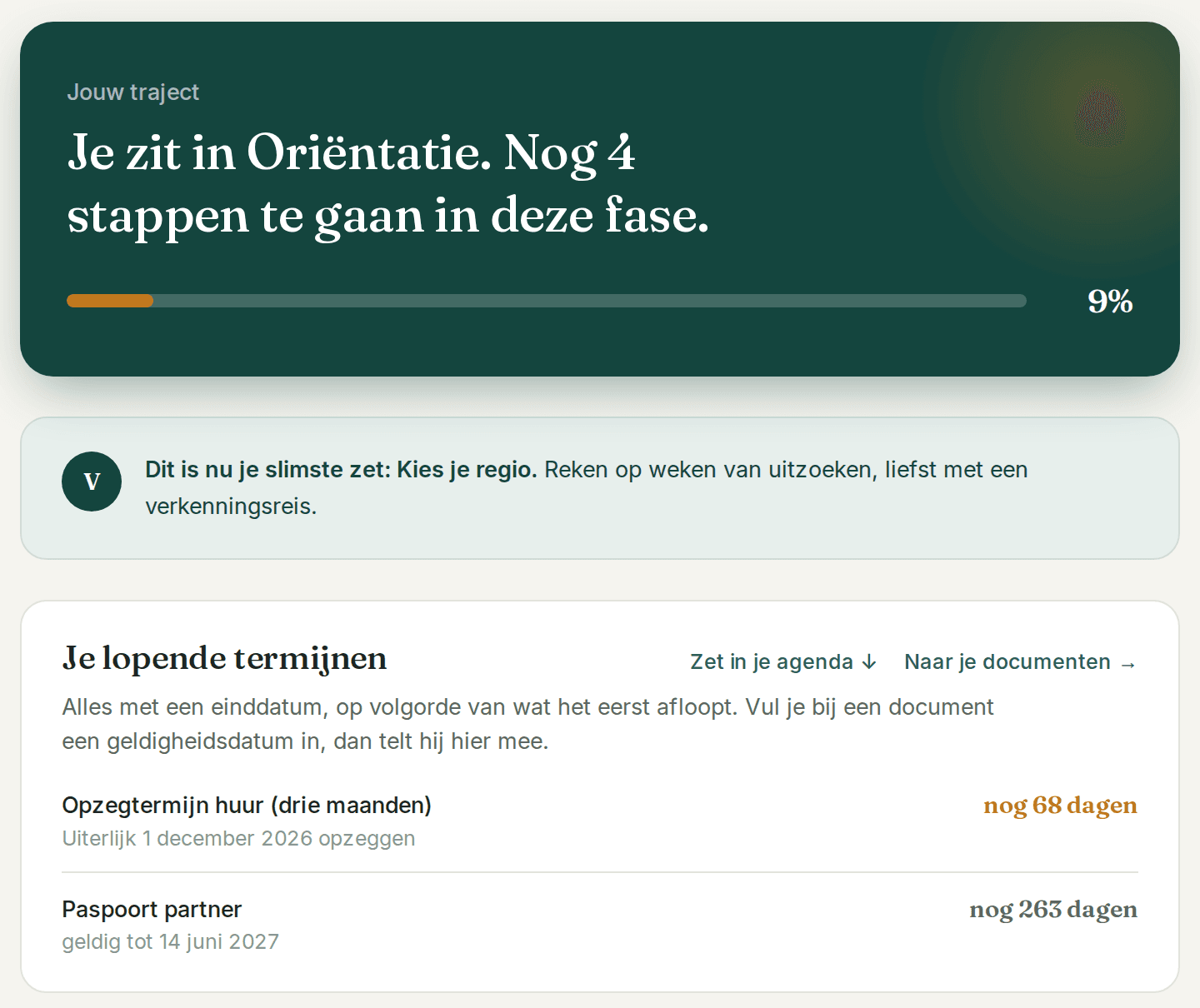
And this is the dashboard that step lives in. The example shows the plan for Spain; your dashboard shows the plan for China.
This is step 3.2 of 41. The other 40 are ready for you, each with the same sources, the same offices and a schedule that keeps track of your dates.
See all 41 steps for ChinaWhat you get for € 399
All 41 steps to China, for your situation
In order, with the office and the official source at every step. Steps that don't apply to you don't appear.
Your deadlines in one place
For each step you see the latest date to start, and you get a heads-up before something is due or expires. Your documents sit in the vault, with their dates.
A plan that stays right
Twice a month we check the sources. If something changes, it's in your plan and you get a message.
The step-by-step plan for China
€ 399
one-off · 41 steps
- Pay once, no subscription
- Destination changes? Within 30 days I switch your plan to another country free of charge
- Stuck on a step? You get a personal answer within two working days
What will your move to China cost? Work it out →
Know someone moving to China? Give this plan as a gift →
Every step on one list, free
Not ready to start yet? Then you get the departure checklist for China: every step in order, to print and tick off. With it, five mails in a week and a half about the pitfalls and the real costs. If the rules for China change, you'll hear about it. After that we ask once where your plans stand, send one offer, and now and then one thing that fits your moment. No newsletter, and you can switch it off at any time.
That was the move. And once you live there?
Which country may tax your pension once you live in China? Is there a favourable regime, a scheme that lowers your tax? And how do you get insured? That depends on where your income comes from. Tick it and you'll see which rules apply to you, with the source.
See the financial conditionsClosing down the Netherlands: all your letters in one go
Moving to China starts with leaving the Netherlands properly. That's why the plan includes the letter tool: you enter your details once and every cancellation and notification letter is ready.
Just the letters, without the plan? That works too, for € 49
- Health insurance, rent, energy, subscriptions, GP, school, bank and pension fund: 16 kinds of letters. You enter your details only once.
- A sending list that counts back from your departure date and your notice period, even when that's three months.
- Also what you need to ask for as an emigrant: your no-claims years in English, your medical file and the school report (the report on your child for the new school).


Auke, maker of Vertrekklaar
On 2 January we're leaving ourselves, on a trip around the world with our family. What I put here, I'm arranging for my own family too.
On 20 September 2026 a customer wrote that the CAK rule for early retirement was missing from his plan. He was right. That evening the step was in thirteen plans, with the source attached.
The knowledge base on China
Per phase, the articles that are already there. They're written from the same journey and go deeper than what fits above.
- The work permit for China: the threshold, the class and the chainChina doesn't select with a pool but with a threshold: a bachelor's degree plus two years of relevant work experience, or sixty points, makes you class B, and your employer files the application. The double legalisation has been replaced by a single apostille, and the work permit card has been digital since December 2024.
- Working in China: the contract, the hours, the tax and the limits of your permitA Chinese employer must conclude a written contract with you within a month; if not, it pays double wages. The law sets the working day at eight hours and pays overtime at least 150%. Your work permit is tied to your employer and your job: work outside it is illegal, with fines of up to ¥ 20,000.
- AOW, pension and tax in China: the treaty that doesn't quite do enoughChina is on the SVB's list of treaty countries — and yet a single person gets the married rate of the AOW (the Dutch state pension) there, almost a third less gross, because the treaty doesn't arrange export. What it does arrange: posting. Plus the tax treaty that lets the Netherlands levy, and the Chinese six-year rule with its 30-day reset.
- Healthcare in China: compulsory in the Chinese insurance, and you arrange the rest yourselfWhoever works in China must join Chinese social insurance, with a basic medical insurance whose premium employer and employee share. There is no CAK route, and the treaty with the Netherlands does not cover healthcare. For your family and for care outside the public system you arrange something yourself, and that differs per city.
- Your pet to China: the titre route past quarantineThe Netherlands isn't on the Chinese list of designated countries, so the default is thirty days of quarantine — but with a chip, vaccination and a titre test at a laboratory designated by Chinese customs your dog or cat is released immediately on arrival. The rules: one animal per person, and mind Beijing's dog rules.
- Your household goods to China: the first shipment duty-free, but twenty kinds of goods always taxedAnyone living in China for at least a year may import personal belongings duty-free once. But customs only handles your shipment once your residence permit is in, and twenty kinds of goods — from computers and televisions to furniture and lamps — remain taxed even in that first shipment.
All 14 articles about China
- Car and driving licence in China: one theory test, and the car stays at home
- Banking and payments in China: an account on your passport, and the 50,000-dollar annual quota
- Buying a house in China: only after a year, one home — and the land stays the state's
- Renting in China: the contract, the deposit and the police registration
- Internet, WeChat and paying: digital life in China, honestly
- Your first weeks in China: three clocks and one order
- School in China: international, an international division, or Chinese
- Residence permit and registration in China: 24 hours, 30 days and the ten-day rule
Also applies to your move
Ready to begin?
The step-by-step plan for China: 41 steps, with your documents and your costs in one place. For each step you see the latest date to start. You pay once and it's yours.