Leaving from Belgium?To the Belgian plan →See the plan for Belgians moving to Japan →This plan is for people leaving the Netherlands.

Japan · Visa required
Emigrating to Japan
For Japan you need a job first. Your employer applies for your Certificate of Eligibility, an approval in advance. After that the visa in The Hague is a week's work. There are no points, no occupation list and no lottery. Here you see where the selection does sit: the job and the language, and what the treaty from 2009 arranges for your AOW.
€ 399 one-off · 39 steps · no subscription
- Kind of journey
- Sponsored work visa: the job first, then the application
- Lead time
- About 6 months. The application itself takes weeks
- Note
- No route without an employer, and life is in Japanese
Last updated: 14 October 2026
Will your departure date work? Check it in the free step-by-step plan →
Five phases, from the route choice to the municipal round
In Japan the selection sits before the application. You need to find an employer willing to sponsor you: to file the application in Japan on your behalf. After that the journey follows a fixed series of deadlines: three months for your COE (the Certificate of Eligibility), fourteen days for the municipality, and 180 days for the dog.
- Orientation
No lottery, but no route without an employer either
In this phase you choose your route, calculate the journey and have two honest conversations. Japan has no points threshold. The standard route is a job with a Japanese employer. That employer applies for your Certificate of Eligibility: an approval in advance for your visa. The points system does exist, but as a bonus. It brings the wait for permanent residence down from ten years to three or even one. The first conversation is about the language. Japanese isn't a visa requirement, but it does decide whether life works there. The second is about your partner's career, because on a family visa your partner may work at most 28 hours a week, and only with a separate permit.Read more
- Job and visa
The selection is in the job application, then the application follows
In this phase you find a job and arrange your visa. Applying from the Netherlands works best where English is the working language: the international IT and tech sector, finance, and the JET Programme for teaching positions. Once the contract is signed, your employer applies for the COE. That's free and takes one to three months. Then you get the visa in The Hague. That takes a week. The fees were quintupled in July 2026, so don't calculate with old amounts. With the visa you travel within three months. If you have a pet, you also start the longest clock of the journey here: 180 days after the titre test, the blood test that shows the rabies vaccination works.Read more
- Closing the Netherlands
Mild for a country outside the EU, thanks to one treaty
In this phase you close things off in the Netherlands, and here a treaty works in your favour: the social security treaty from 2009. The AOW you've built up comes along in full, the single rate of 70% too: the AOW amount for people who live alone. In a country without such arrangements, such as Dubai, a single person gets the married rate. And your Dutch and Japanese pension years add up. A few things you arrange yourself. Healthcare: there's no CAK route, the arrangement through which you stay insured via the Netherlands, and the Japanese system covers 70%. The protective assessment, a tax assessment the Netherlands sets on departure but doesn't collect right away, may require security outside the EU. The benefits stop. And then there's the remittance clause in the tax treaty. It decides whether the Netherlands keeps taxing your pension. That one you take to a tax specialist.Read more
- The move
Generous with your things, strict on the calendar
In this phase you move your things and find out what may come along. Your household contents pass tax-free, with one form in duplicate. You hand it in at your own arrival. The freight has to arrive within six months after you. Medicines up to a month's supply may come freely. If you bring more, apply in advance for the free importation confirmation, an import permission. ADHD medication containing amphetamine is banned, even with a prescription. The car you sell at home. Japan drives on the left, the inspection costs hundreds of thousands of yen every two years, and outside the EEA you get no BPM refund (the car tax you get back on export). And you land at one of the seven airports that issue the residence card directly.Read more
- Arrival in Japan
Fourteen days, one order, and the deadlines of your residence
In this phase you register and arrange your life in Japan. You get your residence card at the airport. After that every registration opens the door to the next. Within fourteen days you go to the municipal office. There you arrange the population register, health insurance and the child allowance. That child allowance only starts from the month after your application. Then come the phone and the bank. If you don't work at an office in Japan, restrictions on international transfers apply for the first six months. Then the rental contract, which asks four to six months' rent up front. Or you take the UR route around it: the semi-public landlord UR. The driving licence exchanges without a test, well within your first year. And pay your premiums on time. That counts in your file for permanent residence.Read more
This is what one step of your plan looks like
This is the real thing: one of the steps of the Japan journey, exactly as it appears in your personal step-by-step plan, with the deadlines, the offices and the sources.
Step 3.2 of your plan
AOW and pension: the treaty does the heavy lifting
- Lead time
- an afternoon of finding out; decide on voluntary insurance
- Costs
- voluntary AOW insurance: 17.9% of income (min ± € 569/year)
In this step you see what happens to your AOW, the Dutch state pension, and to your pension. Here Japan differs fundamentally from Dubai: since 2009 there's been a social security treaty.
That treaty does three things:
- Your accrued AOW comes along in full. That includes the single person's rate: 70% of the net minimum wage. In countries without enforcement arrangements it drops to 50%.
- Your pension years add up. Your Dutch and Japanese insurance time is aggregated. So your compulsory Japanese premiums aren't money thrown away.
- Secondment stays Dutch. If you're posted for at most five years, you stay under the Dutch system.
One thing you decide yourself. For every year outside the Netherlands you miss 2% of AOW accrual. You can close that gap with the voluntary AOW insurance at the SVB, the agency that pays out the AOW.
Two rules for that insurance:
- You apply for it within a year of the end of the compulsory insurance (usually the day you leave).
- It runs for at most ten years.
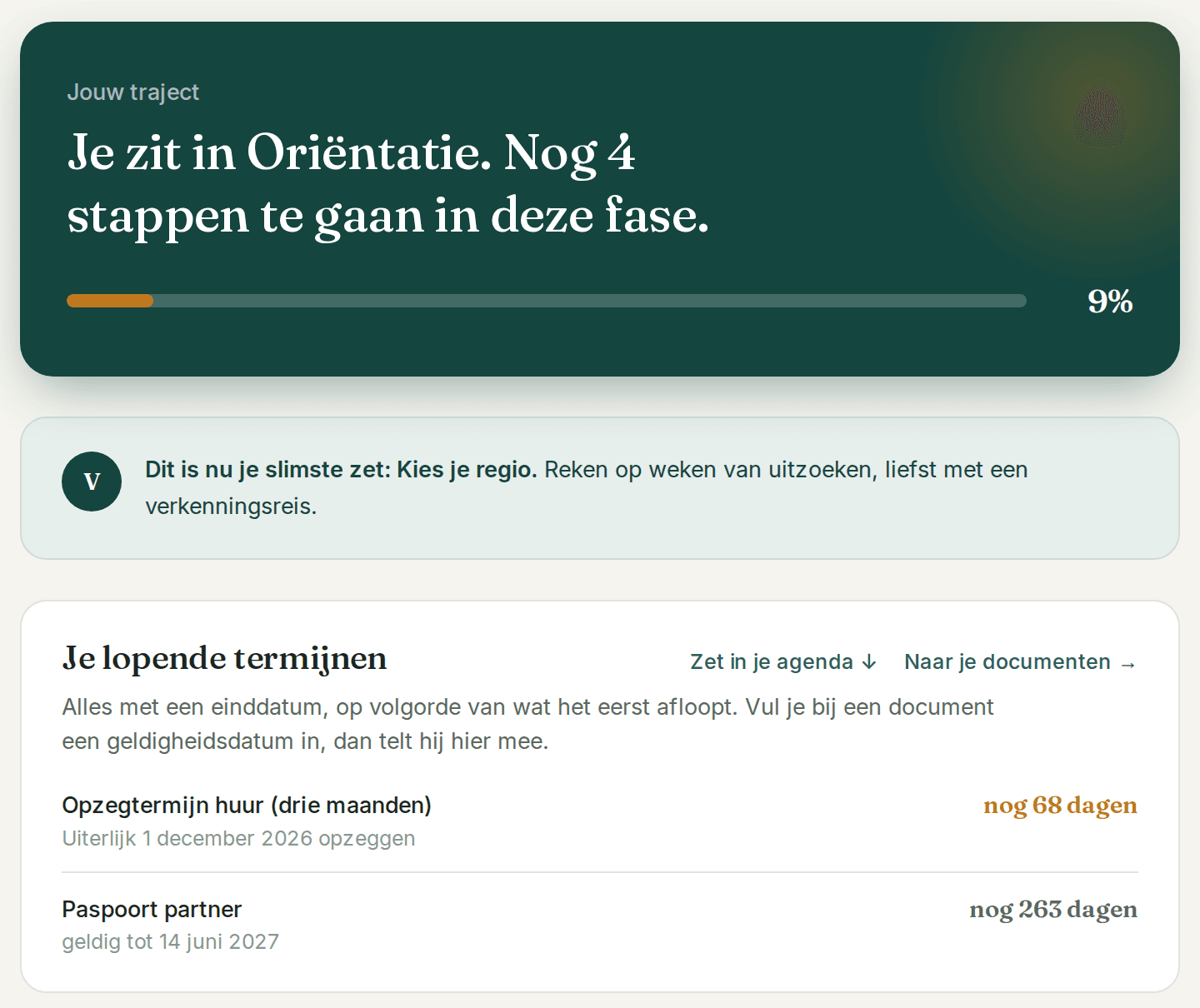
And this is the dashboard that step lives in. The example shows the plan for Spain; your dashboard shows the plan for Japan.
This is step 3.2 of 41. The other 40 are ready for you, each with the same sources, the same offices and a schedule that keeps track of your dates.
See all 41 steps for JapanWhat you get for € 399
All 41 steps to Japan, for your situation
In order, with the office and the official source at every step. Steps that don't apply to you don't appear.
Your deadlines in one place
For each step you see the latest date to start, and you get a heads-up before something is due or expires. Your documents sit in the vault, with their dates.
A plan that stays right
Twice a month we check the sources. If something changes, it's in your plan and you get a message.
The step-by-step plan for Japan
€ 399
one-off · 41 steps
- Pay once, no subscription
- Destination changes? Within 30 days I switch your plan to another country free of charge
- Stuck on a step? You get a personal answer within two working days
What will your move to Japan cost? Work it out →
Know someone moving to Japan? Give this plan as a gift →
Every step on one list, free
Not ready to start yet? Then you get the departure checklist for Japan: every step in order, to print and tick off. With it, five mails in a week and a half about the pitfalls and the real costs. If the rules for Japan change, you'll hear about it. After that we ask once where your plans stand, send one offer, and now and then one thing that fits your moment. No newsletter, and you can switch it off at any time.
That was the move. And once you live there?
Which country may tax your pension once you live in Japan? Is there a favourable regime, a scheme that lowers your tax? And how do you get insured? That depends on where your income comes from. Tick it and you'll see which rules apply to you, with the source.
See the financial conditionsClosing down the Netherlands: all your letters in one go
Moving to Japan starts with leaving the Netherlands properly. That's why the plan includes the letter tool: you enter your details once and every cancellation and notification letter is ready.
Just the letters, without the plan? That works too, for € 49
- Health insurance, rent, energy, subscriptions, GP, school, bank and pension fund: 16 kinds of letters. You enter your details only once.
- A sending list that counts back from your departure date and your notice period, even when that's three months.
- Also what you need to ask for as an emigrant: your no-claims years in English, your medical file and the school report (the report on your child for the new school).


Auke, maker of Vertrekklaar
On 2 January we're leaving ourselves, on a trip around the world with our family. What I put here, I'm arranging for my own family too.
On 20 September 2026 a customer wrote that the CAK rule for early retirement was missing from his plan. He was right. That evening the step was in thirteen plans, with the source attached.
The knowledge base on Japan
Per phase, the articles that are already there. They're written from the same journey and go deeper than what fits above.
- The work visa for Japan: first the job, then the COEJapan selects not with points but with a sponsor: your employer applies for your Certificate of Eligibility in Japan, and after that the visa in The Hague is a week's work. The points system does exist — as a bonus that brings your waiting time for permanent residence down from ten years to three or even one.
- Working in Japan: the contract, the hours, the premiums and the rules of your statusA Japanese employment contract must be in writing, with pay, hours and termination rules. The law sets the working week at 40 hours and pays overtime at least 25% extra, but you only earn holidays after six months. Your status hangs on your work: a change you report within fourteen days, and three months without work can cost you your stay.
- AOW, pension and tax in Japan: the treaty that changes everythingJapan is a treaty country, and that makes a difference: your accrued AOW (the Dutch state pension) goes with you in full — including the single person's rate of 70% — and your Dutch and Japanese pension years are added together. The pitfalls lie elsewhere: the choice between the Japanese contribution refund and the treaty, and a tax treaty with a clause that hangs on your transfers.
- Healthcare in Japan: compulsory cover, 30% co-payment and no CAK routeIn Japan you are obliged to join public insurance: through your employer or through the municipality. You pay 30% of every treatment yourself, with a monthly ceiling that catches the big bills. There is no CAK route, and that makes the handover on the day you travel the moment to watch.
- Taking your pet to Japan: the 180 days that set your departure dateJapan doesn't count the Netherlands among the rabies-free countries, and that means a fixed chain: chip, two rabies vaccinations, a titre test — and then 180 days of waiting, counted from the blood sample. Whoever starts too late pays the difference in quarantine days. This is the step you plan *first*, even before your own departure date.
- Your household goods to Japan: duty-free, with one form you cannot redoUsed household goods enter Japan duty-free if you stay longer than a year and the shipment is cleared within six months of your own arrival. The exemption hangs on one form in duplicate, which you have stamped when you land — and which customs will not issue again if you lose it.
All 13 articles about Japan
- Car and driving licence in Japan: exchange without a test, and leave the car at home
- Banking and payments in Japan: your account, the six-month rule and what the bank must know
- Buying a house in Japan: anyone may — but the tax bill arrives once you've forgotten it
- Renting in Japan: reikin, deposit, the guarantor — and the route around it
- Your first weeks in Japan: the card, the fourteen days and the six-month rule
- School in Japan: free and in Japanese, or international and expensive
- Residence card, jūminhyō and My Number: the Japanese papers and their clocks
Also applies to your move
Ready to begin?
The step-by-step plan for Japan: 41 steps, with your documents and your costs in one place. For each step you see the latest date to start. You pay once and it's yours.