Skip to content

Step-by-step plan · Visa required

The step-by-step plan for Japan

From "we want this" to being settled, in 39 steps. Read phase 1 in full here. Test your departure date along the way. Then you'll know whether you want the rest.

39 steps5 phases90 official sources9 only for your situationchecked on 9 September 2026

Phase 1 starts below ↓The whole plan: € 399 one-off, no subscription.

What it looks like

Not a PDF, not a checklist. A plan that knows what needs to happen now.

Every step sits in its place in the order, with the lead time, the counter and the official source. You tick off, your partner ticks along, and the plan counts back from your departure date: what has to start when, and what is running now.

Below is phase 1, exactly as it appears in the plan.

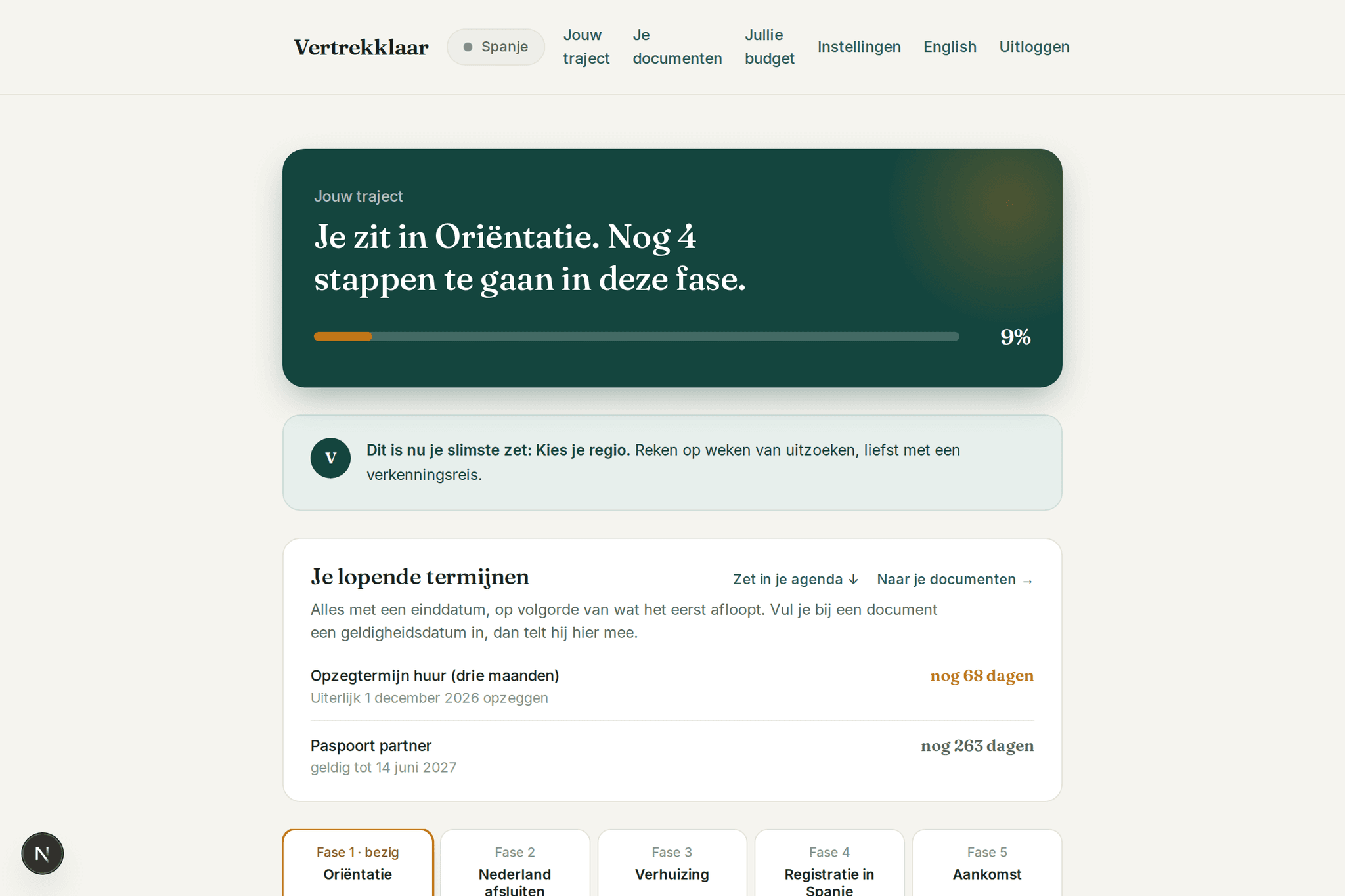
The dashboard of the step-by-step plan for Japan: the current phase, the open steps, the next step and the deadline bar.

The route

  1. Orientation

    6 steps

    Open · You are here

  2. Job and visa

    7 steps

    In your plan

  3. Closing the Netherlands

    14 steps

    In your plan

  4. The move

    5 steps

    In your plan

  5. Arrival in Japan

    7 steps

    In your plan

Phase 1 is the question "can we, and do we want to?". From phase 2 the arranging begins.

Phase 1 · Orientation

6 of 6 steps open

Japan has no queue and no lottery — but also no route without an employer. The real entrance exam isn't the visa; it's finding the job, and being honest about what a life in Japanese asks of you.

By the end of phase 1 you know which route fits you, what the journey will cost, what the language really means for work and life, and the family stands behind the decision.

Step 1.1

Understand the system: first a sponsor, only then papers

Lead time:
reading step
Costs:
none

Japan has no separate work permit: you get one residence status, and it hangs on what you're coming to do. The pivot is the Certificate of Eligibility (COE) — a pre-approval you can't apply for yourself from the Netherlands: a sponsor in Japan does that for you, and for work routes that's your employer. That fixes the order: first the job, then the COE, only then the visa. Whoever wants to move first and search afterwards has no route in this corridor — apart from the trial routes in step 1.2. The good news: once the sponsor is there, the rest is predictable and surprisingly cheap.

Checked against the official source

The official sources for this step

Step 1.2

Choose your route: employer, points bonus or trial year

Lead time:
an evening of comparing
Costs:
none

The standard is the gijinkoku work visa: a job at bachelor's level, no points, no language test for most positions. The HSP points system is a bonus here, not a threshold: 70 points gives five years' certainty and permanent residence after three years, 80 points already after one year — so always count your points. Entrepreneurs: the Business Manager visa was drastically tightened in October 2025 (¥ 30 million capital plus staff plus language requirement) — what older sites say about "¥ 5 million" is no longer correct. And whoever wants to try first: the working-holiday visa (Dutch quota: 200 a year) or the digital-nomad visa (six months, ¥ 10 million annual income, no residence card) — both trial, not emigration.

Step 1.3

Get a picture of what it's going to cost

Lead time:
1-2 hours with the calculator
Costs:
none

The Japanese government isn't the big cost item: the COE is free and the fees stay under a hundred euros per person — though the visa fees were raised sharply in July 2026, so don't count with older amounts. The money is in the landing: a Japanese rental contract asks four to six months' rent upfront, and the buffer until the first salary is the item that counts here. The calculator lines it up for your situation.

Step 1.4

Be honest about the language

Lead time:
a week of researching and trying
Costs:
none

There's no general language requirement for the work visa, and English-language work really exists — especially in the international IT sector and via the JET Programme. But be honest about the rest: the municipal office, the hospital, the rental contract and your children's school speak Japanese. And since April 2026 the immigration service does set a language requirement (JLPT N2) for customer-contact positions at smaller employers. The question for this week isn't "can I get in without Japanese" — you can — but "do we want a life in which we learn it". Start a course today; every month's head start counts.

Step 1.5

Take the decision together

Lead time:
no fixed one; take your time
Costs:
none

Three things the recruitment stories skip. The partner's career: on a dependent visa your partner may work at most 28 hours a week, and only with a separate permission — whoever wants two careers looks seriously at a work status of their own or the HSP route, where the partner does work freely. Unmarried? For unmarried partners there's no regular route; the dependent visa asks for a marriage certificate. And the distance is real: thirteen hours' flying, seven to eight hours' time difference, and a Dutch community of just over a thousand people in the whole country. Japan won't become a second Netherlands — that's the attraction and the price, and you weigh it together.

Checked against the official source

The official sources for this step

Step 1.6

Choose your target date

Lead time:
five minutes, below
Costs:
none

Choose below the date on which you want to be standing in Japan. The plan works out whether that's feasible with what still has to happen — the job hunt is the big unknown here, the rest is surprisingly predictable. A target date is yours: moving it is always allowed.

Phase 1 read

You know what you're getting into. Now the arranging begins.

You've read phase 1 of the step-by-step plan for Japan. The full plan has another 33 steps ready for you: Job and visa, Closing the Netherlands, The move and Arrival in Japan.

The plan counts everything back from your departure date, watches your deadlines and documents, and shows only the steps that apply to you.

The step-by-step plan for Japan

€ 399

one-off · no subscription · instant access

Also included: deadlines watched · documents with expiry dates · only your steps · your partner ticks along · all cancellation letters · questions to Auke.

✎ Auke reads along

Stuck somewhere? Ask your question at the step. Auke reads it himself and answers within two working days.

Not ready yet? Send yourself your date and phase 1 →

Phase 2 · Job and visa0 of 7 steps open

The selection sits in the job application, not in the visa application. Once the employer is in, a fixed chain follows: the Certificate of Eligibility (one to three months, your employer files), the visa in The Hague (a week), and within three months of issue you're standing at the airport.

  1. 2.1Find a job with an employer willing to sponsorweeks to months — this is the real work
  2. 2.2Read the contract with Japanese eyesa few days, before you sign
  3. 2.3Count your points: the bonus that moves your PR clockan evening with the points table
  4. 2.4The COE application: your employer files, you supplystandard 1 to 3 months
  5. 2.5The visa: a week at the embassy in The Hagueas a rule 5 working days
  6. 2.6With your family: the dependent applications and the certificatesonly if this applies to you
  7. 2.7With a pet: start the 180-day clock nowonly if this applies to you
Phase 3 · Closing the Netherlands0 of 14 steps open

This is the mildest non-EU corridor on the site: the 2009 treaty saves your AOW — the single person's rate too — and adds up your pension time. But there's no treaty route for healthcare, the protective assessment asks for security here, and the tax treaty has a clause that hangs on your transfers.

  1. 3.1Healthcare: no treaty route — the Japanese system awaitsarrange the connection before the day of departure
  2. 3.2AOW and pension: the treaty does the heavy liftingan afternoon of finding out; decide on voluntary insurance
  3. 3.3The tax office: providing security, and the remittance clausewith pension or substantial-shareholding assets: with an adviser
  4. 3.4Benefits and child benefit: here it stops — there something startsan hour, partly by phone
  5. 3.5Deregister at the municipalitypossible from 5 days before departure, up to and including the day of departure
  6. 3.6DigiD, bank and your vote: keep the lines with the Netherlandsan afternoon
  7. 3.7Driving licences: renew the Dutch one, get the international onea week
  8. 3.8Partner comes along without a job of their ownonly if this applies to you
  9. 3.9Living partly in the Netherlands: the eight-month ruleonly if this applies to you
  10. 3.10The house in the Netherlands: sell, let or keeponly if this applies to you
  11. 3.11Children who stay in the Netherlands: DUO, healthcare and the houseonly if this applies to you
  12. 3.12Cancel what stops: job, rent, energy, subscriptions and schoolstart three months before departure; most notice periods are one month
  13. 3.13Stay reachable: DigiD, your phone number, your bank and your postarrange it before you leave; afterwards it takes weeks
  14. 3.14Student debt, remote work or your own business: what moves with youreport it before you leave; the consequences run for years
Phase 4 · The move0 of 5 steps open

The Japanese border is generous to your household goods — tax-free, with one form in duplicate — and strict on the calendar: your freight must arrive within six months after you, medicines above a month's supply require a permit in advance, and the pet flies on a clock that already started in phase 2.

  1. 4.1The household goods: across the border free, with one formquotes 3-4 weeks ahead; sea freight 6-8 weeks
  2. 4.2Medicines: one month free, above that paperwork in advanceapplication at least 2 weeks before departure
  3. 4.3The day of travel: land at a card airportthe journey itself; the COE clock sets the latest date
  4. 4.4The pet: the AQS notification and the flightonly if this applies to you
  5. 4.5The car: sell it at homeonly if this applies to you
Phase 5 · Arrival in Japan0 of 7 steps open

The residence card you get as a gift at landing; after that every registration is the key to the next, with one hard clock: fourteen days for the municipal registration. Whoever keeps the order — municipality, phone, bank, house — is sorted in weeks where others wander for months.

  1. 5.1The landing: your card, and straight away that one permissionthe day of arrival itself
  2. 5.2Within fourteen days: the municipal roundone well-prepared morning
  3. 5.3Phone, bank and the six-month rulephone a day; bank 1-2 weeks
  4. 5.4Housing: reikin, the guarantor and the UR routesearching and signing, 2-6 weeks
  5. 5.5Exchange your driving licence — well within your first yearJAF translation 5-10 working days; the exchange a day
  6. 5.6School and childcare: choose the system, not just the schoolonly if this applies to you
  7. 5.7Live with the clocks of your statusreading step

9 of these 33 steps only appear when your answers call for them: a pet, a car, a partner without a job, children staying in the Netherlands. That is the difference between a step-by-step plan and a checklist.

Three questions

Can't I find all this for free?

Yes. Everything in the plan comes from official sources, and they're listed at every step. Phase 1 above is the proof. What you buy is the work around it: which of the 33 following steps apply to you, in which order, with which deadline, and a nudge when something needs doing.

Does this apply to my situation too?

The plan first asks who is coming along, what is coming along and how you're leaving the Netherlands. Steps that don't apply to you don't appear; steps that only apply to you do. Is your situation slightly different from what's written? Ask your question at the step; you'll get an answer within two working days.

What if the rules change after I buy?

Then your plan changes with them. Twice a month we check every source; whatever changes is in your plan the same week, with the date. Your access lasts for your whole departure.

Ready to begin?

The step-by-step plan for Japan: 39 steps, your documents and your costs in one place, with the timing watched. Pay once, and it's yours.