Leaving from Belgium?To the Belgian plan →See the plan for Belgians moving to Thailand →This plan is for people leaving the Netherlands.

Thailand · Visa required
Emigrating to Thailand
To live in Thailand, you need a visa. You don't really settle there: your stay is granted again and again. That decides everything. Your money sits locked for months in a Thai account. Your healthcare is your own problem from day one. And one missed report can cost you your status. Whoever knows and accepts that lives there well and cheaply.
€ 399 one-off · 39 steps · no subscription
- Kind of journey
- Visa, renewed annually
- The four clocks
- Annual extension · 90-day report · re-entry permit · 180 days for tax
- Note
- No S1 and no treaty contribution: you buy your healthcare yourself
Last updated: 14 October 2026
Will your departure date work? Check it in the free step-by-step plan →
Five phases, from the visa choice to the four clocks
This journey doesn't end at arrival. First comes the visa, with its three hard requirements. Then the Dutch side: here you really step out of it, instead of shifting over to another system. After that follows an annual cycle you keep up: extend, report, and the money in the right account at the right moment.
- Orientation
A visa isn't a right of residence
In this phase you choose your visa route and have the conversation about your healthcare. Thailand doesn't give a permit that runs until you cancel it. It gives permission to stay, and as a rule you apply for that anew every year at the immigration office of your province. You choose from the O-A, which you apply for from the Netherlands, the ten-year O-X, or the Non-O with annual extension. With this destination the conversation about your healthcare belongs at the front, not the back: what do you do when your health insurance is cancelled or becomes unaffordable in fifteen years?Read more
- Your visa
Money, insurance and a medical certificate
In this phase you apply for your visa. For the pension route three hard requirements apply. The money: 800,000 baht in the bank, or 65,000 baht a month in demonstrated income, or a combination that comes to 800,000. The insurance: a policy that covers your medical costs in Thailand up to at least 3 million baht (US$ 100,000), for your whole stay. Your insurer fills in the official declaration form for it. And a medical certificate plus a certificate of conduct (VOG), both with a short validity. You apply via the official e-visa portal. If you're married to a Thai, there's a lighter route: the Non-O on the grounds of your marriage, with no age limit, 400,000 baht in the bank or 40,000 baht a month, and no insurance requirement or medical certificate. On arrival, mind the date on the stamp, not the one on the visa.Read more
- Closing the Netherlands
Here it really stops: no S1, no more AOW accrual
In this phase you close off the Netherlands, and here you really step out. With an EU move you shift over to another system. Here your basic insurance ends on deregistration, and nothing automatically takes its place. The tax treaty from 1975 does cooperate. Article 18 assigns your company pension to Thailand, article 19 keeps an ABP pension in the Netherlands. That applies for now: on 21 November 2025 a new treaty was signed that gives the Netherlands the right to tax pensions. That treaty is not yet in force. The export treaty of 2002 lets the AOW you've built up come along in full, the single person's rate too. What does stop is your AOW accrual: every year until your AOW age costs 2%. Your insurance for the survivor's benefit stops too. You apply for voluntary continuation of both within a year. Your certificates go through the full legalisation chain, the series of stamps confirming that a document is genuine, because Thailand isn't in the EU.Read more
- The move
Sea freight, medicines and the car that stays here
In this phase you move your things, and you sort out the car, your medicines and any pet. It's eleven hours' flight, and a container sails six to ten weeks. So count on a period without your things. The car you sell in the Netherlands. Import duties, excise and VAT in Thailand easily exceed the value of the car, and they drive on the left. Mind your medicines. A number of drugs that are simply on prescription here fall under narcotics in Thailand. Then it's not a fine but a criminal case. If a pet is coming along, start three months ahead.Read more
- Arrival in Thailand
Four clocks, and none of the four sends a reminder
In this phase you register in Thailand and set the clocks going that you keep up from then on. Within 24 hours your landlord registers you with the TM30, the report of your address of stay. That's their duty, but your problem if it doesn't happen. Then you open a Thai bank account. The money has to sit there two months before and three months after your extension application. The extension itself you apply for at the office of your province. Before you leave the country, you need a re-entry permit, the permission to come back. The ninety-day report has its own counter. On top of that, 180 days make you a tax resident, a resident for tax purposes. And in 2024 the rule changed: foreign income you bring into Thailand is taxed, in a later year too.Read more
This is what one step of your plan looks like
This is the real thing: one of the steps of the Thailand journey, exactly as it appears in your personal step-by-step plan, with the deadlines, the offices and the sources.
Step 5.4 of your plan
The re-entry permit: don't leave the country without one
- Lead time
- can be arranged the same day
- Costs
- see the cost indication
This step prevents the most expensive mistake newcomers make, and that mistake is completely avoidable. A re-entry permit is your permission to come back to your granted stay after a trip abroad.
If you leave Thailand without a re-entry permit, your granted stay lapses the moment you depart. That applies even if there's still half a year on your stamp. You then come back as a tourist and may do the whole journey again.
How you arrange the permit:
- It can be done the same day, at Immigration or at the airport.
- There's a variant for one trip and a variant for several trips.
- If you go to the Netherlands or a neighbouring country even once a year, take the multiple.
What this step rests on
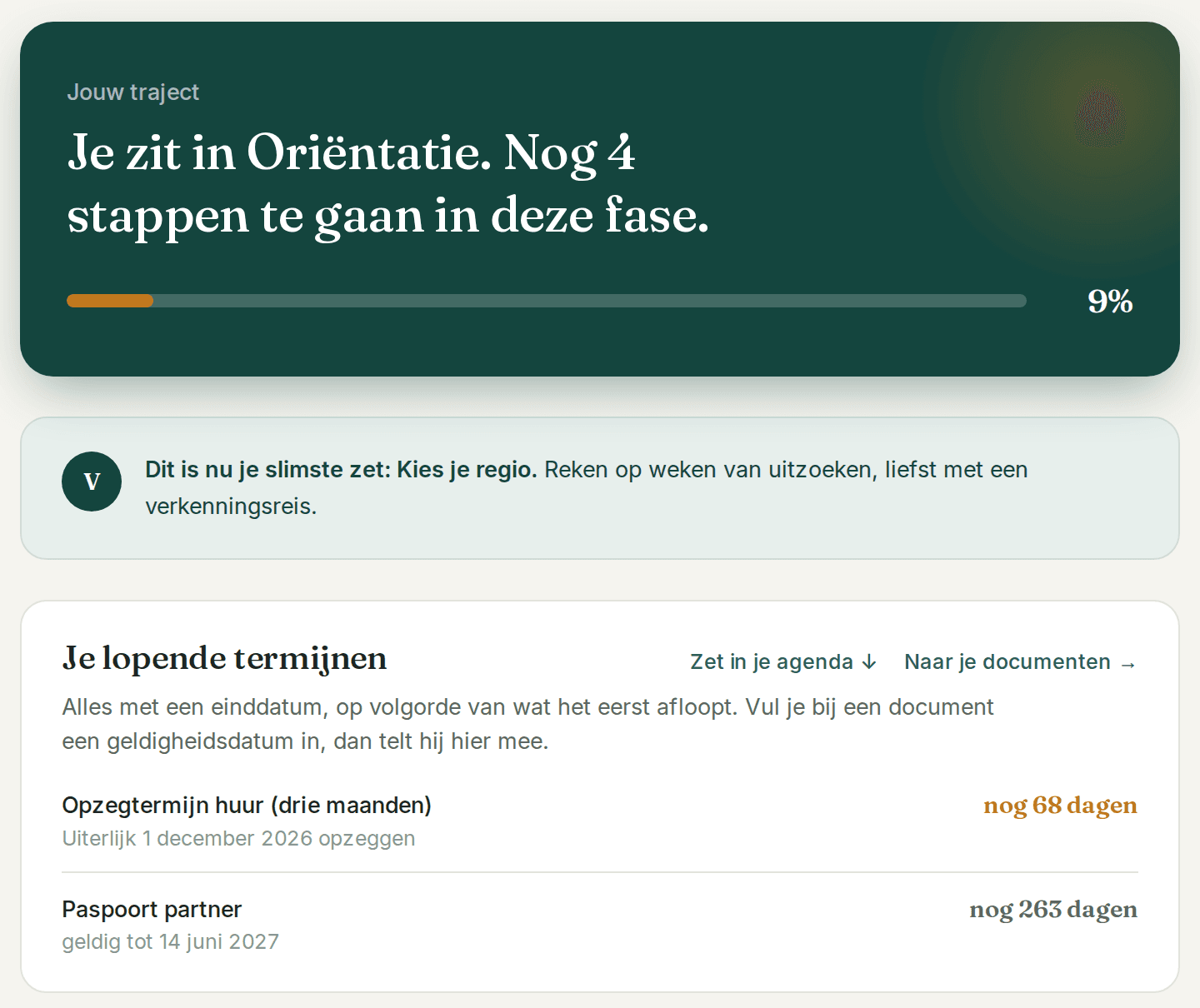
And this is the dashboard that step lives in. The example shows the plan for Spain; your dashboard shows the plan for Thailand.
This is step 5.4 of 44. The other 43 are ready for you, each with the same sources, the same offices and a schedule that keeps track of your dates.
See all 44 steps for ThailandWhat you get for € 399
All 44 steps to Thailand, for your situation
In order, with the office and the official source at every step. Steps that don't apply to you don't appear.
Your deadlines in one place
For each step you see the latest date to start, and you get a heads-up before something is due or expires. Your documents sit in the vault, with their dates.
A plan that stays right
Twice a month we check the sources. If something changes, it's in your plan and you get a message.
The step-by-step plan for Thailand
€ 399
one-off · 44 steps
- Pay once, no subscription
- Destination changes? Within 30 days I switch your plan to another country free of charge
- Stuck on a step? You get a personal answer within two working days
What will your move to Thailand cost? Work it out →
Know someone moving to Thailand? Give this plan as a gift →
Every step on one list, free
Not ready to start yet? Then you get the departure checklist for Thailand: every step in order, to print and tick off. With it, five mails in a week and a half about the pitfalls and the real costs. If the rules for Thailand change, you'll hear about it. After that we ask once where your plans stand, send one offer, and now and then one thing that fits your moment. No newsletter, and you can switch it off at any time.
That was the move. And once you live there?
Which country may tax your pension once you live in Thailand? Is there a favourable regime, a scheme that lowers your tax? And how do you get insured? That depends on where your income comes from. Tick it and you'll see which rules apply to you, with the source.
See the financial conditionsClosing down the Netherlands: all your letters in one go
Moving to Thailand starts with leaving the Netherlands properly. That's why the plan includes the letter tool: you enter your details once and every cancellation and notification letter is ready.
Just the letters, without the plan? That works too, for € 49
- Health insurance, rent, energy, subscriptions, GP, school, bank and pension fund: 16 kinds of letters. You enter your details only once.
- A sending list that counts back from your departure date and your notice period, even when that's three months.
- Also what you need to ask for as an emigrant: your no-claims years in English, your medical file and the school report (the report on your child for the new school).


Auke, maker of Vertrekklaar
On 2 January we're leaving ourselves, on a trip around the world with our family. What I put here, I'm arranging for my own family too.
On 20 September 2026 a customer wrote that the CAK rule for early retirement was missing from his plan. He was right. That evening the step was in thirteen plans, with the source attached.
The knowledge base on Thailand
Per phase, the articles that are already there. They're written from the same journey and go deeper than what fits above.
- The visa routes to Thailand: O-A, O-X and the Non-O side by sideThree routes matter for Dutch pensioners, and they differ mainly in where your money has to be and how often you have to go back to the counter. Plus the mistake everyone makes at least once: the validity of your visa is not the same as the date your stay ends.
- Healthcare in Thailand: there is no treaty route, and that is the real riskWithin the EU you slot into the local system with an S1. To Thailand that route doesn't exist: your basic insurance stops on deregistration and you buy a policy yourself. Thai private healthcare is good and cheap — but the premium hangs on your age, existing conditions are excluded, and above a certain age nobody will take you on as a new customer any more.
- The four clocks of your Thai stay — and none of the four warns youThe annual extension, the ninety-day report, the re-entry permit and the 180 days that make you a tax resident. Four deadlines with different lengths, different counters and different reasons to reset. The re-entry permit is the most expensive avoidable mistake: without it your stay loses its validity the moment you leave the country.
- Working in Thailand: no work permit, no work, and not on a retirement visa eitherIn Thailand a foreigner may not work without a work permit, whatever visa they hold, and on the O-A retirement visa work is prohibited altogether. A work permit goes through a Thai employer and a Non-Immigrant B visa, for one year or for two, and a list of occupations stays reserved for Thais. Whoever works remotely looks at the LTR visa.
- The LTR visa in Thailand: ten years' stay and tax-free foreign income, for those who clear the thresholdThe Board of Investment's Long-Term Resident visa gives ten years' stay, a yearly report instead of one every ninety days, and for pensioners an exemption from Thai tax on foreign income they bring in. The threshold for a pensioner is 80,000 dollars of passive income a year, and an unmarried partner cannot come along.
- With children to Thailand: the visa hangs on the school or on you, and child benefit stopsA school-age child enters Thailand on a parent's visa, or on a student visa of its own with a letter from the school or from the Ministry of Education. For the retirement visa, a family with school-age children is not a standard case. And because Thailand is not a treaty country, the Dutch child benefit stops after the quarter in which you leave.
All 14 articles about Thailand
- AOW, pension and tax in Thailand: two treaties help, and a third is missing
- Your dog or cat to Thailand: the import permit by email, and a ten-day window
- Your household goods to Thailand: free of import duties, but within a seven-month window
- Car and driving licence in Thailand: the car stays here, the licence you get there
- A bank account in Thailand: the bank decides per customer, and your visa hangs on the balance
- Renting in Thailand: the deposit, the standard contract and the landlord who falls outside it
- Your first weeks in Thailand: the stamp, your landlord's 24 hours and the first ninety days
- Living and buying in Thailand: no land in your own name, but a flat is possible
Also applies to your move
Ready to begin?
The step-by-step plan for Thailand: 44 steps, with your documents and your costs in one place. For each step you see the latest date to start. You pay once and it's yours.