
Brazil · Visa required
Emigrating to Brazil
Brazil is the country of the half treaty. The tax treaty of 1990 settles exactly who taxes what — your AOW and your government pension stay Dutch, your annuity becomes Brazilian, and your occupational pension is taxed by both countries above 5,000 dollars a year, with a credit — but the social security treaty of 2002 never entered into force: whoever goes alone gets the AOW at the married rate, and there is no CAK. The permit is achievable: 2,000 dollars a month for whoever comes on a pension, 1,500 for whoever works remotely, with a file that gets an apostille in the Netherlands and a sworn translation in Brazil. And the car stays here: Brazil doesn't admit used cars. This page shows how it really works.
€ 399 one-off · 37 steps · no subscription
- Kind of journey
- Residence permit on a pension (2,000 dollars a month) or on remote work — in advance at the consulate or on the spot
- The clock
- 90 days as a tourist; after a visa 90 days to register, after a grant in Brazil 30
- Note
- Half a treaty: tax settled, AOW to the married rate, no CAK — and the car doesn't come along
Last updated: 5 October 2026
Will your departure date work?
Choose your country and your date. You see how much time the plan needs and which steps take longest.
Five phases, from the resolution to the carnê-leão
A route with an income test in dollars and a paper chain you can't skip: apostille in the Netherlands, sworn translation in Brazil, and a registro within ninety or thirty days. Plus a tax treaty that splits your income in four, a social security treaty that exists on paper but doesn't work, and a healthcare system that is free and still asks for a policy of your own. This plan works with the rules of now.
- Orientation
One law, a list of grounds, and half a treaty
A pension with 2,000 dollars a month, remote work with 1,500, an employer, an investment, a study or a family — all the same permit, the autorização de residência, with a resolution per ground that names the threshold. In this phase you learn what the treaty of 1990 does with your income, why the treaty of 2002 doesn't protect your AOW, and why healthcare is free and still asks for a plano de saúde.
- Your right of residence
A pension statement, a birth certificate and a certificate of conduct — apostilled and sworn-translated
The income test is in dollars in a resolution; the documents are the work. The statement from the SVB or your fund with the proof that you can transfer the money to Brazil, your birth certificate and a certificate of conduct of the last five years — each with an apostille from the court and a translation by a tradutor juramentado. Then you choose the gate: the VITEM visa at the consulate in Amsterdam, or the application in Brazil itself, within the ninety days you have as a tourist. Partner and children come along through family reunion.
- Closing the Netherlands
Four sums from one treaty, a policy before deregistering and the married rate
The familiar list, but the tax step here is four sums: the AOW and the government pension stay taxed in the Netherlands, the annuity becomes Brazilian, and the occupational pension is taxed by both countries above 5,000 dollars a year, with a credit — and outside the EU without tax credits. Further: the own policy accepted before you deregister, because there is no CAK; the SVB in time, with the AOW at the married rate for whoever goes alone; and the Brazilian side already known: worldwide income, the residence date and the carnê-leão.
- The move
The household goods free as bagagem desacompanhada, the car that isn't allowed, and a certificate on the MAPA's model
By sea container to Santos or Rio, four to eight weeks. Used things enter the country tax-free, as long as the shipment comes in between three months before and six months after your arrival. The car doesn't come along: Brazil forbids the import of used cars, so you sell it here. The pet travels on an NVWA certificate on the MAPA's compulsory model, without quarantine.
- Arrival in Brazil
The registro, the CPF, the bank on the protocol, the SUS — and the carnê-leão
The chain after landing is a series of numbers. The registro at the Polícia Federal within ninety days after a visa or thirty after a grant, the protocol that gives the same rights until the card is there, the CPF you already get from the Netherlands, the bank you open on the protocol, the SUS and the plano, the driving licence that has to be converted within a hundred and eighty days. And from the day you're a tax resident: the carnê-leão every month, the annual return in spring, and the renewal before the end date.
This is what one step of your plan looks like
Not a brochure but the real thing: this is one of the steps of the Brazil journey, exactly as it appears in your personal step-by-step plan — with the deadlines, the counters and the sources.
Step 3.2 of your plan
Know where you pay tax: the treaty splits your income in four
- Lead time
- one good conversation with a tax adviser, then an application of weeks
- Costs
- advice hours
With most destinations this is the step of one exemption. Here it is four sums, and they all come from the treaty of 1990.
Your AOW stays Dutch: article 18(3) places payments under a social security system exclusively with the country that pays them. So the SVB keeps withholding, and Brazil may tax nothing on it. Your government pension — ABP and everything from a former employment with the government — stays Dutch too (article 19(2)), unless you live in Brazil and have become Brazilian.
Your annuity goes the other way: article 18(1) places annuities exclusively with the country of residence. For that you apply to the Belastingdienst for the wage tax exemption, with a Brazilian certificate of residence. Your occupational pension sits in between: up to an amount of 5,000 dollars per calendar year taxed only in Brazil, but what comes above that the Netherlands may tax too — and it does. Brazil then credits the Dutch tax (article 23(5)), so you don't pay twice, but you do pay the higher of the two rates.
And the rule nobody sees coming: whoever lives outside the EU isn't a qualifying non-resident taxpayer and usually has no entitlement to the tax part of the tax credits. So on your AOW, your government pension and the Dutch-taxed part of your occupational pension you pay the rate without the general tax credit and without the elderly person's credit. Have a tax adviser lay those four sums side by side, with the return as a non-resident taxpayer alongside.
What this step rests on
- Wetten.overheid.nl — the tax treaty with Brazil, article 18 (pensions, annuities and social security), article 19 (government payments) and article 23 (credit)
- Belastingdienst — tax credits if you live outside the Netherlands
- Belastingdienst — living abroad with Dutch income
- Belastingdienst — filing an M-aangifte for the year in which you lived partly outside the Netherlands
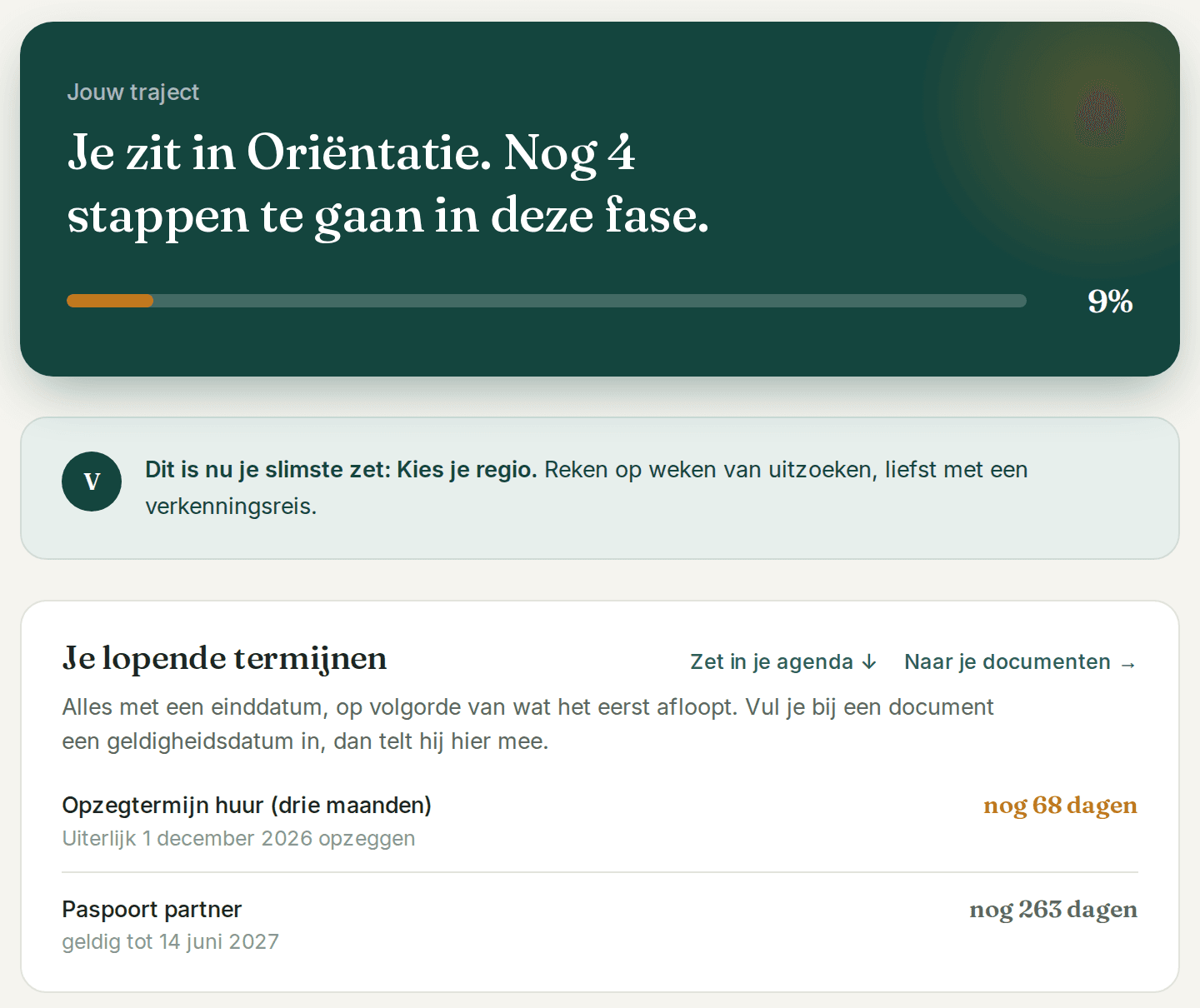
And this is the dashboard that step lives in, here with the plan for Spain.
This is step 3.2 of 37. The other 36 are ready for you — each with the same sources, the same counters and a planning that watches your dates.
See all 37 steps for BrazilFive mails, and you see your whole journey
Not ready to start yet? Then we'll send you the departure guide for Brazil: five mails in a week and a half, with the order, the pitfalls and the real costs. After that one question about where your plans stand, and beyond that only a short update when something in Brazil really changes — at most one a month, no newsletter, and you can switch it off at any time.
Calculate what your move to Brazil costs
Answer a few short questions about your situation. You immediately get a range of what it costs. Free, no account needed.
That was the move. And once you live there?
Who may tax your pension once you live in Brazil, is there a favourable regime, and how do you become insured? That depends on where your income comes from. Tick it and you see which rules apply to you — with the source.
See the financial conditionsClosing down the Netherlands: all your letters in one go
Moving to Brazil starts with leaving the Netherlands tidily. That's why the plan includes the letter tool: you enter your details once and every cancellation and notification letter is ready.
- Health insurance, rent, energy, subscriptions, GP, school, bank, pension fund — 16 kinds of letters from details you enter once.
- A sending list that counts back from your departure date and your notice period, even when that's three months.
- What an emigrant has to ask for and an ordinary canceller doesn't: your no-claims years in English, your medical file, the school report.
The knowledge base on Brazil
Per phase, the articles that are already there. They're written from the same journey and go deeper than what fits above.
- Orientation5 min
Healthcare in Brazil: the SUS is there for everyone, and the plano de saúde has waiting periods from 24 hours to 300 days
Brazil is not on the CAK's list of treaty countries: your Dutch basic insurance stops on the day of deregistration and no S1 comes in its place. What replaces it is twofold. The public system, the SUS, is universal according to the constitution and according to the migration law also open to migrants, whatever their status. Besides that almost every Dutch person takes out a plano de saúde, whose waiting periods the law of 1998 caps: 24 hours for emergencies, 180 days for the rest, 300 days for childbirth, and two years for what you already had. And the visa itself requires insurance valid in Brazil, before you even leave.
Updated 5 October 2026
- Your right of residence5 min
The residence routes to Brazil: 2,000 dollars of pension, 1,500 dollars remotely, or an employer who carries the file
As a Dutch citizen you enter Brazil without a visa, for at most 90 days per 180. Whoever stays needs an autorização de residência, and the migration law of 2017 has fixed doors for it: a pension of at least 2,000 dollars a month, remote work with 1,500 dollars a month, an investment from 500,000 reais, an employer who lodges in Brazil first, or a family member who already lives there. You lodge at the consulate in Amsterdam or in Brazil itself, and register with the Polícia Federal within 90 days of arrival.
Updated 5 October 2026
- Your right of residence5 min
Working in Brazil: the employer opens the file, the digital nomad works for abroad, and the diploma goes past a state university
Working as an employee in Brazil does not start with you but with your employer: he applies to the Ministry of Justice for an autorização de residência prévia, for 168.13 reais and with a decision period of thirty days, and only then does the consulate put the work visa in your passport. Whoever works remotely for a foreign client has the nomad route with 1,500 dollars a month. Self-employment is possible after the residence permit, with a CNPJ. And a Dutch diploma only counts after revalidação by a Brazilian state university. The migration law gives the migrant the same labour rights as a Brazilian.
Updated 5 October 2026
- Closing the Netherlands5 min
AOW, pension and tax in Brazil: the treaty of 1990 divides, and the treaty of 2002 exists only on paper
The Netherlands and Brazil have a tax treaty from 1990 that assigns a different country per income: the AOW stays Dutch, an annuity becomes Brazilian, and of an occupational pension the first 5,000 dollars a year go to Brazil while the Netherlands may also tax the rest. Brazil taxes its residents on worldwide income, up to 27.5 percent, with a monthly return for foreign income. And the social security treaty of 2002 never entered into force: the AOW travels at the married rate, which costs a single person twenty percentage points.
Updated 5 October 2026
- The move5 min
Car and driving licence in Brazil: the used car may not enter the country, and the Dutch licence is valid 180 days
Taking your car to Brazil is not possible: Portaria SECEX 249 of 2023 forbids the import of used consumer goods, and a car falls under that; the customs' removal exemption only knows household goods and tools. The bpm you do not get back on export to Brazil either, because that refund only exists within the EU and the EEA. The Dutch driving licence is valid 180 days after arrival, with an international driving permit alongside; after that you do the medical and psychological examination at the DETRAN for a Brazilian licence, without a driving test.
Updated 5 October 2026
- The move5 min
Your pet to Brazil: a certificate from the NVWA, rabies, deworming within 15 days, and no quarantine
A dog or cat enters Brazil on a Certificado Veterinário Internacional issued by the NVWA, according to the model that has been mandatory since 6 September 2025. The requirements are in Portaria MAPA 741 of 2024: rabies vaccination from 90 days of age, for a first vaccination at least 21 days before departure, a deworming within 15 days and a clinical examination within 10 days before the certificate, which itself is valid 60 days. No quarantine, no blood test, and the chip is not mandatory for Brazil, but the NVWA does require it. Whoever ever wants to return to the Netherlands has the rabies titre determined before departure.
Updated 5 October 2026
21 more articles about Brazil and about leaving the Netherlands
Aankomst in Brazilië
- 5 min
Bank and payments in Brazil: the law gives you the right to an account, the bank decides the documents, and Pix is free
The migration law expressly gives the migrant the right to open a bank account, but the central bank adds in its brochure that no bank is obliged to open one and that the bank itself decides the list of documents. What is fixed: the CPF, and as identity document the CRNM or the protocol of your registration. A payment account up to 5,000 reais has simpler rules. After that you pay with Pix, the central bank's system that is free for individuals, and your pension comes in through an institution authorised for the exchange market, always in reais.
Updated 5 October 2026
- 5 min
CRNM and CPF: the two numbers everything in Brazil hangs on, and the 90-day clock
Brazil has no municipal registration. What takes its place are two numbers: the RNM of the Polícia Federal, with the residence card CRNM, and the CPF of the Receita Federal, the tax number that the bank, the landlord and the phone shop ask for. The registration must be done within 90 days of arrival, costs 204.77 reais and yields a card that is valid nine years for indefinite residence. The CPF costs nothing and you can get it in Amsterdam, before you leave.
Updated 5 October 2026
- 5 min
Buying a house in Brazil: free in the city, capped on the land, and ownership that only exists after registration
A foreigner may buy a house or apartment in Brazil without a permit, in his own name and with a CPF. The limit lies in the countryside: agricultural land falls under the law of 1971, which caps a foreigner at fifty módulos and ties everything above three módulos to permission. What you pay on top of the price is the ITBI of the municipality — in São Paulo 3 percent — plus the notary and the registry, and you only own once the deed is on the matrícula of the property. A house gives no residence right; only the investment route from 700,000 reais does.
Updated 5 October 2026
- 5 min
Renting in Brazil: thirty months, a fiador or a three-month deposit, and a rent that may not be in euros
Renting is possible from the first day, on your passport and your CPF, and the Lei do Inquilinato of 1991 regulates more than the landlord will mention. A written contract of thirty months or longer ends on the end date without notice; a shorter contract runs on indefinitely afterwards and the landlord only gets out of it on fixed grounds. Your security is a deposit of at most three months' rent, a fiador or a rental guarantee insurance, never two at once, and the rent may not be in foreign currency. The contract is also the address that the Polícia Federal and the consulate want to see from you.
Updated 5 October 2026
- 5 min
Your first weeks in Brazil: the 90 days of the Polícia Federal, the CPF you already have, and an address that is yourself
The first weeks in Brazil revolve around one clock: within 90 days of arrival your registration with the Polícia Federal must have been requested, and while waiting for the card the protocol is your document. Everything that hangs around it — a rental contract as address, a payment account on your CPF, the registration at the neighbourhood post of the SUS, driving on your Dutch licence — is possible before the card, and most things even without it. What cannot wait: the registration, and the policy that bridges the waiting period of the plano de saúde.
Updated 5 October 2026
- 5 min
School in Brazil: compulsory from 4 to 17, free at the public school, and a file that travels via DUO and the court
The constitution and the education law make the educação básica compulsory and free at the public school from four to seventeen: the pre-school, nine years of ensino fundamental from six, and the ensino médio. The school year counts at least 200 school days and 800 hours, the language is Portuguese, and the migration law gives the child of a migrant the same right to the public school as a Brazilian child, whatever the residence status. What the Dutch file has to withstand is the apostille — for school documents first via DUO, then the court — and the translation by a tradutor público in Brazil.
Updated 5 October 2026
Leaving the Netherlands — for every destination
- 5 min
Keeping a bank account and DigiD: the two lines you never cut
After your deregistration you still need the Netherlands for years — for the M return, refunds and your pension. Within the EU your bank account is a right, towards Australia a favour from the bank. And your DigiD you arrange before departure, not after.
Updated 26 September 2026
- 5 min
The protective assessment: the bill that travels with you, and that never expires for one item
On emigration the Netherlands imposes an assessment on your pension, your annuity and your substantial shareholding that you don't have to pay — as long as you do nothing that makes it collectable. For pension and annuity it usually lapses after ten years. For a substantial shareholding it doesn't: that one remains valid indefinitely.
Updated 26 September 2026
- 6 min
Emigrating on a Dutch benefit: what comes with you and what stops, with Turkey as the example
A WIA, WAO or WAZ benefit comes with you to the EU and to a country the Netherlands has a treaty with; beyond that it stops. WW comes along for three months at most within Europe, Wajong and social assistance stop. Per benefit what you report, when, and what is left of it in Turkey.
Updated 5 October 2026
- 4 min
Emigrating with children after a divorce: the consent that comes before everything
With joint custody you can't just go abroad with the children — you need the consent of the other parent, or substitute consent from the court. What the court weighs, and why leaving without consent is legally child abduction.
Updated 26 September 2026
- 5 min
Emigrating on early retirement: the CAK route is expected to close as of 1 November 2026
Whoever moves to the EU or Switzerland with a Dutch pension arranges their healthcare via the CAK. That door is closing to a crack: as expected, from 1 November only new applicants with AOW, Anw, WAO, WIA or Wajong will be admitted. Early retirement and RVU fall outside it — whoever is already a customer keeps their rights.
Updated 26 September 2026
- 4 min
The M form: the tax return for the year in which you emigrated
For the year of your departure you lived partly inside and partly outside the Netherlands, and a separate return goes with that. Nowadays it can be done online — but you have to think of it yourself, because an invitation rarely comes by itself.
Updated 26 September 2026
- 4 min
Your AOW accrual stops on departure — and you have one year to repair that
Every year outside the Netherlands costs you 2% AOW (the Dutch state pension), for life. The SVB has a voluntary continuation that closes that gap — but signing up is only possible in the first year after departure, and almost everyone misses that deadline.
Updated 25 September 2026
- 5 min
Your Dutch pension abroad: what travels with you, and who taxes it
The AOW travels in full to the EU and to Australia — the latter thanks to a 2001 treaty. Your company pension too, but where you pay tax on it depends on the tax treaty, and you arrange the exemption yourself.
Updated 26 September 2026
- 4 min
Cancelling your health insurance without a gap
Your Dutch basic insurance is tied to living or working in the Netherlands and stops being a given on emigration. The art is to have the end date match your new cover — and to know which route belongs to your situation.
Updated 26 September 2026
- 4 min
Taking medicines across the border: certificates, supply and the 90-day ceiling
For medicines under the Opium Act you need a certificate — and the Dutch system only carries you for three months. What you arrange with the CAK, what Australia wants to see at the border, and why finding a local doctor simply belongs to your first weeks.
Updated 26 September 2026
- 5 min
Partner coming along without a job of their own: deregistering, healthcare, AOW and the house
Your partner has a job, a visa or a right of residence there; you go along without a job of your own. Administratively you are no passenger: the deregistration, the end of your health insurance and your AOW accrual apply to you separately. What you get back if you arrange it well, what it costs if you let it slide — and when "simply staying registered" is allowed.
Updated 26 September 2026
- 4 min
Stopping benefits on emigration: do it yourself, and in time
Rent benefit, healthcare benefit, childcare benefit and the child budget don't stop by themselves on the day you leave. Whoever lets them run receives a claw-back months later — this is what you arrange per benefit.
Updated 26 September 2026
- 5 min
Deregistering with the municipality: when exactly, and what stops then
Deregistering from the BRP is only possible from five days before departure, and is compulsory as soon as you're away for more than eight months a year. What stops at that moment, what stays, and which piece of paper you have to ask for right away.
Updated 26 September 2026
- 5 min
When does your pension stay taxed in the Netherlands? The three pots and the three conditions
"Your pension is taxed in your new country of residence" is right by approximation and not in the details. Your AOW, your company pension and your government pension each follow a rule of their own, and with the company pension the Netherlands can still levy if three conditions apply at once. This article explains which three, and which four questions you have to answer for your own situation.
Updated 26 September 2026
Ready to begin?
Forty-nine journeys are fully ready: your step-by-step plan, your documents and your costs in one place, with the timing watched. Pay once, and it's yours.