Skip to content

Step-by-step plan · Visa required

The step-by-step plan for Australia

From "we want this" to being settled, in 39 steps. Read phase 1 in full here. Test your departure date along the way. Then you'll know whether you want the rest.

39 steps5 phases59 official sources9 only for your situationchecked on 9 September 2026

Phase 1 starts below ↓The whole plan: € 499 one-off, no subscription.

What it looks like

Not a PDF, not a checklist. A plan that knows what needs to happen now.

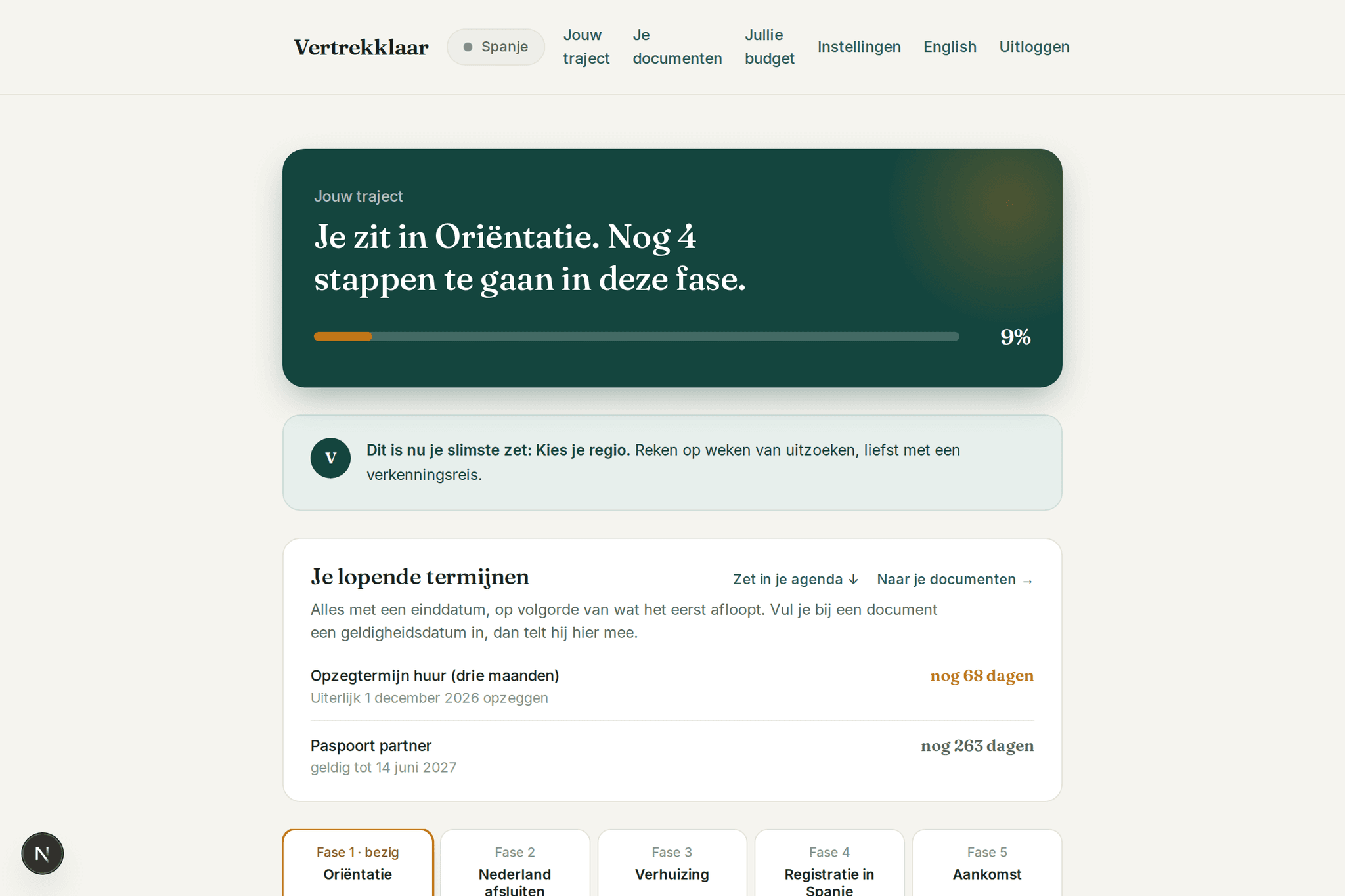
Every step sits in its place in the order, with the lead time, the counter and the official source. You tick off, your partner ticks along, and the plan counts back from your departure date: what has to start when, and what is running now.

Below is phase 1, exactly as it appears in the plan.

The dashboard of the step-by-step plan for Australia: the current phase, the open steps, the next step and the deadline bar.

The route

  1. Orientation

    6 steps

    Open · You are here

  2. Documents

    7 steps

    In your plan

  3. Language test

    5 steps

    In your plan

  4. Lodging

    6 steps

    In your plan

  5. Move & arrival

    15 steps

    In your plan

Phase 1 is the question "can we, and do we want to?". From phase 2 the arranging begins.

Phase 1 · Orientation

6 of 6 steps open

Only after this phase do you start spending money. Not before — whoever pays first and researches afterwards pays twice.

By the end of phase 1 you know which visa route realistically fits your profile, whether your occupation is on the list, roughly how many points you score, roughly what the journey will cost, and whether you as a family stand behind the decision.

Step 1.1

Understand the three visa routes

Lead time:
reading step
Costs:
none

Australia has three main routes for skilled migrants, and which one fits you decides your whole journey. The 189 (Skilled Independent) is permanent and without obligations: you may live and work anywhere. The 190 (State Nominated) is also permanent, but a state nominates you and expects you to live there for the first two years — you get 5 extra points for it. The 491 (Regional) is a provisional visa for five years with 15 extra points, where you live in a regional area for three years and can then apply for permanent residence. Rule of thumb: the more points you bring yourself, the more independent the route you can choose.

One thing official sites don't make clear: the official minimum is 65 points, but the invitation threshold is higher and differs per occupation: in the June 2026 round from 65 points for sought-after trades to 100 for the most crowded occupations. That difference between "may take part" and "gets invited" is where most people lose time and money.

Checked against the official source

The official sources for this step

Step 1.2

Check whether your occupation is on the list

Lead time:
1-2 hours of searching
Costs:
none

Without an occupation on the skilled occupation list there's no route — so this is your very first check, before you do anything else. Look up your occupation via the ANZSCO classification. Note: it's not about your job title but about the task description; a Dutch job name doesn't always translate one-to-one. For the 189 your occupation has to be on the MLTSSL; for the 190 and 491 broader lists apply. If your occupation is only on the broader lists, you know right away you have to think towards state nomination or regional.

Is your occupation on the list?

Checked against the official source

The official sources for this step

Step 1.3

Calculate your indicative points

Lead time:
about an hour
Costs:
none

The points system counts among other things age (maximum under 33), English level, work experience and education. Be strict with yourself — points you hope to get don't count. If you come out well above 85, the independent 189 route is realistic. If you're between 65 and 80, look seriously at the 190 (+5) or the 491 (+15). Below 65 the journey isn't feasible in its current form — better that you know that now than after thousands of euros in assessments.

Two hard limits to know: you have to be under 45 at the moment of invitation, and the partner situation counts. A partner with their own skills assessment and Competent English yields 10 points, Competent English alone 5, and as a single applicant you get 10. If your partner is also on the occupation list, work out both scenarios: who becomes the main applicant can make the difference.

This is an indication, not a guarantee. Your points are only officially determined at your application.

Calculate your indicative points

Age at the time of invitation
English

No test yet? Choose what you expect to achieve.

Work experience in your occupation, outside Australia, in the last ten years
Highest qualification
Your situation

Checked against the official source

The official sources for this step

Step 1.4

Get a picture of what it's going to cost

Lead time:
1-2 hours with the calculator
Costs:
none

Before you go further, you want to know what you're getting into. The calculator above works on your own moving choices — not on an average family — and shows three cost blocks: the application phase (assessments, tests, translations, visa fees — quickly a few thousand euros for a family), the move (depending on your choices: from almost nothing to well over ten thousand euros), and the landing period (deposit, temporary rent, bridging until income — often underestimated).

A rule of thumb that makes the journey less stressful: only start spending once you can carry the whole application block without borrowing.

Step 1.5

The family conversation

Lead time:
weeks, not hours
Costs:
none

This is the step without forms, and yet this is where most journeys fail. Emigrating isn't something you do alone — even if the papers are in one name. Discuss with your partner and, depending on their age, your children: why do we want this, what are we giving up, and what is for each of us the condition for saying yes?

A practical point that's often forgotten: the partner who isn't the main applicant needs a working life there too — check already whether that occupation has prospects there. Take your time for this; all the following steps are easier with a family that really stands behind the choice.

Step 1.6

Choose your target date

Lead time:
decision moment
Costs:
none

Close the orientation phase with a target date for departure. Not as a deadline — as a compass. The tool counts back from now: which step has to start when to keep that date feasible, and where there's slack. A realistic picture: from start to visa, this journey takes most people 12 to 24 months, depending on assessment lead times and invitation rounds.

You fill it in below in this card, and filling it in is completing the step. You can always adjust your target date — the planning adjusts with it.

Phase 1 read

You know what you're getting into. Now the arranging begins.

You've read phase 1 of the step-by-step plan for Australia. The full plan has another 33 steps ready for you: Documents, Language test, Lodging and Move & arrival.

The plan counts everything back from your departure date, watches your deadlines and documents, and shows only the steps that apply to you.

The step-by-step plan for Australia

€ 499

one-off · no subscription · instant access

Also included: deadlines watched · documents with expiry dates · only your steps · your partner ticks along · all cancellation letters · questions to Auke.

✎ Auke reads along

Stuck somewhere? Ask your question at the step. Auke reads it himself and answers within two working days.

Not ready yet? Send yourself your date and phase 1 →

Phase 2 · Documents0 of 7 steps open

Documents have lead times and validity periods. The art isn't to apply for everything as early as possible, but for everything at the right moment.

  1. 2.1Determine your assessing authority and start the skills assessment8-16 weeks
  2. 2.2Collect your basic documents1-4 weeks
  3. 2.3Arrange translations (only what's needed)1-3 weeks per batch
  4. 2.4Police certificates: map out which ones you needtaking stock takes an evening
  5. 2.5Qualification assessment, if your authority asks for ita few weeks to months
  6. 2.6Medical examination: not yetappointment plus result, a few weeks
  7. 2.7Pet: register with Australian customsonly if this applies to you
Phase 3 · Language test0 of 5 steps open

The language test is the biggest points dial you can operate yourself. Between the minimum and a top score are 20 points — often the difference between years of waiting and an invitation.

  1. 3.1Understand what the test does for your pointsreading step
  2. 3.2Choose your test: IELTS or PTEdecision moment
  3. 3.3Book your test at the right momentbooking can be done right away, the wait until the test date grows
  4. 3.4Practise specifically4-8 weeks, a few hours a week
  5. 3.5Result in: cash in or improvePTE usually within 2 days, IELTS a few days to a good two weeks
Phase 4 · Lodging0 of 6 steps open

From the invitation a clock ticks: 60 days to lodge your application. Everything from phases 2 and 3 is prepared so that those 60 days are a formality and not a panic.

  1. 4.1Lodge your Expression of Interest via SkillSelectlodging 1-2 hours; waiting for an invitation is unpredictable
  2. 4.2Apply for state nomination (route 190 or 491 only)varies strongly per state and round
  3. 4.3Invitation in: the 60-day clock60 days, hard deadline
  4. 4.4Police certificates and medical examination: do them nowDutch certificate days to weeks, foreign ones 4-12 weeks, examination a few weeks
  5. 4.5Lodge the application via ImmiAccounthalf a day with good preparation
  6. 4.6The waiting periodindication 5-11 months
Phase 5 · Move & arrival0 of 15 steps open

The visa is done, but there's still one hard deadline in it: your first-arrival date. After that the journey shifts from paperwork to practical.

  1. 5.1Know your first-arrival datedeadline from your visa decision
  2. 5.2Request moving quotes and plan the shipmentonly if this applies to you
  3. 5.3Book your pet's transportonly if this applies to you
  4. 5.4Arrange the import of your caronly if this applies to you
  5. 5.5Close the Netherlands neatlyderegistering is possible from 5 days before departure; the whole takes 4-8 weeks
  6. 5.6The first week in order1-2 weeks; a TFN can take up to 28 days
  7. 5.7Housing, school and transportonly if this applies to you
  8. 5.8Landedit's done
  9. 5.9Partner comes along without a job of their ownonly if this applies to you
  10. 5.10Living partly in the Netherlands: the eight-month ruleonly if this applies to you
  11. 5.11The house in the Netherlands: sell, rent out or keeponly if this applies to you
  12. 5.12Children staying in the Netherlands: DUO, healthcare and the houseonly if this applies to you
  13. 5.13Cancel what stops: job, rent, energy, subscriptions and schoolstart three months before departure; most notice periods are one month
  14. 5.14Stay reachable: DigiD, your phone number, your bank and your postarrange it before you leave; afterwards it takes weeks
  15. 5.15Student debt, remote work or your own business: what moves with youreport it before you leave; the consequences run for years

9 of these 33 steps only appear when your answers call for them: a pet, a car, a partner without a job, children staying in the Netherlands. That is the difference between a step-by-step plan and a checklist.

Three questions

Can't I find all this for free?

Yes. Everything in the plan comes from official sources, and they're listed at every step. Phase 1 above is the proof. What you buy is the work around it: which of the 33 following steps apply to you, in which order, with which deadline, and a nudge when something needs doing.

Does this apply to my situation too?

The plan first asks who is coming along, what is coming along and how you're leaving the Netherlands. Steps that don't apply to you don't appear; steps that only apply to you do. Is your situation slightly different from what's written? Ask your question at the step; you'll get an answer within two working days.

What if the rules change after I buy?

Then your plan changes with them. Twice a month we check every source; whatever changes is in your plan the same week, with the date. Your access lasts for your whole departure.

Ready to begin?

The step-by-step plan for Australia: 39 steps, your documents and your costs in one place, with the timing watched. Pay once, and it's yours.