Leaving from Belgium?To the Belgian plan →See the plan for Belgians moving to United States →This plan is for people leaving the Netherlands.

United States · Visa required
Emigrating to the United States
You can only move to the US through a specific route: an employer, your own business, talent, family or the lottery. There's no form to sign up with. This page shows honestly which routes there are, which door stands open specially for Dutch citizens, and what the journey really costs.
€ 399 one-off · 40 steps · no subscription
- Kind of journey
- Visa route: there is no general emigration path
- The Dutch door
- E-2: invest and direct yourself, thanks to the treaty of 1957
- Healthcare
- No arrangement via a treaty: you insure yourself
Last updated: 14 October 2026
Will your departure date work? Check it in the free step-by-step plan →
Five phases, from finding the key to being landed
The order is stricter here than elsewhere. Without a visa there's no move, and without the right route there's no visa. That's why the route choice comes first, and we only spend money after that.
- Orientation
First the key: the route that suits you
In this phase you find out which of the five routes fits your situation. The United States has no points system and no free movement. You also discover the door that stands open specially for Dutch citizens: the E-2 visa, for those who invest in their own business. It exists thanks to a friendship treaty in force since 1957. You clear up the most stubborn misunderstanding: ESTA isn't an emigration route but a ninety-day tourist scheme. And you calculate healthcare, because here it's a real cost item.Read more
- Your visa
The route decides who files, what it costs and how long it takes
In this phase you arrange your visa. On the employer routes your employer files the application. On the E-2 you do everything yourself, directly at the consulate in Amsterdam. You build a file that convinces a consular officer in half an hour. It shows an investment that's at risk, a business that can yield more than a minimal income, and demonstrable control. Count on twelve weeks or more before the interview, and on an issuance fee (a surcharge per nationality) that runs into the thousands.Read more
- Closing the Netherlands
No treaty route for your healthcare, so build your own bridge
In this phase you close the Netherlands and arrange your own healthcare before departure. Your accrued AOW, the Dutch state pension, travels along thanks to the social security treaty, and your pension is neatly divided. The AOW does stay taxed exclusively in the Netherlands. For healthcare there's no route via the CAK (the Dutch agency for healthcare abroad), because the US isn't on the treaty-country list. What you cancel in the Netherlands, you buy back yourself in America. On top of that: the tax settlement, your deregistration and your documents with apostille (an international stamp of authenticity) and English translation.Read more
- The move
The container comes along, the car doesn't
In this phase you ship your belongings and decide about the car and pets. Your household goods enter the US duty-free if you had them in use for a year, with one customs form your mover files. The car is the honest bad news. Anything younger than 25 years has to meet American safety standards, and customs itself warns about sellers claiming that's no big deal. So sell it here, and put an American car in as a fixed item. For the dog there are import rules of its own, with months of lead time.Read more
- Arrival in the United States
Administratively you start from zero
In this phase you build your life in America from zero: no number, no insurance, no credit history. The order decides how fast you can simply live. First your Social Security Number, the American counterpart of the Dutch BSN. Then your health insurance, within the sixty days your move gives you. Then an account and a credit card to build that credit history; without it every landlord and every utility asks for a deposit. Then the driving licence (a new test; the deadline runs from your settlement) and the school of your district.Read more
This is what one step of your plan looks like
This is the real thing: one of the steps of the United States journey, exactly as it appears in your personal step-by-step plan, with the deadlines, the offices and the sources.
Step 1.2 of your plan
Know the Dutch door: the friendship treaty
- Lead time
- reading step
- Costs
- none
As a Dutch citizen you have a door most nationalities don't have: the E-2 visa. That's the visa for whoever invests a substantial amount in a real American business and will run that business themselves. You need no employer for it, no lottery and no queue.
That door exists thanks to a treaty of friendship and commerce with the United States, in force since 5 December 1957. Because of it, the Netherlands is on the list of treaty countries for the E-2 visa.
Two things to get right straight away:
- There is no fixed minimum amount. The consulate in Amsterdam says literally that there's no amount that counts as "substantial". It's about the proportion to what the business costs: the cheaper the enterprise, the higher the share you have to put in yourself.
- The business may not be marginal. It has to be able to yield more than just a minimal income for you and your family.
Know too that this visa is emphatically temporary. You may renew it without limit as long as the business runs. But you have to demonstrably keep the intention to leave when your status ends. The consulate even asks for a signed declaration about that. If you expect a green card, a permanent visa, via this route, you're looking at the wrong track.
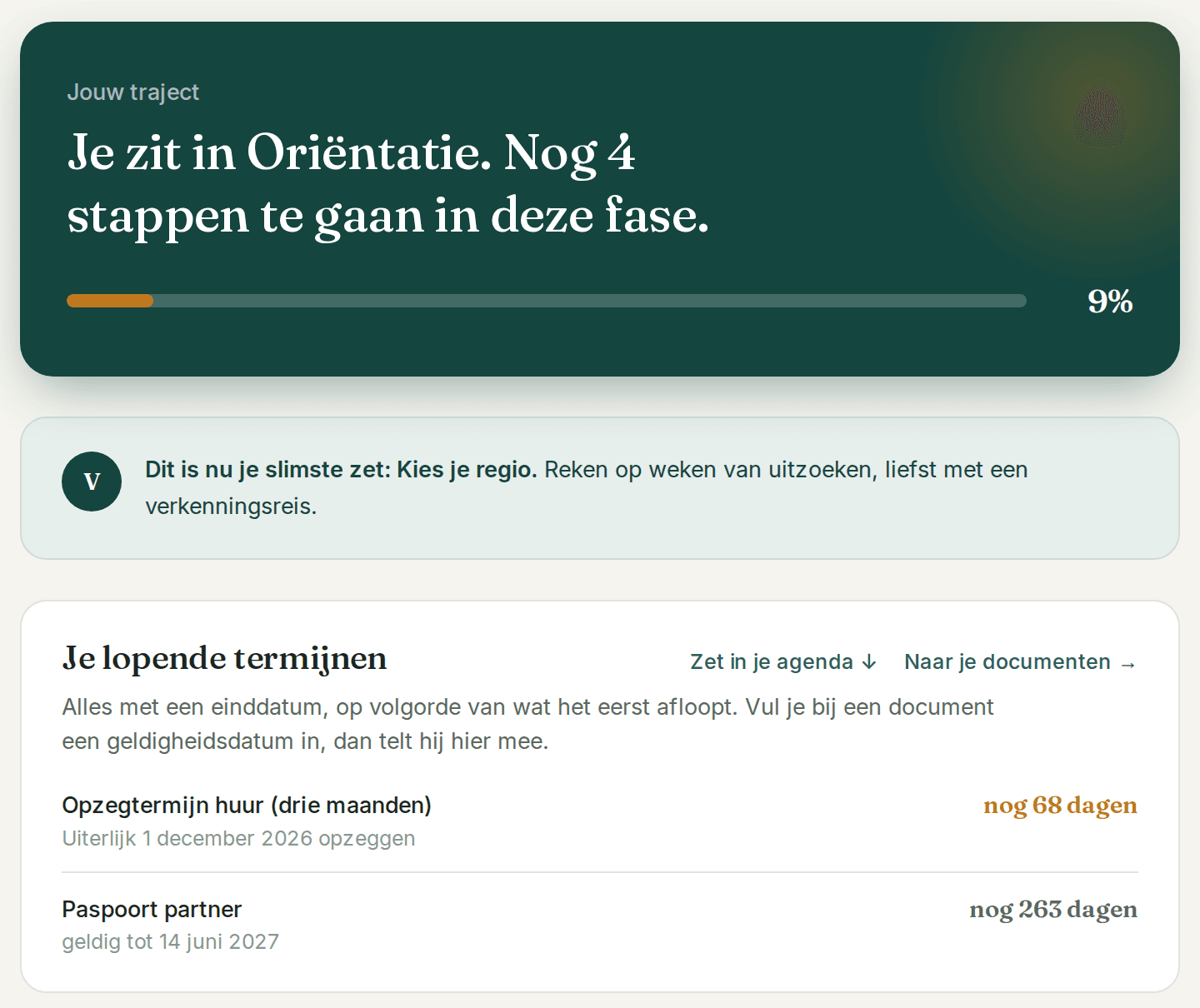
And this is the dashboard that step lives in. The example shows the plan for Spain; your dashboard shows the plan for United States.
This is step 1.2 of 42. The other 41 are ready for you, each with the same sources, the same offices and a schedule that keeps track of your dates.
See all 42 steps for United StatesWhat you get for € 399
All 42 steps to United States, for your situation
In order, with the office and the official source at every step. Steps that don't apply to you don't appear.
Your deadlines in one place
For each step you see the latest date to start, and you get a heads-up before something is due or expires. Your documents sit in the vault, with their dates.
A plan that stays right
Twice a month we check the sources. If something changes, it's in your plan and you get a message.
The step-by-step plan for United States
€ 399
one-off · 42 steps
- Pay once, no subscription
- Destination changes? Within 30 days I switch your plan to another country free of charge
- Stuck on a step? You get a personal answer within two working days
What will your move to United States cost? Work it out →
Know someone moving to United States? Give this plan as a gift →
Every step on one list, free
Not ready to start yet? Then you get the departure checklist for United States: every step in order, to print and tick off. With it, five mails in a week and a half about the pitfalls and the real costs. If the rules for United States change, you'll hear about it. After that we ask once where your plans stand, send one offer, and now and then one thing that fits your moment. No newsletter, and you can switch it off at any time.
That was the move. And once you live there?
Which country may tax your pension once you live in United States? Is there a favourable regime, a scheme that lowers your tax? And how do you get insured? That depends on where your income comes from. Tick it and you'll see which rules apply to you, with the source.
See the financial conditionsClosing down the Netherlands: all your letters in one go
Moving to United States starts with leaving the Netherlands properly. That's why the plan includes the letter tool: you enter your details once and every cancellation and notification letter is ready.
Just the letters, without the plan? That works too, for € 49
- Health insurance, rent, energy, subscriptions, GP, school, bank and pension fund: 16 kinds of letters. You enter your details only once.
- A sending list that counts back from your departure date and your notice period, even when that's three months.
- Also what you need to ask for as an emigrant: your no-claims years in English, your medical file and the school report (the report on your child for the new school).


Auke, maker of Vertrekklaar
On 2 January we're leaving ourselves, on a trip around the world with our family. What I put here, I'm arranging for my own family too.
On 20 September 2026 a customer wrote that the CAK rule for early retirement was missing from his plan. He was right. That evening the step was in thirteen plans, with the source attached.
The knowledge base on the United States
Per phase, the articles that are already there. They're written from the same journey and go deeper than what fits above.
- The five keys to America: which routes really exist?There is no general emigration route to the United States. You need a specific key: an employer, a business of your own, extraordinary talent, family, or luck in the lottery. This is what each route demands — and why ESTA is none of them.
- The E-2 visa: the American door the 1957 treaty opens for Dutch citizensThanks to a treaty from 1957, Dutch citizens can obtain an E-2 visa: invest in a real American business and run it yourself. No employer, no lottery, no minimum amount — but a file that has to be right, an issuance fee of over two thousand dollars, and one hard limit: this is not a route to a green card.
- Your first weeks in America: SSN, health insurance and a credit history from zeroIn America you start administratively at zero — no credit history, no health insurance, no number. The order determines how quickly you can live normally: the Social Security Number first, the insurance within sixty days, and the credit card you need to ever rent a home.
- Working in America: your right to work hangs on your status, not on a permitIn America there is no separate work permit you apply for: your right to work follows from your visa status. Whoever comes on an E-2 may only work in their own business; the partner of an E-2 or L-1 holder may work anywhere. Whoever needs an Employment Authorization Document applies for it with Form I-765. After that comes a labour market without statutory holidays and with twelve weeks of unpaid family leave.
- Liable for American tax: two reporting duties, and the child born thereAs soon as you live in the US, America taxes your worldwide income — including your Dutch savings and your BV. On top of that stand two reporting duties that exist side by side, not instead of each other. And whoever has a child there gives that child an American passport and a filing obligation that lasts a lifetime.
- AOW, healthcare and tax in America: what comes along, what stops — and what works like this nowhere elseThanks to the treaty, the accrued AOW (the Dutch state pension) travels fully to the US — but as the only destination it remains taxed exclusively in the Netherlands. The notorious American WEP reduction has been abolished since 2024. And the healthcare story is hard: no treaty route, no safety net — you insure yourself.
All 14 articles about United States
- Your partner stays in the Netherlands: is the money you send taxed?
- Coming along on an L-2: what you let go of in the Netherlands — and what you get back for it
- Your car and your household contents to America: what is allowed, and why the car had better stay behind
- Taking your pet to America: one free form for the dog, nothing federal for the cat
- Buying a house in America: no notary, but an escrow — and three days to read everything
- Renting in America: the empty file, the deposit per state and the report you may see
- Driving licence in America: the test again, a deadline per state, and the Dutch renewal that is possible
- School in America: free from five, compulsory from six, and your state's vaccination list
Also applies to your move
Ready to begin?
The step-by-step plan for United States: 42 steps, with your documents and your costs in one place. For each step you see the latest date to start. You pay once and it's yours.