Leaving from Belgium?To the Belgian plan →See the plan for Belgians moving to Dubai →This plan is for people leaving the Netherlands.
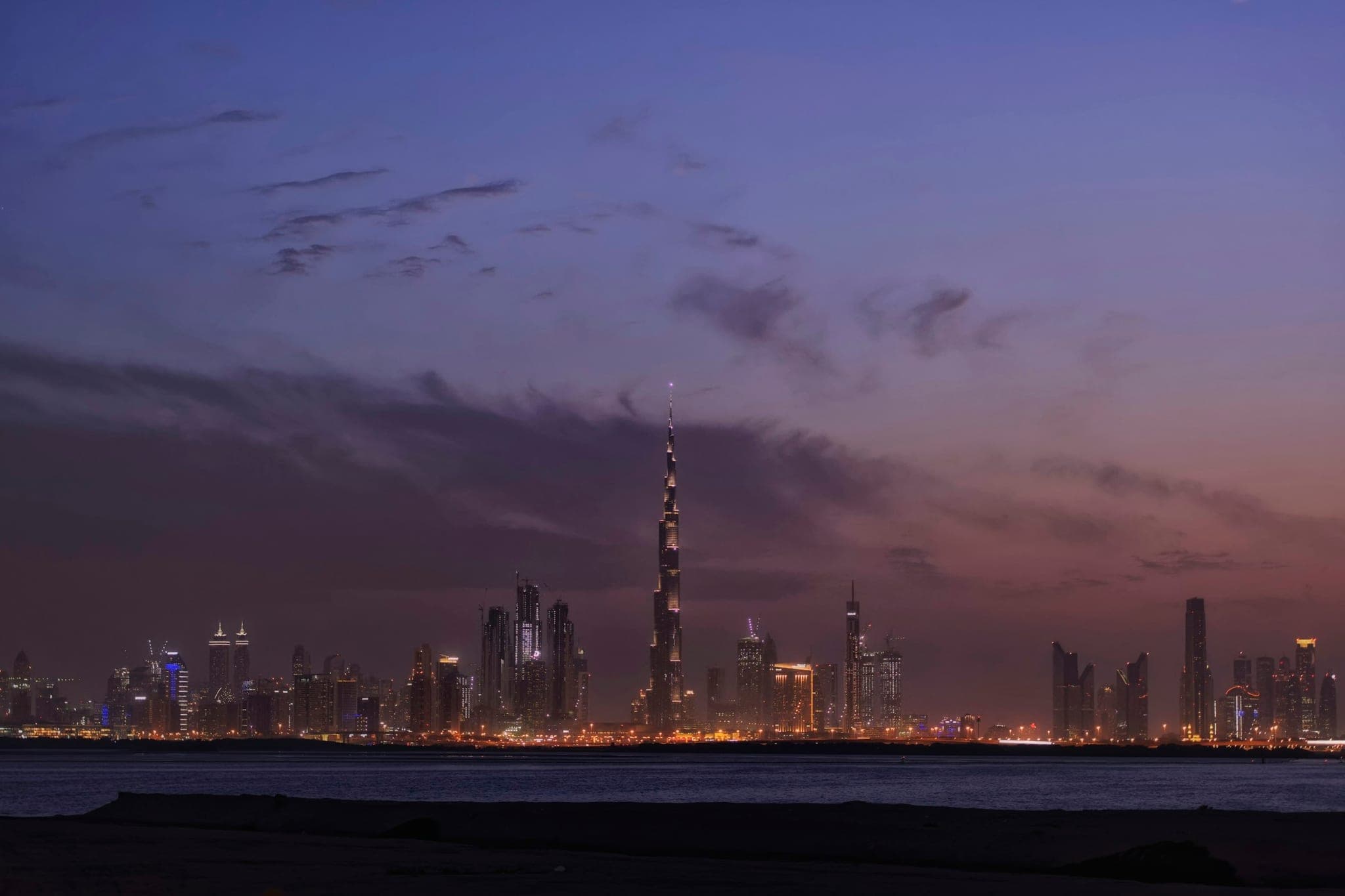
Dubai · Visa required
Emigrating to Dubai
For Dubai you need a sponsor for your visa: an employer, an investment or your own income. Points don't count here. The application is fast: days, not months. This page shows the routes and the trade that comes with them: a high net income, against zero accrual and a right of residence that hangs on your sponsor.
€ 399 one-off · 36 steps · no subscription
- Kind of journey
- Sponsored visa: via employer, investment or income
- Lead time
- About 5 months. The application itself takes days
- Note
- Zero tax, but also zero accrual: no pension, no safety net
Last updated: 14 October 2026
Will your departure date work? Check it in the free step-by-step plan →
Five phases, from the route choice to the first cheque
In Dubai it isn't the application that takes the most time, but the preparation. Your documents go through the legalisation chain: a series of stamps confirming that your Dutch certificates are genuine. You choose the school before the neighbourhood. And your pension plan is in place before the first payslip. The sixty-day clock only starts at landing.
- Orientation
Choose your route and weigh the trade honestly
In this phase you choose your visa route and weigh up the trade. There are five routes, without points. The standard is the employer route: your employer sponsors your visa. The Golden Visa (ten years) you get with AED 2 million in property or a salary from 30,000 a month. The Green Visa you get on your own income. The remote-work visa, for people who work remotely, is possible from USD 3,500 a month. The retirement visa is for the over-55s. The trade looks like this. You pay zero income tax and keep a high net income. Against that stand zero accrual, a right of residence that hangs on your sponsor, and a country that formally never becomes yours.Read more
- Your visa
The application is fast, the stamps aren't
In this phase you apply for your visa and get your papers in order. Dubai decides on an entry permit within 48 hours: the permission to travel into the country. The fees are hundreds of dirhams: the mirror image of Australia. The time is in what has to happen around it. The UAE isn't an apostille country: the simple stamp with which many countries accept a Dutch certificate doesn't work here. So every certificate goes through the full legalisation chain, via the Consular Service Centre and the embassy. The family visa asks for legalised marriage and birth certificates. Health insurance for the family is your duty as sponsor. And with children you choose the school before the neighbourhood, because all education is private.Read more
- Closing the Netherlands
Here Dubai shows its price: the world upside down
In this phase you close things off in the Netherlands, and here Dubai shows its price. It's the mirror image of every EU route. If you're single, you get the married rate of the AOW, the amount for someone with a partner: 50 instead of 70 percent of the net minimum wage. That applies for as long as you live there, and voluntary insurance does not solve it. There's no CAK route, the arrangement through which you stay insured via the Netherlands in a treaty country. Private insurance is the only way. The protective assessment (a tax assessment the Netherlands sets on departure but doesn't collect right away) has no automatic deferral. Sometimes you have to provide security. All benefits and the child benefit stop. And because nothing is accrued there, the most important step without a form belongs here: your own pension plan, laid down before departure.Read more
- The move
Your household goods may come, but the border is strict on other things
In this phase you arrange what comes along and what doesn't. Used household goods pass tax-free on first settlement. Your inventory list and residence permit are the keys to that. More important is what's not allowed. Alcohol never goes in the container. Medicines travel only on your person, with papers. Ordinary Dutch prescriptions, like ADHD medication and sleeping pills, are controlled substances here. A permit procedure applies to them. For dogs there's a banned list, and it includes the Rottweiler and the Dobermann. The car you sell at home. Outside the EEA you get no BPM refund (the car tax you get back on export). But locally you'll find a GCC market, the car market of the Gulf states, full of cheap alternatives. The landing itself starts the sixty-day clock.Read more
- Arrival in Dubai
Sixty days, one order, and then the discipline
In this phase you arrange your residence on the spot, and then your life in Dubai. First the medical examination, then the Emirates ID (your UAE identity card) and the visa in your passport. After that everything opens at once. The bank: your salary runs compulsorily via the Wage Protection System, the system through which the government tracks wage payments. The family, which you now sponsor. And the home, which you pay a year ahead, in cheques. Ejari is the compulsory registration of your tenancy contract. The RERA index, the official rent index, protects you when the rent goes up. The driving licence exchanges without a test. The most important habit starts with the first payslip: be your own pension every month. The gratuity, your employer's end-of-service payment, is a farewell gift, not an old age.Read more
This is what one step of your plan looks like
This is the real thing: one of the steps of the Dubai journey, exactly as it appears in your personal step-by-step plan, with the deadlines, the offices and the sources.
Step 1.2 of your plan
Choose your route: employer, gold, green or income
- Lead time
- an evening of comparing
- Costs
- none
In this step you choose the visa route that fits you. There are five routes. Points or a lottery play no part.
- The employer route is the standard. You find an employer who sponsors you, and they arrange your visa: two years, renewable.
- The Golden Visa (10 years) you buy with AED 2 million in property. Or you earn it with a specialist salary from AED 30,000 a month.
- The Green Visa (5 years, without a sponsor) asks as a freelancer AED 360,000 annual income over the last two years. As a skilled worker you need AED 15,000 a month.
- The remote-work visa (1 year) is possible from USD 3,500 a month. It's for whoever brings their Dutch job along and works remotely.
- The retirement visa (55+, 5 years) is the visa for retirees. In Dubai it asks AED 240,000 annual income, or AED 1 million in savings plus AED 1 million in property.
Choose on the basis of what you have, not what you hope. The thresholds are hard.
What this step rests on
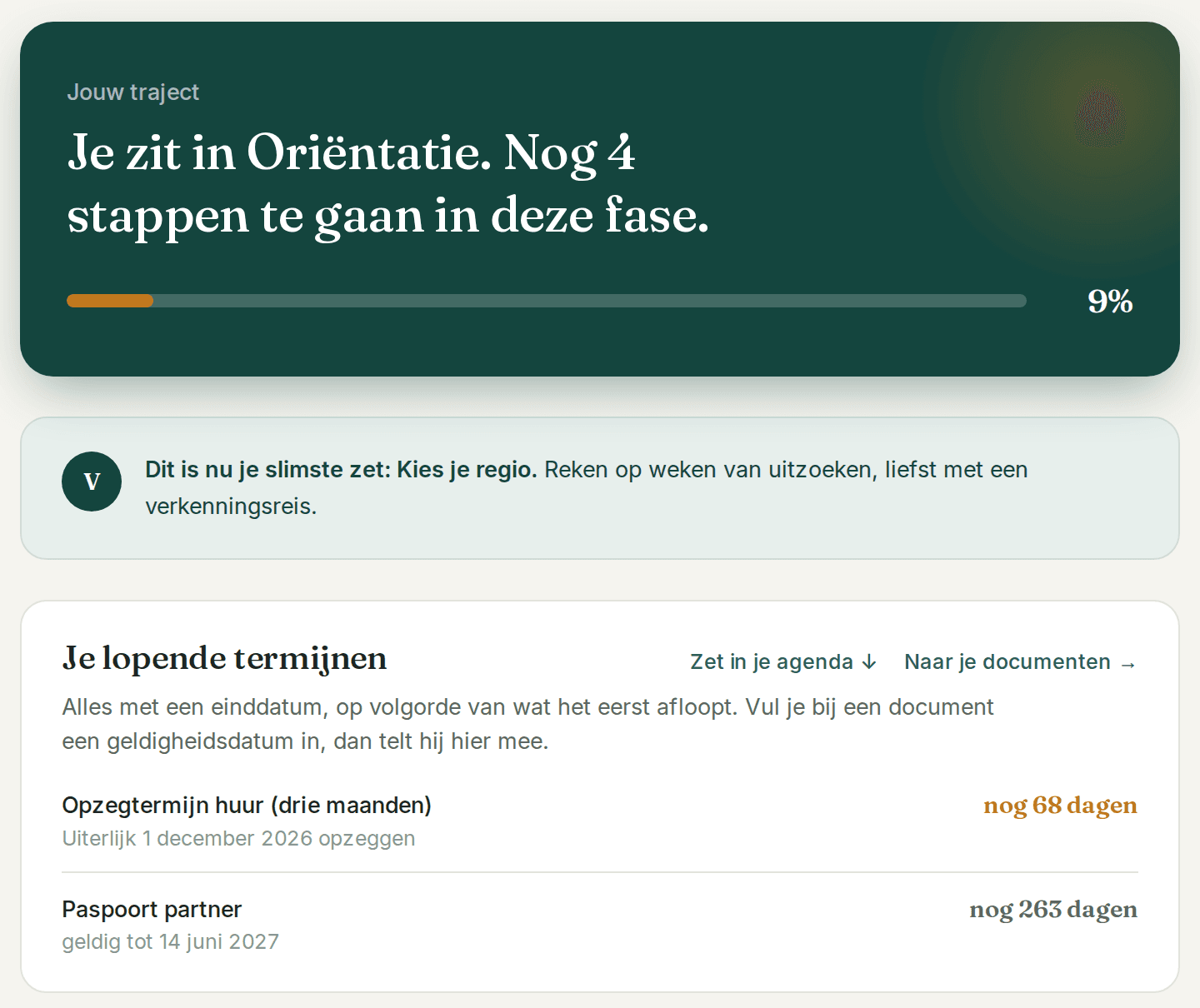
And this is the dashboard that step lives in. The example shows the plan for Spain; your dashboard shows the plan for Dubai.
This is step 1.2 of 38. The other 37 are ready for you, each with the same sources, the same offices and a schedule that keeps track of your dates.
See all 38 steps for DubaiWhat you get for € 399
All 38 steps to Dubai, for your situation
In order, with the office and the official source at every step. Steps that don't apply to you don't appear.
Your deadlines in one place
For each step you see the latest date to start, and you get a heads-up before something is due or expires. Your documents sit in the vault, with their dates.
A plan that stays right
Twice a month we check the sources. If something changes, it's in your plan and you get a message.
The step-by-step plan for Dubai
€ 399
one-off · 38 steps
- Pay once, no subscription
- Destination changes? Within 30 days I switch your plan to another country free of charge
- Stuck on a step? You get a personal answer within two working days
What will your move to Dubai cost? Work it out →
Know someone moving to Dubai? Give this plan as a gift →
Every step on one list, free
Not ready to start yet? Then you get the departure checklist for Dubai: every step in order, to print and tick off. With it, five mails in a week and a half about the pitfalls and the real costs. If the rules for Dubai change, you'll hear about it. After that we ask once where your plans stand, send one offer, and now and then one thing that fits your moment. No newsletter, and you can switch it off at any time.
That was the move. And once you live there?
Which country may tax your pension once you live in Dubai? Is there a favourable regime, a scheme that lowers your tax? And how do you get insured? That depends on where your income comes from. Tick it and you'll see which rules apply to you, with the source.
See the financial conditionsClosing down the Netherlands: all your letters in one go
Moving to Dubai starts with leaving the Netherlands properly. That's why the plan includes the letter tool: you enter your details once and every cancellation and notification letter is ready.
Just the letters, without the plan? That works too, for € 49
- Health insurance, rent, energy, subscriptions, GP, school, bank and pension fund: 16 kinds of letters. You enter your details only once.
- A sending list that counts back from your departure date and your notice period, even when that's three months.
- Also what you need to ask for as an emigrant: your no-claims years in English, your medical file and the school report (the report on your child for the new school).


Auke, maker of Vertrekklaar
On 2 January we're leaving ourselves, on a trip around the world with our family. What I put here, I'm arranging for my own family too.
On 20 September 2026 a customer wrote that the CAK rule for early retirement was missing from his plan. He was right. That evening the step was in thirteen plans, with the source attached.
The knowledge base on Dubai
Per phase, the articles that are already there. They're written from the same journey and go deeper than what fits above.
- The visa routes to Dubai: employer, gold, green or incomeNo points and no lottery: the UAE right of residence hangs on what you bring. The employer route is the standard, the Golden Visa (10 years) asks for AED 2 million in property or a salary from 30,000 a month, the Green Visa runs on your own income, and there's a route for remote workers and the over-55s. Plus what does not exist: a residence permit without an end date.
- Documents for Dubai: the legalisation chain explainedThe UAE is not an apostille country, so the single stamp that suffices within Europe doesn't exist here. Every certificate goes through a chain: any pre-legalisation, the Consulair Dienstencentrum in The Hague (€ 10 per document), and the UAE embassy, which since digital attestation also covers the ministry in the Emirates in a single application. Which documents you need, in which order the stamps go, and why you do this before departure.
- Schools in Dubai: everything is private, and this is how you chooseFor expat children there is no public education in Dubai: everything runs through private schools under the supervision of the KHDA, with seventeen curricula side by side. The good news: the fees are regulated, for 2026-27 even frozen, and the "registration fee" is legally an advance that is offset against the fees. This is how you choose a school — and how you prevent your neighbourhood from choosing the school instead of the other way round.
- Working in Dubai: the work permit, the contract and the rules to know before you signIn Dubai you only work with a work permit from the labour ministry MOHRE, and your employer applies for it and pays for it. Your contract is always fixed-term, at most three years, with a probation period of at most six months. Whoever walks away during that probation can be refused a new permit for a year. Plus the freelance route, and what happens to your degree.
- Healthcare in Dubai: your employer insures you, the family is your billIn Dubai health insurance is compulsory for every resident. Your employer must insure you and may not recover the premium from your pay; for your partner and children you, as sponsor, are responsible. There is no CAK route, because the Emirates are not a treaty country. What the basic policy covers, what it makes you pay, and where the gap falls.
- Your pet to Dubai: no titre test from the Netherlands, but a breed list that goes further than you thinkThe Emirates regard the Netherlands as a country with a low rabies risk, so a titre test is not needed for a dog or cat from the Netherlands. You do need an import permit of AED 200 that is valid for ninety days, a series of vaccinations, and an NVWA vet within 24 hours before departure. And the breed list: besides fighting dogs it also includes the Rottweiler, the Dobermann and the Boxer.
All 14 articles about Dubai
- Your household goods to Dubai: free of import duty, but only once your residence permit is there
- Banking and payments in Dubai: an account within two working days, and the cheque that is still a contract
- The Emirates ID: your number for everything in Dubai, and the clock attached to it
- No pension in Dubai: the gratuity, the AOW trap and what you have to do yourself
- Buying a house in Dubai: freehold in the designated zones, 4% at the DLD — and after that no tax, but a fee
- Renting in Dubai: cheques, Ejari and the RERA index
- Your first weeks in Dubai: sixty days, one order, and then the family
- Driving licence and car in Dubai: exchange without a test, and why the car is better left at home
Also applies to your move
Ready to begin?
The step-by-step plan for Dubai: 38 steps, with your documents and your costs in one place. For each step you see the latest date to start. You pay once and it's yours.