
South Korea · Visa required
Emigrating to South Korea
With a Dutch passport you may spend ninety days in South Korea without a visa, but you may not work then, and you can't stay either. Whoever wants to live there needs a visa, and it depends on a reason: a job, a Korean spouse, Korean descent, remote work as a digital nomad, or a working holiday if you're between 18 and 30. Korea has no retirement visa. If you're a Korean adoptee, there's the F-4 visa, without a language test. Your AOW goes along in full, even if you go alone. There's no healthcare treaty, so no CAK: whoever works in Korea or married a Korean is insured with the Korean national health insurance straight away, and everyone else after six months.
€ 399 one-off · 43 steps · no subscription
- Kind of journey
- A visa from the embassy, with a reason: work (E-7), a Korean spouse (F-6), Korean descent (F-4), digital nomad (F-1-D) or working holiday (H-1)
- The clock
- Within ninety days of arrival the residence card at the immigration office, a new address within fifteen days, and the Korean health insurance, for most routes after six months
- Note
- No retirement visa; an AOW treaty, so the full AOW; a tax treaty that gives your occupational pension to Korea; no healthcare treaty, so no CAK
Last updated: 26 October 2026
Will your departure date work? Check it in the free step-by-step plan →
Five phases, from the first ninety days to your residence card
This journey turns on one question: on what ground may you stay? Without a visa you're a tourist, ninety days at a time. To live there you choose a route, and every route has its own proof: a contract with a Korean employer, a marriage that's valid in Korea, papers that show your Korean descent, an income from outside Korea, or your age. After arrival you get your residence card within ninety days. On top of that there's what the brochure doesn't mention: your AOW goes along in full, and the tax treaty gives your occupational pension to Korea, which in the first years only taxes foreign income if you bring it into Korea.
- Orientation
Ninety days at a time, five routes, and a treaty for your AOW
In this phase you learn how living in South Korea works, and what it does to your income and your healthcare. With a Dutch passport you may stay ninety days, without working. Whoever wants to live there chooses a route: work, a Korean spouse, Korean descent, digital nomad or working holiday. A retirement visa doesn't exist, and we tell you that straight away. Because of the 2003 treaty a single person keeps the full AOW. There's no healthcare treaty, so no CAK. And the travel advice is green, except for the demilitarised zone along the border with North Korea.Read more
- Your visa
Choosing a route, papers with an apostille, and the application in The Hague
In this phase you arrange your visa. You apply before you leave, through the visa centre of the Korean embassy in The Hague. For work you need a Korean employer who shows your contract and your diplomas. For the F-6 you marry first, in a way Korea recognises, and show an income. Whoever was Korean at birth, adoptees included, can apply for the F-4 without a language test. A digital nomad shows an income from outside Korea and a health policy with high cover. Your papers get an apostille, and a translation if they aren't in English or Korean.Read more
- Closing the Netherlands
The full AOW, the occupational pension to Korea, and no CAK
In this phase you work through the familiar list for closing down in the Netherlands. Your AOW goes along in full, even if you go alone, but child benefit, the allowances and unemployment benefit stop. The Netherlands keeps taxing your AOW, and a pension from government service too. The tax treaty gives your occupational pension to Korea. You no longer get a tax credit. There's no CAK: arrange a policy that runs until the Korean health insurance starts. And whoever leaves before the AOW age can insure themselves voluntarily within one year.Read more
- The move
Household goods free if you stay a year, the car stays here
In this phase you move the household goods, the car and the pet. If you stay at least a year, you bring things you used for more than three months without import duties, as long as they arrive within six months of you. A car may come, but without an exemption: count on about a quarter of its value in tax, plus inspections. So sell it here. Your dog or cat needs a microchip and a rabies blood test; the EU pet passport may replace the certificate. Have the blood test done in the Netherlands: then it also counts for the way back.Read more
- Arrival in South Korea
The residence card, then housing, healthcare, bank and licence
In this phase you arrange your stay, your home, your healthcare and your driving licence after landing. Within ninety days you get your residence card at the immigration office, and you report a new address within fifteen days. Renting comes with a deposit, sometimes a very large one: with jeonse you pay no rent but lend the landlord a large part of the value. After six months at the latest you're compulsorily insured with the NHIS, the Korean national health insurance; whoever works in Korea or has an F-6, straight away. And you exchange your Dutch driving licence without an exam, but you do hand it in.Read more
This is what one step of your plan looks like
This is the real thing: one of the steps of the journey to South Korea, exactly as it appears in your personal step-by-step plan, with the deadlines, the offices and the sources.
Step 3.4 of your plan
Deregister and tell the SVB: your AOW goes along in full
- Lead time
- deregistering is possible from 5 days before departure; the whole takes 4-8 weeks
- Costs
- limited — cancellation costs per contract
In this step you deregister from your municipality and pass on your new address. If you're going to live outside the Netherlands for more than eight months a year, you must deregister. That's possible from five days before your departure up to the day itself.
The municipality passes your new address on to Dienst Toeslagen. But an allowance you're no longer entitled to, such as rent allowance, you stop yourself in Mijn toeslagen.
Also report your departure to the SVB. For the AOW, Korea is a favourable exception:
- The full AOW goes along. The General Old Age Pensions Act gives whoever lives outside the Netherlands the AOW for married people. But that doesn't apply in a country where you can be entitled under a treaty, and Korea is such a country. So a single person keeps the AOW for a single person.
- The Anw and the WIA go along too. The treaty also applies to survivors and to incapacity for work.
- An allowance doesn't. The Supplementary Benefits Act gives no supplement to whoever lives outside the Netherlands. The AIO supplement stops after 91 days a year outside the Netherlands.
- The WW doesn't. Whoever lives outside the Netherlands isn't entitled to WW, and the treaty doesn't include the WW.
That difference is big. In a country without such a treaty, a single person falls back from seventy to fifty percent of the minimum wage. In Korea they don't.
If you leave before your AOW age, your AOW build-up stops. The treaty arranges the payment, not the build-up. Whoever goes to live outside the Netherlands is usually no longer insured for the AOW and the Anw. For every year that you aren't insured, you later get 2 percent less AOW. You can close the gap with voluntary insurance with the SVB. For that you have one year from the moment you're no longer insured. In 2026 the AOW insurance costs 17.9 percent of your income, at least 569 and at most 5,693 euros a year. If you go together, this applies to each of you separately.
Are you being posted? If your Dutch employer sends you to Korea, under the treaty you can stay insured in the Netherlands for up to five years. Request the statement for that from the SVB in time.
What this step rests on
- NederlandWereldwijd — when must I deregister from a Dutch municipality
- NederlandWereldwijd — how do I deregister when I go abroad
- Wetten.overheid.nl — the social security treaty with Korea, articles 2 and 5
- SVB — the treaty countries for the AOW, including South Korea
- General Old Age Pensions Act, articles 8a and 9a — the rule for whoever lives outside the Netherlands, and the exception for treaty countries
- Supplementary Benefits Act, article 4a — no supplement for whoever lives outside the Netherlands
- SVB — the AIO supplement stops after 91 days outside the Netherlands
- Unemployment Insurance Act, article 19 — no WW for whoever lives outside the Netherlands
- SVB — you go to live outside the Netherlands: 2 percent less AOW per uninsured year, and one year to insure yourself voluntarily
- SVB — what voluntary insurance outside the Netherlands costs in 2026
- Dienst Toeslagen — I'm moving abroad, what do I report?
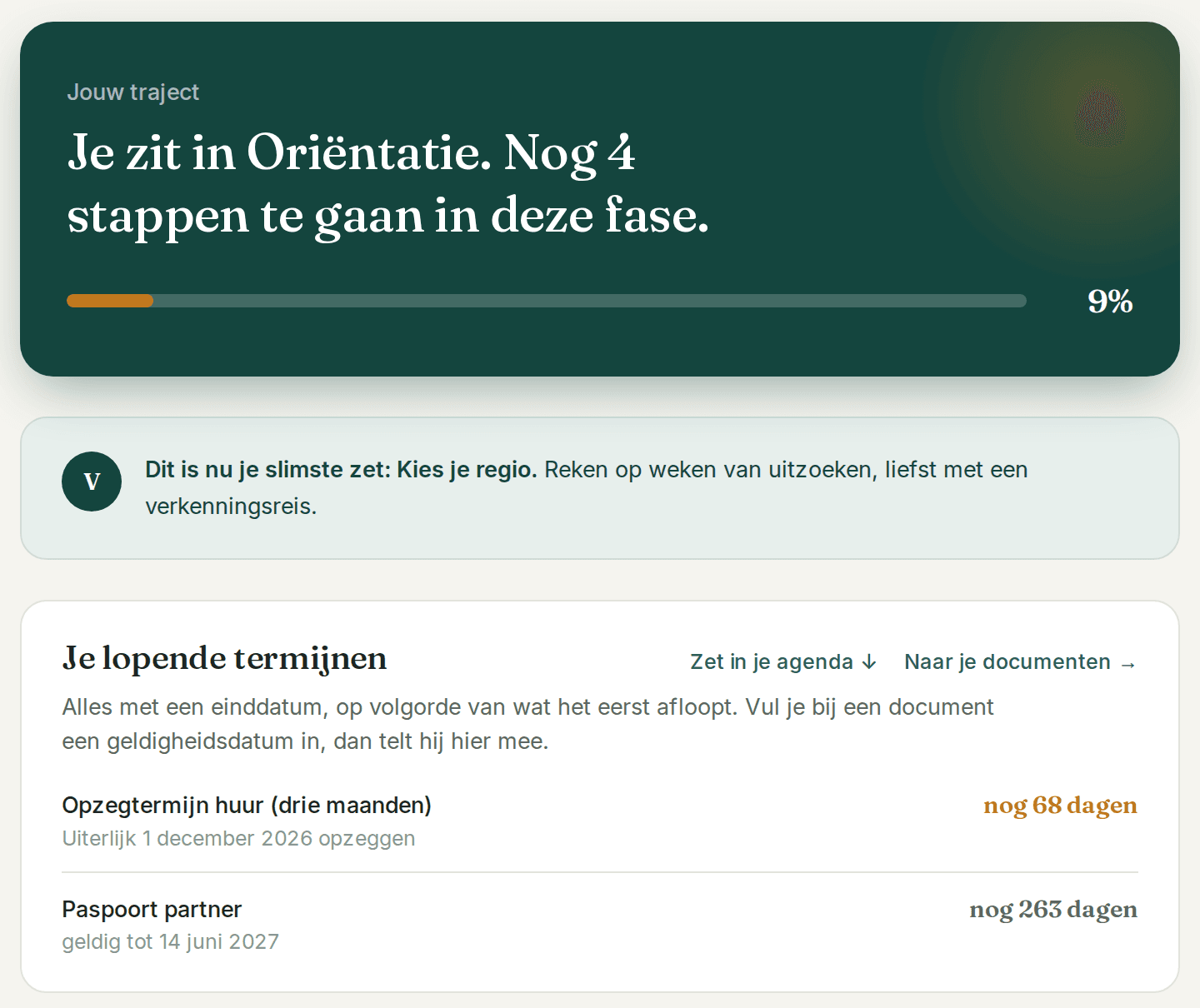
And this is the dashboard that step lives in. The example shows the plan for Spain; your dashboard shows the plan for South Korea.
This is step 3.4 of 43. The other 42 are ready for you, each with the same sources, the same offices and a schedule that keeps track of your dates.
See all 43 steps for South KoreaWhat you get for € 399
All 43 steps to South Korea, for your situation
In order, with the office and the official source at every step. Steps that don't apply to you don't appear.
Your deadlines in one place
For each step you see the latest date to start, and you get a heads-up before something is due or expires. Your documents sit in the vault, with their dates.
A plan that stays right
Twice a month we check the sources. If something changes, it's in your plan and you get a message.
The step-by-step plan for South Korea
€ 399
one-off · 43 steps
- Pay once, no subscription
- Destination changes? Within 30 days I switch your plan to another country free of charge
- Stuck on a step? You get a personal answer within two working days
What will your move to South Korea cost? Work it out →
Know someone moving to South Korea? Give this plan as a gift →
Every step on one list, free
Not ready to start yet? Then you get the departure checklist for South Korea: every step in order, to print and tick off. With it, five mails in a week and a half about the pitfalls and the real costs. If the rules for South Korea change, you'll hear about it. After that we ask once where your plans stand, send one offer, and now and then one thing that fits your moment. No newsletter, and you can switch it off at any time.
That was the move. And once you live there?
Which country may tax your pension once you live in South Korea? Is there a favourable regime, a scheme that lowers your tax? And how do you get insured? That depends on where your income comes from. Tick it and you'll see which rules apply to you, with the source.
See the financial conditionsClosing down the Netherlands: all your letters in one go
Moving to South Korea starts with leaving the Netherlands properly. That's why the plan includes the letter tool: you enter your details once and every cancellation and notification letter is ready.
Just the letters, without the plan? That works too, for € 49
- Health insurance, rent, energy, subscriptions, GP, school, bank and pension fund: 16 kinds of letters. You enter your details only once.
- A sending list that counts back from your departure date and your notice period, even when that's three months.
- Also what you need to ask for as an emigrant: your no-claims years in English, your medical file and the school report (the report on your child for the new school).


Auke, maker of Vertrekklaar
On 2 January we're leaving ourselves, on a trip around the world with our family. What I put here, I'm arranging for my own family too.
On 20 September 2026 a customer wrote that the CAK rule for early retirement was missing from his plan. He was right. That evening the step was in thirteen plans, with the source attached.
The knowledge base on South Korea
Per phase, the articles that are already there. They're written from the same journey and go deeper than what fits above.
- Residence routes to South Korea: work, a Korean partner, Korean descent, nomad or working holidayWith a Dutch passport you may be in South Korea for 90 days without a visa, but you may not work. If you want to stay, you need a visa. There are five routes: work (E-7), a Korean spouse (F-6), Korean descent (F-4, also for adoptees), digital nomad (F-1-D) and working holiday (H-1, aged 18 to 30 inclusive). A retirement visa does not exist.
- Adopted from Korea and returning to South Korea: the F-4 visa, your papers and your nationalityIf you were adopted from Korea as a child and were Korean at birth, you can live and work in South Korea with the F-4 visa. You do not have to take a Korean language test. You can also regain Korean nationality without giving up Dutch nationality towards Korea. Whether you remain Dutch is something to have confirmed by the IND.
- Working in South Korea: the E-7 visa, the side routes, and what you pay in tax and contributionsTo work in South Korea you need a visa with the right to work. For skilled workers that is usually the E-7 visa, which your employer sets in motion, with a minimum wage of 31,120,000 won a year for professionals. Teaching English on an E-2 visa is not open to Dutch nationals. As an employee you pay 6 to 45% tax, and contributions to the Korean pension that you do not get back when you leave.
- AOW, pension and tax in South Korea: full AOW, and the 1978 treatyFor the AOW, South Korea is a treaty country: since 1 October 2003 a social security agreement has applied, so even a single person gets the full AOW there. Under the 1978 tax treaty the Netherlands taxes your AOW and an ABP pension from government service. A company pension may only be taxed by Korea. For the first five years Korea taxes foreign income only if you transfer it to Korea.
- Dog or cat to South Korea: chip, titre test and your EU pet passport, and registering your dog after arrivalYour dog or cat may come to South Korea with a chip, a rabies vaccination and a titre test with a result of at least 0.5 IU/ml. The blood sample is at most 24 months old on arrival. An EU pet passport may replace the health certificate. If something is not right, quarantine follows at your expense. You then register a dog with the municipality.
- Household goods to South Korea: duty-free if you live there for at least a year, and in within six monthsIf you will live in South Korea for at least a year, you bring your used household goods free of import duties. You have used the items for more than three months, and what you ship separately arrives within six months of your own arrival. Furniture and appliances are limited in number. A car and expensive jewellery are always taxed.
All 14 articles about South Korea
- Car and driving licence in South Korea: bringing your car costs about a quarter, you exchange your licence without an exam
- Banking and paying in South Korea: an account with your residence card, cash, and transferring money
- The first weeks in South Korea: the arrival card, your residence card within 90 days and your address within 15 days
- Buying a house in South Korea: can you as a foreigner, and why in Seoul you first need a permit
- Renting in South Korea: jeonse or wolse, two years of tenancy protection and a fixed date on your contract
- Registration in South Korea: the residence card, your address, extending and the 1345 helpline
- School in South Korea: the school year starts on 1 March, the local school is open to you, and international schools
- Healthcare in South Korea: no CAK, the NHIS after six months, and what you pay yourself
Also applies to your move
Ready to begin?
The step-by-step plan for South Korea: 43 steps, with your documents and your costs in one place. For each step you see the latest date to start. You pay once and it's yours.