Leaving from Belgium?To the Belgian plan →See the plan for Belgians moving to Australia →This plan is for people leaving the Netherlands.

Australia · Visa required
Emigrating to Australia
You need a visa as a skilled worker: skilled migration. Not an application you lodge and wait for, but a journey of years. The order decides whether it works. Here you see the journey, the rough costs and where it usually goes wrong.
€ 499 one-off · 39 steps · no subscription
- Kind of journey
- Visa needed in advance
- Selection
- Points system and occupation list
- Lead time
- One to three years (indicative)
Last updated: 14 October 2026
Will your departure date work? Check it in the free step-by-step plan →
Five phases, from orientation to your first week
Each phase builds on the one before. That order isn't about working tidily. It's the heart of the matter: almost every expensive mistake in this journey is a step taken too early.
- Orientation
Can it be done, and what's it going to cost?
In this phase you find out whether Australia is feasible. Afterwards you know which of the three visa routes realistically fits your profile, whether your occupation is on the occupation list, roughly how many points you score and roughly what the journey costs. No document comes out of it yet, so it feels like nothing is happening. Yet this is where most journeys are saved or lost. Only after that do you spend money, not before.Read more
- Documents
Not as early as possible, but at the right moment
In this phase you gather your documents: the skills assessment (the official assessment of your diplomas and work experience), your basic documents and translations where needed. Documents have lead times and validity periods, and they work against each other. Apply too early and something expires while you wait for something else. That's why the medical examination deliberately stays put here. That's not a delay but a choice.Read more
- Language test
The biggest points dial you operate yourself
In this phase you take an English test: IELTS or PTE. They measure the same thing, but not in the same way, so the choice is personal. More important is what the test does to your points. Between the minimum that admits you and a top score lie twenty points. That's often exactly the difference between waiting years for an invitation and getting one. This is the only place in the journey where practising directly yields points.Read more
- Lodging
You register your interest, and then a clock starts ticking
In this phase you apply for your visa. You lodge your Expression of Interest via SkillSelect: your profile in the Australian government's online system. On two of the three routes a state nomination is added: a state that puts you forward. When the invitation arrives, you have sixty days to lodge your full application. The previous phases make those sixty days a formality instead of an emergency.Read more
- Move & arrival
From paperwork to practical
Your visa is done. Now comes the move, and it wants to be planned months ahead. Shipping your household contents takes 6 to 12 weeks. Your pet needs an import permit and goes into quarantine on arrival. Your car needs a permit before it may go into the container. And the Netherlands wants to be closed neatly. Once landed, the registrations hook into each other: your bank account only works once you've shown your passport at a branch, and without a tax number you're taxed at the maximum on your wages. Whoever knows the order is settled in two weeks where others take two months.Read more
This is what one step of your plan looks like
This is the real thing: one of the steps of the Australia journey, exactly as it appears in your personal step-by-step plan, with the deadlines, the offices and the sources.
Step 5.4 of your plan
Arrange the import of your car
- Lead time
- the assessment may take up to 60 working days — start well before you plan the shipment
- Costs
- AUD 50 application fee plus AUD 9 register charge; then 5% import duty, 10% GST and inspection/modifications
If you want to take your car, you need an import approval in advance. Without that approval, importing is an offence. A car that arrives without approval isn't released. It then sits in the port at your expense.
The application runs via ROVER, the portal where you apply for the import approval. The assessment may take up to 60 working days. So arrange this before you even plan the shipment.
For emigrants there's the personal-effects route, the scheme for the own belongings of people settling in Australia. It has precise conditions:
- The car has been your property continuously for at least twelve months.
- It's demonstrably in use. A stored car with a low mileage doesn't count.
- You're coming to Australia to stay.
- You apply within six months of your first arrival.
The fee is AUD 50. On top of that comes AUD 9 for entry on the Australian vehicle register. The money is in what comes after.
Because a relocation exemption like Spain and Portugal have doesn't exist. Motor vehicles are explicitly excluded from the Australian household-goods concession, the tax-free import of your household goods. So count on:
- 5% import duty. The EU trade agreement that scraps this has been negotiated but isn't in force yet.
- On top of that 10% GST, the Australian VAT, on value, freight and insurance together.
And then the rule that does older cars in: asbestos. Import is forbidden, and foreign tolerances don't count. You have to demonstrate that the car is asbestos-free. Brakes and gaskets are the notorious parts.
Here's how to deal with it:
- Have suspect parts tested or replaced before shipping.
- Keep every receipt.
Insufficient proof means testing at the border, at your expense.
Add all this up, and the honest conclusion is the same as always: only a car of special value deserves the crossing. After arrival the registration in your state follows, and that wants to see the import approval.
Where you arrange it
What this step rests on
- Department of Infrastructure — import approval compulsory before import (Road Vehicle Standards Act, s. 22)
- Department of Infrastructure — the personal-effects route and its conditions
- Federal Register of Legislation — AUD 50 fee for the personal-effects route (Road Vehicle Standards Rules 2019, s. 241)
- Federal Register of Legislation — AUD 9 charge for entering a passenger car on the vehicle register (Road Vehicle Standards Charges (Imposition—General) Regulations 2021, s. 7)
- Australian Border Force — taxes on import, and no release without payment
- Australian Border Force — asbestos in imported vehicles: the burden of proof is on you
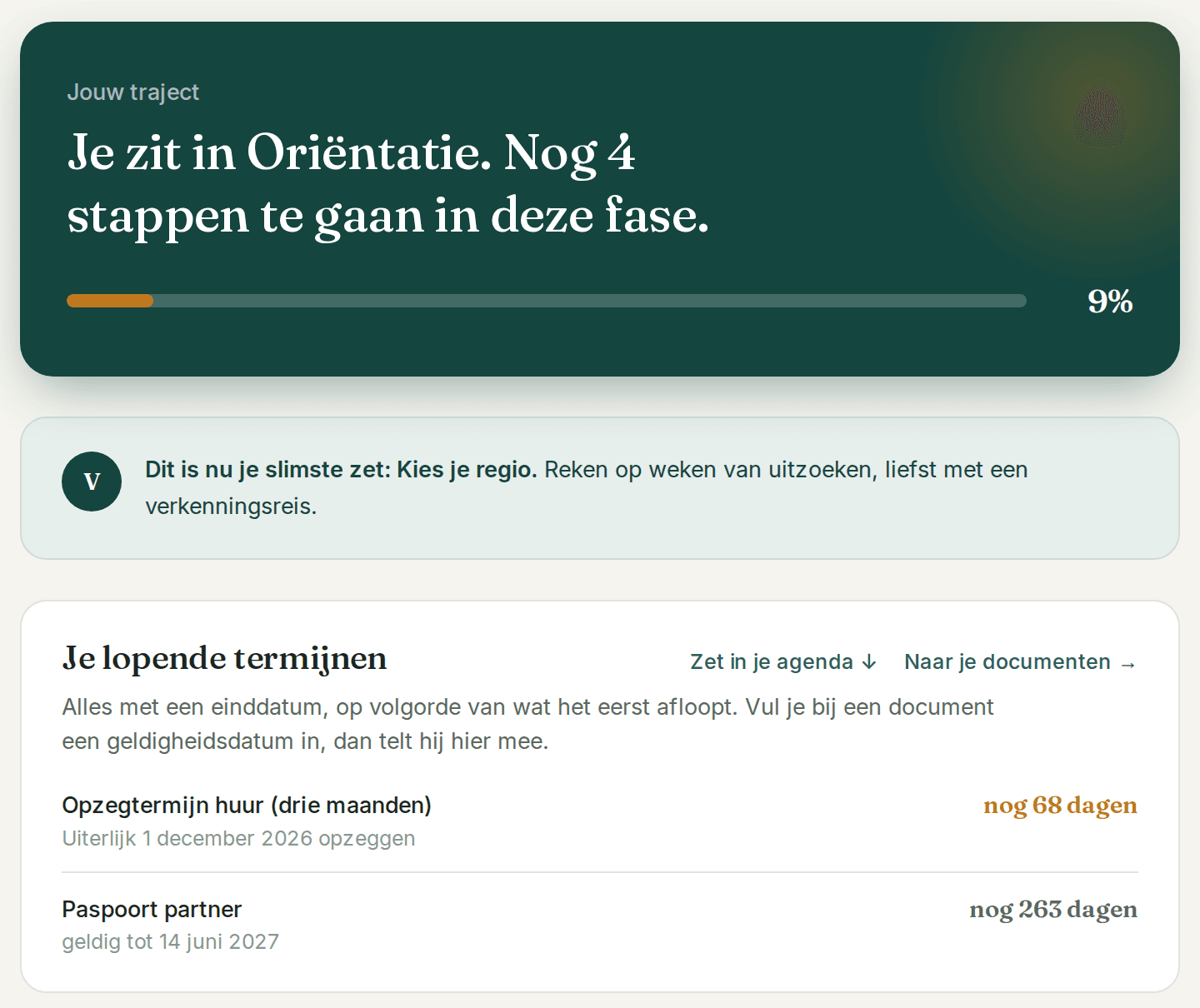
And this is the dashboard that step lives in. The example shows the plan for Spain; your dashboard shows the plan for Australia.
This is step 5.4 of 41. The other 40 are ready for you, each with the same sources, the same offices and a schedule that keeps track of your dates.
See all 41 steps for AustraliaWhat you get for € 499
All 41 steps to Australia, for your situation
In order, with the office and the official source at every step. Steps that don't apply to you don't appear.
Your deadlines in one place
For each step you see the latest date to start, and you get a heads-up before something is due or expires. Your documents sit in the vault, with their dates.
A plan that stays right
Twice a month we check the sources. If something changes, it's in your plan and you get a message.
The step-by-step plan for Australia
€ 499
one-off · 41 steps
- Pay once, no subscription
- Destination changes? Within 30 days I switch your plan to another country free of charge
- Stuck on a step? You get a personal answer within two working days
What will your move to Australia cost? Work it out →
Know someone moving to Australia? Give this plan as a gift →
Every step on one list, free
Not ready to start yet? Then you get the departure checklist for Australia: every step in order, to print and tick off. With it, five mails in a week and a half about the pitfalls and the real costs. If the rules for Australia change, you'll hear about it. After that we ask once where your plans stand, send one offer, and now and then one thing that fits your moment. No newsletter, and you can switch it off at any time.
That was the move. And once you live there?
Which country may tax your pension once you live in Australia? Is there a favourable regime, a scheme that lowers your tax? And how do you get insured? That depends on where your income comes from. Tick it and you'll see which rules apply to you, with the source.
See the financial conditionsClosing down the Netherlands: all your letters in one go
Moving to Australia starts with leaving the Netherlands properly. That's why the plan includes the letter tool: you enter your details once and every cancellation and notification letter is ready.
Just the letters, without the plan? That works too, for € 49
- Health insurance, rent, energy, subscriptions, GP, school, bank and pension fund: 16 kinds of letters. You enter your details only once.
- A sending list that counts back from your departure date and your notice period, even when that's three months.
- Also what you need to ask for as an emigrant: your no-claims years in English, your medical file and the school report (the report on your child for the new school).


Auke, maker of Vertrekklaar
On 2 January we're leaving ourselves, on a trip around the world with our family. What I put here, I'm arranging for my own family too.
On 20 September 2026 a customer wrote that the CAK rule for early retirement was missing from his plan. He was right. That evening the step was in thirteen plans, with the source attached.
The knowledge base on Australia
Per phase, the articles that are already there. They're written from the same journey and go deeper than what fits above.
- The three visa routes to Australia, explained189, 190 or 491 — which one fits you determines your whole journey. And why the difference between "may take part" and "gets invited" costs most people time and money.
- Police certificates: why timing is everything hereThey take 4 to 12 weeks and they are valid for only 12 months. Applying too early is just as expensive as too late — this is where careful planning pays off. What Australia asks exactly, what the Dutch VOG costs, and how to apply for it once you've already left.
- IELTS or PTE — which test suits you?The language test is the biggest points dial you can turn yourself: the difference between minimum and top score is 20 points. Both tests are accepted, but they reward different things.
- Medicare for Dutch citizens: what it covers, and the deadline migrants missAs a PR holder — or even as a PR applicant — you simply get into Medicare. What almost nobody knows: the Netherlands has a healthcare agreement with Australia that bridges your landing, and a clock is ticking for whoever wants to avoid a loading on their private insurance: the first anniversary of your Medicare registration, 2% loading per year after that, up to 70%, for ten years.
- The skills assessment: who assesses your occupation, and why that step has to come firstBefore Australia looks at your visa application, an assessing authority must establish that you really master your occupation. This is the longest processing time in the preparation phase — the step you therefore start first, and a result valid for at most three years.
- The points system: how to calculate your Australian scoreAge, English, work experience and education — the points system decides whether you get an invitation. This is how you add up your score, and this is the difference between being allowed to take part and being invited.
All 24 articles about Australia
- Is your occupation on the list? This is how you look it up
- When you need a migration adviser — and when you don't
- Apostille and legalisation: which document needs what
- The medical examination: why you shouldn't do it too early
- Your pet to Australia: 180 days of waiting, a titre test and ten days of quarantine
- AOW, pension and tax in Australia: everything moves to the state of residence — except your ABP
- The 60-day clock: what must be ready before your invitation comes
- The visa fees: what a family pays at submission
- State nomination: the 190 and 491 routes, explained
- Banking and paying in Australia: open your account within six weeks, then your passport is enough
- Buying a house in Australia: without PR the existing housing market is closed until mid-2029
- Renting in Australia: winning the application without an Australian history
- Taking your car to Australia: an import approval first, then 5% duty and 10% GST
- Your first two weeks in Australia, in order
- Your household contents to Australia: tax-free if you owned everything for twelve months, and the car isn't included
- Your driving licence in Australia: the Netherlands is on the right list — but the clock ticks per state
- Going to school in Australia: free for PR families, expensive for whoever comes too early
- Working in Australia: your visa is your work permit, and then come TFN, superannuation and recognition of your trade
Also applies to your move
Ready to begin?
The step-by-step plan for Australia: 41 steps, with your documents and your costs in one place. For each step you see the latest date to start. You pay once and it's yours.