Skip to content

Step-by-step plan · No visa required

The step-by-step plan for France

From "we want this" to being settled, in 30 steps. Read phase 1 in full here. Test your departure date along the way. Then you'll know whether you want the rest.

30 steps5 phases62 official sources9 only for your situationchecked on 9 September 2026

Phase 1 starts below ↓The whole plan: € 199 one-off, no subscription.

What it looks like

Not a PDF, not a checklist. A plan that knows what needs to happen now.

Every step sits in its place in the order, with the lead time, the counter and the official source. You tick off, your partner ticks along, and the plan counts back from your departure date: what has to start when, and what is running now.

Below is phase 1, exactly as it appears in the plan.

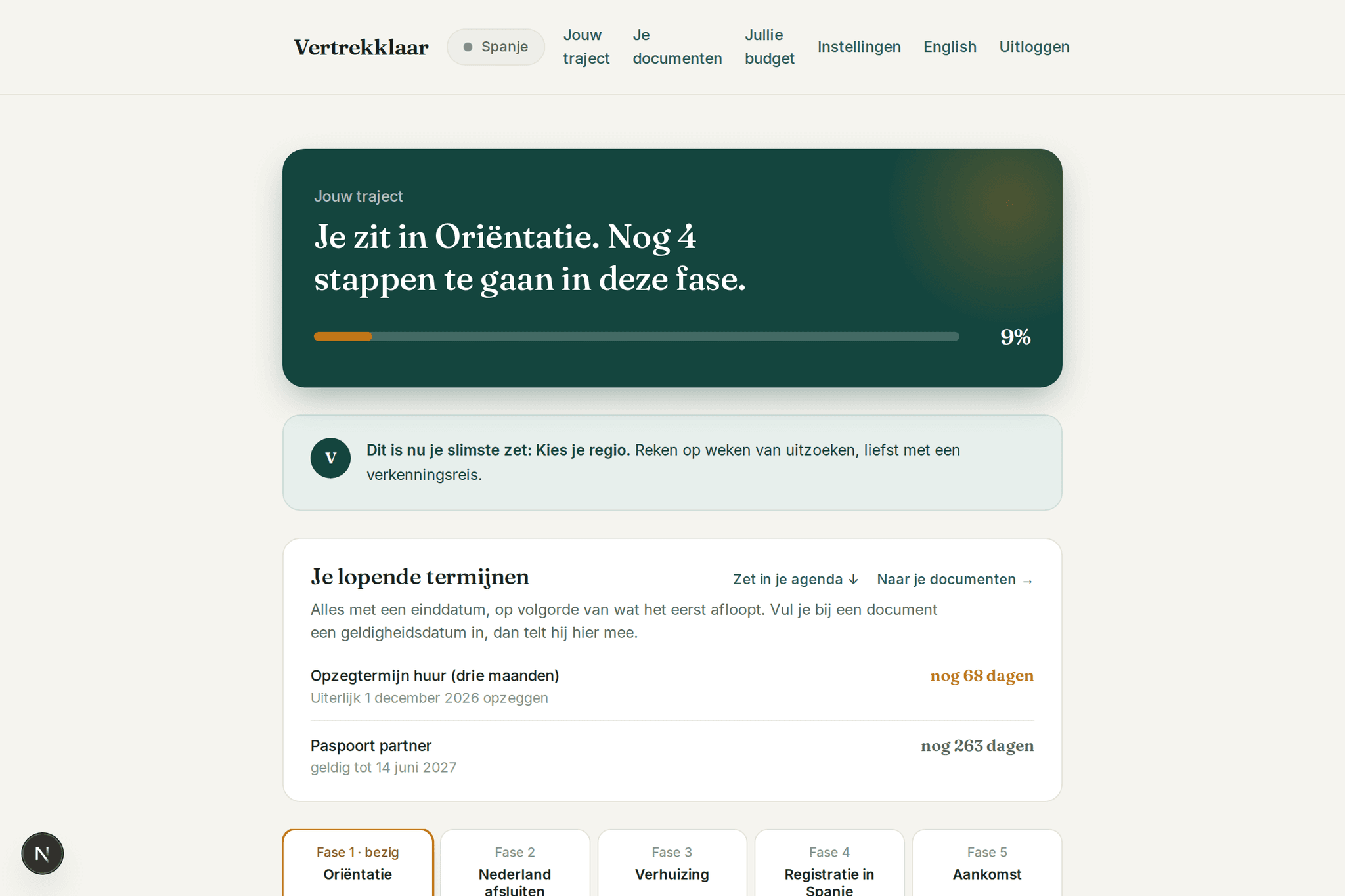
The dashboard of the step-by-step plan for France: the current phase, the open steps, the next step and the deadline bar.

The route

  1. Orientation

    6 steps

    Open · You are here

  2. Closing the Netherlands

    11 steps

    In your plan

  3. The move

    5 steps

    In your plan

  4. Arrival

    4 steps

    In your plan

Phase 1 is the question "can we, and do we want to?". From phase 2 the arranging begins.

Phase 1 · Orientation

6 of 6 steps open

There's even less here that stops you than in Spain — no registration duty, no counter. That's exactly why you have to know yourself what does have to happen: healthcare, tax and an address you can prove.

By the end of phase 1 you know how you'll get into French healthcare, which region you'll live in, roughly what the journey will cost, and whether you as a family stand behind the decision.

Step 1.1

Living there is simply allowed; that doesn't make you settled

Lead time:
reading step
Costs:
none

No visa, no registration, no residence card — French law says it literally: EU citizens don't need a residence document. If you want one anyway (handy at some counters), you can apply for a carte de séjour "Citoyen UE", but nothing obliges you.

For completeness, because this site also tells what nobody tells: there is a notification at the mairie in the law, within three months of settling. There's no fine on it, proof of it may nowhere be a condition, and the government information doesn't even mention it anymore. The only consequence of not notifying is that you're formally deemed to have lived there for less than three months.

The real lesson is a different one: because no counter forces you, nothing starts by itself either. Healthcare, the tax office and the bank only learn you exist when you report yourself — and of those three, healthcare counts in months. This journey turns on clocks you have to start.

Step 1.2

Know how you'll get into French healthcare

Lead time:
an evening of research; arranging it can take months
Costs:
none

Three routes, just as in Spain and Portugal — but with a longer bridging period, and that's the core warning of this route. If you're going to work in France, you're entitled to the country-of-residence system (PUMa) from the start of your work and can register right away. If you're retired, the S1 form from the CAK (the Dutch body for healthcare abroad) arranges your access. If you don't work — you live off assets, or work remotely for a Dutch employer — your right only starts after three months of stable residence, and your means have to be at least at the level of the French social minimum.

Add to that the processing of your registration itself may take months, and the sum is clear: between your Dutch cover (which stops on emigration) and your working French cover there's a gap you have to bridge. How you do that you arrange in phase 2 — here you only need to know which route applies.

Step 1.3

Choose your region

Lead time:
weeks of research, preferably with a scouting trip
Costs:
none — a scouting trip is a choice, not an obligation

France is big, and the choice of region has two sides here that Dutch dreamers both underestimate. The first is money: the official rent observatories measure about twenty-six euros per square metre in Paris, eleven to thirteen in the provincial cities, and six to seven in the deep countryside. So the same monthly rent buys two to four times as much home outside France's own Randstad.

The second side is amenities. In parts of the countryside GPs don't take on new patients — and without a declared GP healthcare reimburses structurally less (phase 5 explains how that works). Whoever chooses the quiet checks first whether there's a doctor, a school and a station within reach. And count outside the summer: second-home regions have a winter side, with closed shutters and a village square without people.

Outside the cities English is no safety net. The language weighs more heavily in this journey than in Spain or Portugal — take it into the choice, not as a footnote.

Step 1.4

Get a picture of what it's going to cost

Lead time:
1-2 hours with the calculator
Costs:
none

The calculator for France works on your own moving choices and shows three cost blocks. The application block is virtually zero for France — there's no registration after all, and no fees. The money is in the move (the shortest trip of all our destinations, so also the cheapest) and in the landing: deposit and rent, living while no income comes in yet, and the mutuelle — the supplementary health insurance almost every French person has — in your monthly budget.

A rule of thumb that makes the journey less stressful: don't count yourself rich on a quick sale or a quick job, and only start spending once the first months are covered.

Step 1.5

The family conversation

Lead time:
weeks, not hours
Costs:
none

This is the step without forms, and yet this is where most journeys fail. Emigrating isn't something you do alone — even if the papers are in one name. Discuss with your partner and, depending on their age, your children: why do we want this, what are we giving up, and what is for each of us the condition for saying yes?

With France the language deserves the heaviest weight in the conversation. Daily life — the school, the doctor, the town hall, the neighbours — runs in French, and unlike in the Algarve or on the Costa there's no English-speaking safety net outside the cities. For children what applies everywhere applies: young children pick it up surprisingly fast, for teenagers the transition is harder and extra support is no luxury.

Step 1.6

Choose your target date

Lead time:
decision moment
Costs:
none

Close the orientation phase with a target date for departure. Not as a deadline — as a compass. Here too you wait for nobody's permission, so the pace is up to you. A realistic picture: from serious decision to being settled, this journey takes most people three to nine months — where "settled" with France above all means: the healthcare clock run out.

You fill it in below in this card, and filling it in is completing the step. You can always adjust your target date — the planning adjusts with it.

Phase 1 read

You know what you're getting into. Now the arranging begins.

You've read phase 1 of the step-by-step plan for France. The full plan has another 24 steps ready for you: Closing the Netherlands, The move, Getting the basics in order in France and Arrival.

The plan counts everything back from your departure date, watches your deadlines and documents, and shows only the steps that apply to you.

The step-by-step plan for France

€ 199

one-off · no subscription · instant access

Also included: deadlines watched · documents with expiry dates · only your steps · your partner ticks along · all cancellation letters · questions to Auke.

✎ Auke reads along

Stuck somewhere? Ask your question at the step. Auke reads it himself and answers within two working days.

Not ready yet? Send yourself your date and phase 1 →

Phase 2 · Closing the Netherlands0 of 11 steps open

France has no number to collect in advance — the head start you take here is paperwork in order, and healthcare cover that bridges the long French enrolment.

  1. 2.1Collect your documents, and know the rules of the game1-4 weeks
  2. 2.2Arrange healthcare cover that bridges the French enrolmentresearching and taking out, 1-3 weeks; the CAK route you start two months before departure
  3. 2.3Know where you'll pay taxone good conversation with a tax adviser
  4. 2.4Deregister and close the Netherlandsderegistering is possible from 5 days before departure; the whole takes 4-8 weeks
  5. 2.5Partner comes along without a job of their ownonly if this applies to you
  6. 2.6Living partly in the Netherlands: the eight-month ruleonly if this applies to you
  7. 2.7The house in the Netherlands: sell, rent out or keeponly if this applies to you
  8. 2.8Children staying in the Netherlands: DUO, healthcare and the houseonly if this applies to you
  9. 2.9Cancel what stops: job, rent, energy, subscriptions and schoolstart three months before departure; most notice periods are one month
  10. 2.10Stay reachable: DigiD, your phone number, your bank and your postarrange it before you leave; afterwards it takes weeks
  11. 2.11Student debt, remote work or your own business: what moves with youreport it before you leave; the consequences run for years
Phase 3 · The move0 of 5 steps open

The shortest trip of all destinations — but the car deserves the sharpest sum of the whole journey here, because a relocation exemption doesn't exist.

  1. 3.1Choose your form of movedecision moment
  2. 3.2Request quotes and plan the transportonly if this applies to you
  3. 3.3Pet along: chip, rabies jab and the EU pet passportonly if this applies to you
  4. 3.4Decide about the car — and work out the malus firstonly if this applies to you
  5. 3.5Arrange your first accommodationbooking can be quick; do it before your departure
Phase 4 · Getting the basics in order in France0 of 4 steps open

No registration counter, but an order: without proof of address no bank, without notification no healthcare — and the sécurité sociale takes longest, so you start that first.

  1. 4.1Find your home, and start your address chainweeks to months, depending on region and season
  2. 4.2Start your registration with the sécurité sociale (CPAM)the application is an afternoon; the processing counts in months
  3. 4.3Report to the French tax officea few weeks
  4. 4.4Bank account and running matters1-2 weeks
Phase 5 · Arrival0 of 4 steps open

From settled to simply living: school via the mairie, a GP before you need one, and one hard one-month deadline for the car.

  1. 5.1School for the children, via the mairieonly if this applies to you
  2. 5.2Choose a médecin traitant and complete healthcarea few weeks — the finding is the work, not the form
  3. 5.3Put the car on French platesonly if this applies to you
  4. 5.4Landedit's done

9 of these 24 steps only appear when your answers call for them: a pet, a car, a partner without a job, children staying in the Netherlands. That is the difference between a step-by-step plan and a checklist.

Three questions

Can't I find all this for free?

Yes. Everything in the plan comes from official sources, and they're listed at every step. Phase 1 above is the proof. What you buy is the work around it: which of the 24 following steps apply to you, in which order, with which deadline, and a nudge when something needs doing.

Does this apply to my situation too?

The plan first asks who is coming along, what is coming along and how you're leaving the Netherlands. Steps that don't apply to you don't appear; steps that only apply to you do. Is your situation slightly different from what's written? Ask your question at the step; you'll get an answer within two working days.

What if the rules change after I buy?

Then your plan changes with them. Twice a month we check every source; whatever changes is in your plan the same week, with the date. Your access lasts for your whole departure.

Ready to begin?

The step-by-step plan for France: 30 steps, your documents and your costs in one place, with the timing watched. Pay once, and it's yours.