Skip to content

Step-by-step plan · No visa required

The step-by-step plan for Croatia

From "we want this" to being settled, in 35 steps. Read phase 1 in full here. Test your departure date along the way. Then you'll know whether you want the rest.

35 steps5 phases65 official sources8 only for your situationchecked on 9 September 2026

Phase 1 starts below ↓The whole plan: € 199 one-off, no subscription.

What it looks like

Not a PDF, not a checklist. A plan that knows what needs to happen now.

Every step sits in its place in the order, with the lead time, the counter and the official source. You tick off, your partner ticks along, and the plan counts back from your departure date: what has to start when, and what is running now.

Below is phase 1, exactly as it appears in the plan.

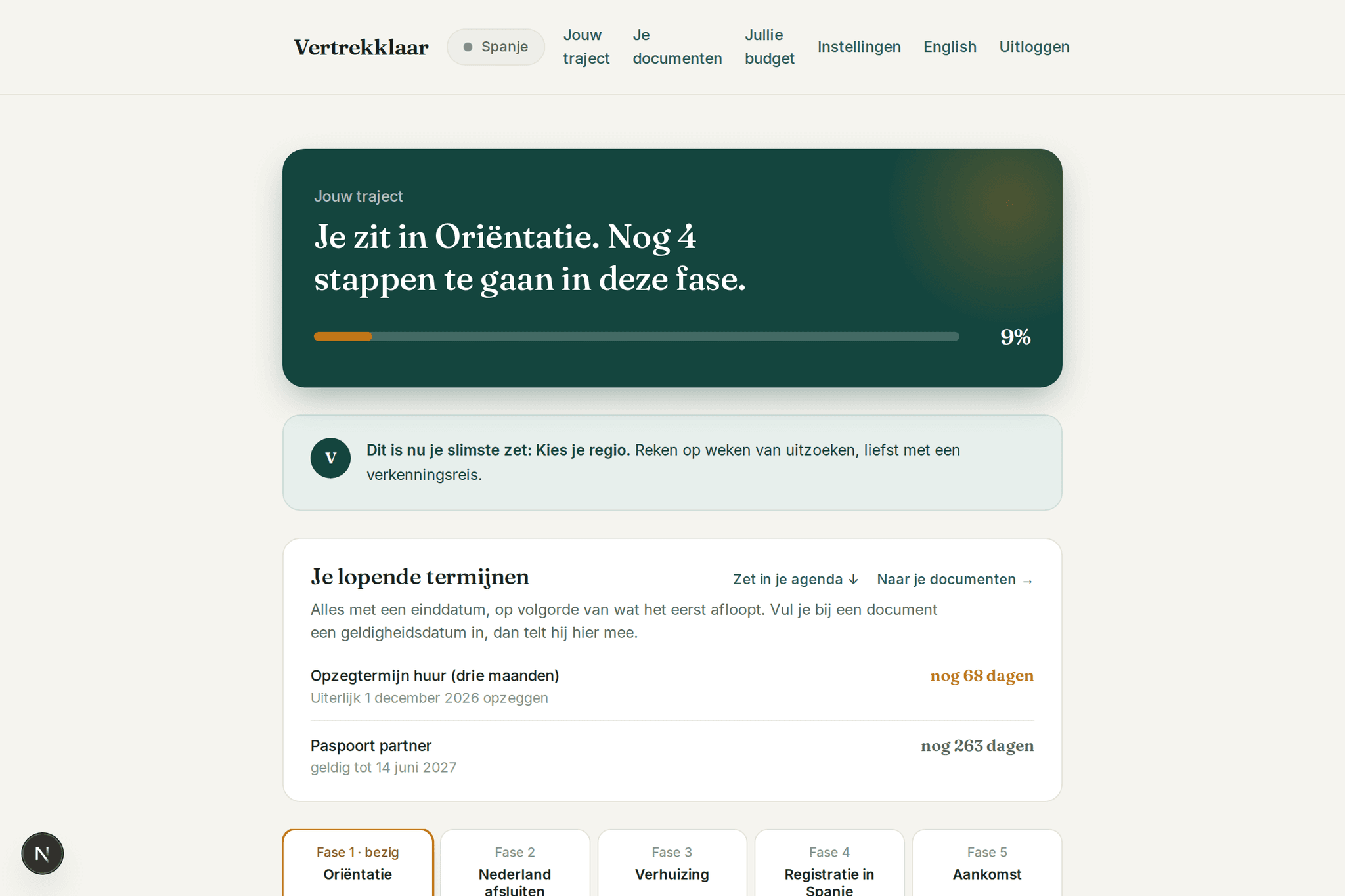
The dashboard of the step-by-step plan for Croatia: the current phase, the open steps, the next step and the deadline bar.

The route

  1. Orientation

    5 steps

    Open · You are here

  2. Closing the Netherlands

    14 steps

    In your plan

  3. The move

    3 steps

    In your plan

  4. Registration in Croatia

    6 steps

    In your plan

  5. Arrival

    7 steps

    In your plan

Phase 1 is the question "can we, and do we want to?". From phase 2 the arranging begins.

Phase 1 · Orientation

5 of 5 steps open

Croatia has been euro and Schengen since 2023, and the paperwork starts with one number: the OIB. After that the choice that decides everything isn't which city, but which side of the country — the coast with its tourist summer and empty winter, or continental Zagreb. And since 2024 your municipality literally sets your tax rate.

By the end of phase 1 you know the Croatian chain, you know what the choice of municipality does for tax, the choice of coast or inland has been made and the family stands behind the decision.

Step 1.1

Understand the system: one number, then the police

Lead time:
reading step
Costs:
none

As an EU citizen you don't need a permit, but you do need an order. Everything starts with the OIB — the personal identification number every contract, every account and every counter asks for. Then comes the home, and then the registration of your residence: not at the municipality, but at the police (MUP), with form 1b, at the latest eight days after the end of your first three months. The biometric residence card you can apply for at the same time is optional and costs € 13.27 — but in practice you want it, because it's your ID at every following desk. After five years' uninterrupted residence you apply for permanent residence with form 3b. The plan keeps the order and the clocks for you.

Step 1.2

Choose your Croatia: the coast or the continent

Lead time:
an evening of research, and the conversation about it
Costs:
none

On holiday you choose the coast, but living is a different sum. The Adriatic coast — Split, Zadar, Istria — has the summer you know, and a winter almost nobody knows: from October to April restaurants and shops close, and half the housing stock runs as holiday lets in summer, which makes annual contracts scarce. Zagreb is the opposite: a real city with life, jobs and schools all year round — but continental, with cold winters and without the sea. There's a tax side too: since 2024 municipalities set their own tax rate, and Zagreb sits at the top end. Make this choice before the rest of the journey — it determines your rental market, your winter and your tax bill.

Step 1.3

Get a picture of what it's going to cost

Lead time:
1-2 hours with the calculator
Costs:
none

The paperwork is cheap here — the OIB is free and the residence card costs € 13.27. The money is in the journey (about 1,400 kilometres to Zagreb, with tolls and vignettes along the way), in the home, and above all in the car: Croatia has no exemption from its special motor vehicle tax on relocation, and that makes the car a real sum here. Work it out with your own choices.

Step 1.4

Take the decision together

Lead time:
no fixed one; take your time
Costs:
none

Croatia feels familiar — euro, Schengen, two days' driving — and four things deserve an honest conversation. The wage level: the minimum wage is € 1,050 gross a month and skilled salaries too are far below Dutch ones. The language: Croatian is a Slavic language, and outside the tourist zone and the IT sector you won't get through a counter with English. The season on the coast: the summer is overwhelming there and the winter empty. And the distance to work: whoever doesn't keep working remotely for a Dutch employer has to look at the Croatian labour market honestly. Also discuss who carries the income in the first months.

Step 1.6

Choose your target date

Lead time:
five minutes, below
Costs:
none

Choose below the date on which you want to be standing in Croatia. The plan works out whether that's feasible with what still has to happen, and from that moment watches the clocks that exist: three months plus eight days for the registration, fifteen days for the PPMV declaration of the car, and eight days for the healthcare enrolment.

Phase 1 read

You know what you're getting into. Now the arranging begins.

You've read phase 1 of the step-by-step plan for Croatia. The full plan has another 30 steps ready for you: Closing the Netherlands, The move, Registration in Croatia and Arrival.

The plan counts everything back from your departure date, watches your deadlines and documents, and shows only the steps that apply to you.

The step-by-step plan for Croatia

€ 199

one-off · no subscription · instant access

Also included: deadlines watched · documents with expiry dates · only your steps · your partner ticks along · all cancellation letters · questions to Auke.

✎ Auke reads along

Stuck somewhere? Ask your question at the step. Auke reads it himself and answers within two working days.

Not ready yet? Send yourself your date and phase 1 →

Phase 2 · Closing the Netherlands0 of 14 steps open

The familiar list, with a treaty sum that turns out surprisingly. The 2000 treaty has your occupational pension taxed exclusively in Croatia — and Croatia halves the tax on pension income there. But your AOW stays taxed in the Netherlands, and an ABP pension too. Whoever remembers "pension follows the country of residence" gets half of it wrong here.

  1. 2.1Arrange your healthcare: the basic insurance stops on moving daystart 2-3 months before departure; the CAK application takes ± 4 weeks
  2. 2.2AOW and pension: the treaty divides, and Croatia halvesthe notification is an afternoon; the exemption declaration takes weeks
  3. 2.3The tax wrap-up: the M form and the protective assessmentthe M form follows in the year after departure
  4. 2.4Stop the benefits and child benefitan hour
  5. 2.5Deregister at the municipalityfive working days before departure, not earlier
  6. 2.6DigiD, bank and your vote: keep the lines with the Netherlandsan afternoon
  7. 2.7Documents: extracts and the cover statement from your insurerextracts within a week; the statement on request
  8. 2.8Partner comes along without a job of their ownonly if this applies to you
  9. 2.9Living partly in the Netherlands: the eight-month ruleonly if this applies to you
  10. 2.10The house in the Netherlands: sell, let or keeponly if this applies to you
  11. 2.11Children who stay in the Netherlands: DUO, healthcare and the houseonly if this applies to you
  12. 2.12Cancel what stops: job, rent, energy, subscriptions and schoolstart three months before departure; most notice periods are one month
  13. 2.13Stay reachable: DigiD, your phone number, your bank and your postarrange it before you leave; afterwards it takes weeks
  14. 2.14Student debt, remote work or your own business: what moves with youreport it before you leave; the consequences run for years
Phase 3 · The move0 of 3 steps open

Within the EU and within Schengen, moving is administratively nothing: no customs, no declaration, no border control. Apart from one thing — the car. Croatia levies its special motor vehicle tax on your own relocation car too, without exemption. That's the sum you do before the removal van is booked.

  1. 3.1Plan the journey and the household goods: two days' driving, no borderquotes 4-6 weeks ahead
  2. 3.2The car: do the PPMV sum firstonly if this applies to you
  3. 3.3The pet: EU passport and a chip that can be readonly if this applies to you
Phase 4 · Registration in Croatia0 of 6 steps open

The chain, in the only order in which it works: OIB, home, registration with the police, HZZO. The OIB you arrange from the Netherlands by e-mail already — the biggest time saving of this journey. And the clock of the registration is more precise than it seems: three months plus eight days after entry.

  1. 4.1The OIB: arrange it from the Netherlandsby e-mail ± 8 days; at the counter often the same day
  2. 4.2Find your home — and mind what kind of contract you signsearching 2-8 weeks; on the coast longer for an annual contract
  3. 4.3Registration with MUP: form 1b, within the clockthe appointment is the wait; the card follows by post
  4. 4.4HZZO: within eight days, and with the right paperthe enrolment itself is a counter appointment
  5. 4.5e-Građani: the digital keyan hour, as soon as you have the residence card
  6. 4.6Bank account: with OIB and your residence documentan appointment; the account is usually open within a week
Phase 5 · Arrival0 of 7 steps open

The papers are in; now it becomes a life. The car has the tightest clock of the whole journey — fifteen days for the PPMV declaration. Then the things that make the difference: the dopunsko every Croat has, the tax rate your municipality sets, and the winter in which the coast closes.

  1. 5.1The car: PPMV declaration within fifteen days, then the platesonly if this applies to you
  2. 5.2Work: the wage level, the coast and free accessongoing
  3. 5.3Healthcare in practice: the co-payment and the dopunskoongoing
  4. 5.4Family: school, and the allowance that's set offonly if this applies to you
  5. 5.5Tax: your municipality sets the rate, and your pension counts halfthe return follows in spring
  6. 5.6Learn Croatian: further than the campsiteongoing; count on a year before it really starts working
  7. 5.7The small print: driving licence, utilities and the buraspread over the first year

8 of these 30 steps only appear when your answers call for them: a pet, a car, a partner without a job, children staying in the Netherlands. That is the difference between a step-by-step plan and a checklist.

Three questions

Can't I find all this for free?

Yes. Everything in the plan comes from official sources, and they're listed at every step. Phase 1 above is the proof. What you buy is the work around it: which of the 30 following steps apply to you, in which order, with which deadline, and a nudge when something needs doing.

Does this apply to my situation too?

The plan first asks who is coming along, what is coming along and how you're leaving the Netherlands. Steps that don't apply to you don't appear; steps that only apply to you do. Is your situation slightly different from what's written? Ask your question at the step; you'll get an answer within two working days.

What if the rules change after I buy?

Then your plan changes with them. Twice a month we check every source; whatever changes is in your plan the same week, with the date. Your access lasts for your whole departure.

Ready to begin?

The step-by-step plan for Croatia: 35 steps, your documents and your costs in one place, with the timing watched. Pay once, and it's yours.