Leaving from Belgium?To the Belgian plan →See the plan for Belgians moving to England →This plan is for people leaving the Netherlands.

England · Visa required
Emigrating to England
Since Brexit, England is a real emigration country again: you need a visa, and for that visa first a job. So the order matters more than ever. If you know it, you're ahead of everyone still using the old language level (B1) and old fees. This page shows how the journey runs.
€ 399 one-off · 40 steps · no subscription
- Kind of journey
- Visa route: the job first, then the Skilled Worker visa
- Language requirement
- English at level B2, stricter since January 2026
- Biggest cost item
- The health surcharge (IHS): £ 1,035 per adult per year, £ 776 per child, paid up front
Last updated: 14 October 2026
Will your departure date work? Check it in the free step-by-step plan →
Five phases, from job offer to being settled
For England you need a visa. That visa doesn't hang on points for what you bring, but on a job you first have to find. After that come a customs border that didn't exist before Brexit, and a country without a registration counter at the town hall.
- Orientation
No visa without a job
In this phase you find out whether the route exists for you. The main route is the Skilled Worker visa, the visa for skilled employees. That starts not with a form, but with an employer who wants and is allowed to sponsor you: an employer recognised by the British government. You check whether your occupation is on the list and whether the salary meets the threshold. That threshold is £ 41,700, or the usual wage in your trade (the going rate) if that's higher. You learn that the language requirement has been at B2 since 2026. And you calculate the journey, including the health surcharge. You pay it per family member per year, and almost everyone underestimates it.Read more
- Job and visa
Your employer sponsors your visa
In this phase you find the job and apply for the visa. You apply to employers from the public sponsor register, the list of recognised employers, and you pass the language test. Then the chain follows. Your employer assigns you a Certificate of Sponsorship: the official statement that it's hiring you. You apply for the visa online and pay the fees plus the full health surcharge up front. From the Netherlands the decision usually comes within three weeks. You don't get a paper document. Your status is an eVisa, a digital visa. From it you create a share code, a code with which employer and landlord check your right to live there online.Read more
- Closing the Netherlands
A real emigration, not an EU move
In this phase you close things down in the Netherlands. The UK is no longer an EU country, and you notice that most here. Your health insurance stops, and there's no European safety net. Your AOW accrual stops. You settle the tax around your departure via the tax treaty and the M form, the tax return for your emigration year. You deregister with the municipality and keep DigiD and a Dutch account. And you gather the documents British counters will want a certified translation of: a translation with an official statement that it's correct.Read more
- The move
Close by, but with a customs border
In this phase you move your household contents, car and pet. The household contents go by lorry via the ferry or the tunnel. Since Brexit that's formally an import. One form decides whether your belongings come across tax-free: the ToR exemption (Transfer of Residence, the relief for removal goods). That form has to be there before the lorry drives. The car is an honest sum. Bringing it is allowed, but in England you drive on the left, in a car with the steering wheel on the left. Add conversion and inspection, and bringing it rarely pays off. The pet, surprisingly, may simply come along on its EU passport, but via an approved route: a crossing with an approved carrier.Read more
- Arrival in England
No registration counter, but an order
In this phase you arrange life in England: home, work, healthcare and school. England has no population register. You arrange separate things with separate authorities, and the right order saves weeks. The share code opens the home and the job. Working is allowed before your National Insurance Number arrives, your number for work, tax and social security. The GP registers you without a single paper. The council (the local authority) knows you as soon as the council tax runs, the local tax. For the children you arrange school via that same council. Then the real arriving begins.Read more
This is what one step of your plan looks like
This is the real thing: one of the steps of the England journey, exactly as it appears in your personal step-by-step plan, with the deadlines, the offices and the sources.
Step 4.1 of your plan
Apply for the ToR exemption before the move
- Lead time
- application an evening; allow amply for the processing
- Costs
- none — the exemption itself is free
With this step your household contents enter England without import duties and VAT. Almost nobody knows about it, and it's worth thousands of euros.
Since Brexit your household contents are formally an import. Without exemption you pay import duties plus VAT on the value of everything that goes into the lorry. The Transfer of Residence exemption (ToR) removes that, if you arrange it in time.
This is how you apply:
- You apply online at HMRC, the British tax and customs authority.
- You send an inventory list. Grouping is allowed, and a photo of a handwritten list counts too.
- You send a proof of address on both sides, and your passport page.
- After approval you get a unique reference number (URN). That number is what your mover needs at customs.
The conditions:
- You lived at least twelve months outside the UK.
- The goods have been in your possession and use for at least six months.
- You import them within twelve months of settling.
- You may not sell or transfer them in the first year after import.
Alcohol and tobacco fall outside it.
Where you arrange it
What this step rests on
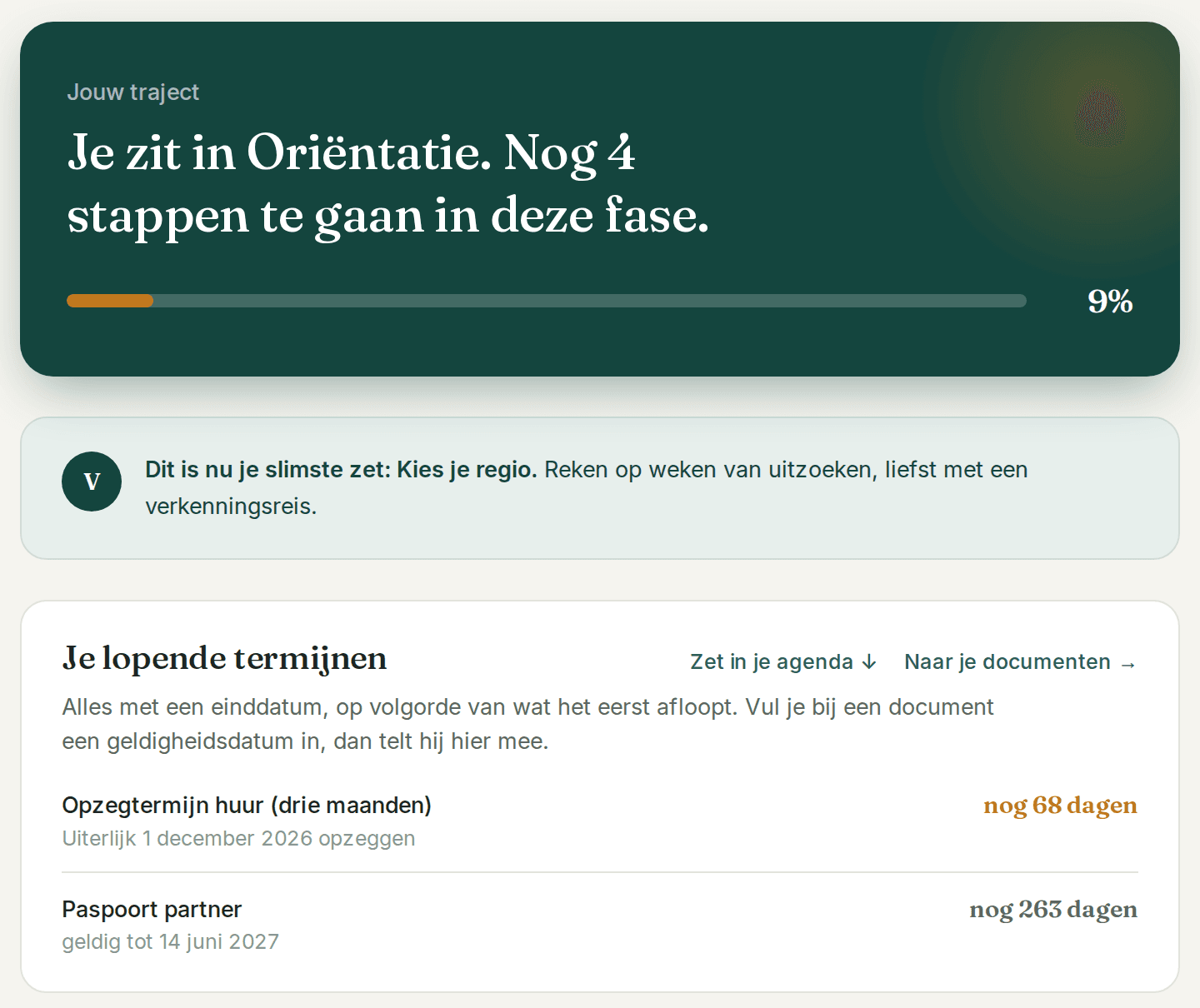
And this is the dashboard that step lives in. The example shows the plan for Spain; your dashboard shows the plan for England.
This is step 4.1 of 42. The other 41 are ready for you, each with the same sources, the same offices and a schedule that keeps track of your dates.
See all 42 steps for EnglandWhat you get for € 399
All 42 steps to England, for your situation
In order, with the office and the official source at every step. Steps that don't apply to you don't appear.
Your deadlines in one place
For each step you see the latest date to start, and you get a heads-up before something is due or expires. Your documents sit in the vault, with their dates.
A plan that stays right
Twice a month we check the sources. If something changes, it's in your plan and you get a message.
The step-by-step plan for England
€ 399
one-off · 42 steps
- Pay once, no subscription
- Destination changes? Within 30 days I switch your plan to another country free of charge
- Stuck on a step? You get a personal answer within two working days
What will your move to England cost? Work it out →
Know someone moving to England? Give this plan as a gift →
Every step on one list, free
Not ready to start yet? Then you get the departure checklist for England: every step in order, to print and tick off. With it, five mails in a week and a half about the pitfalls and the real costs. If the rules for England change, you'll hear about it. After that we ask once where your plans stand, send one offer, and now and then one thing that fits your moment. No newsletter, and you can switch it off at any time.
That was the move. And once you live there?
Which country may tax your pension once you live in England? Is there a favourable regime, a scheme that lowers your tax? And how do you get insured? That depends on where your income comes from. Tick it and you'll see which rules apply to you, with the source.
See the financial conditionsClosing down the Netherlands: all your letters in one go
Moving to England starts with leaving the Netherlands properly. That's why the plan includes the letter tool: you enter your details once and every cancellation and notification letter is ready.
Just the letters, without the plan? That works too, for € 49
- Health insurance, rent, energy, subscriptions, GP, school, bank and pension fund: 16 kinds of letters. You enter your details only once.
- A sending list that counts back from your departure date and your notice period, even when that's three months.
- Also what you need to ask for as an emigrant: your no-claims years in English, your medical file and the school report (the report on your child for the new school).


Auke, maker of Vertrekklaar
On 2 January we're leaving ourselves, on a trip around the world with our family. What I put here, I'm arranging for my own family too.
On 20 September 2026 a customer wrote that the CAK rule for early retirement was missing from his plan. He was right. That evening the step was in thirteen plans, with the source attached.
The knowledge base on England
Per phase, the articles that are already there. They're written from the same journey and go deeper than what fits above.
- The Skilled Worker visa: how the route to England works after BrexitNo visa, no move — and the Skilled Worker visa doesn't start with a form but with a job. What the sponsor requirement means, which salary threshold applies (£41,700, or the going rate for your occupation if that is higher), and what the process really costs.
- Moving to England: is it still possible after Brexit, and how?Yes, but no longer without a visa. Which routes are open to a Dutch citizen, who still falls under the EU Settlement Scheme, what the fees and the Immigration Health Surcharge cost, and how England differs from a move within the EU.
- ToR1: the form that can save your move to England thousands of eurosSince Brexit your household goods are formally an import: without relief you pay import duty plus VAT on everything in the lorry. The Transfer of Residence relief removes that — if you apply for it before the removal company sets off.
- Your first weeks in England: NIN, GP, bank and council tax in the right orderEngland has no population register — there is no counter where you "just register". Instead you arrange four separate things, and the order saves weeks: you may work before your National Insurance Number arrives, and the GP asks for no proof of address.
- The English language requirement has been raised to B2 — and this is how you prove itSince 8 January 2026 the Skilled Worker visa requires level B2, no longer B1. Many sites still quote the old level. Which tests count (SELT), how long a result stays valid, and when you don't need to sit a test at all.
- Working in England: your visa decides what is allowed, and you translate your diploma into British terms yourselfWith a Skilled Worker visa you work for one sponsor, with room for at most twenty hours a week on the side, also as a self-employed person. Your partner may do almost anything. You have your Dutch diploma compared by UK ENIC, and whether your profession is protected you look up in the British register. Plus what is left of a British gross salary.
All 16 articles about England
- AOW, healthcare and pension in England: what comes along, what stops — and the treaty route almost nobody knows
- The FIG regime: four years without British tax on your Dutch income, if you claim it
- Your car and driving licence in England: driving on the left, NOVA, and the sums to do first
- Taking your pet to England: the EU passport still counts, the tapeworm clock is not to be missed
- A bank account in England: the right to a basic bank account, and what protects your savings
- Buying a house in England: nothing is certain until exchange — and read what you're actually buying
- Renting in England: the Right to Rent check, the deposit cap and what a landlord may not ask
- Your National Insurance Number: apply only once you're in England, and you can work before it arrives
- School in England: apply through the council, younger than you think, and free
- Healthcare in England: you pay the IHS upfront, then the NHS is free — apart from prescriptions and the dentist
Also applies to your move
Ready to begin?
The step-by-step plan for England: 42 steps, with your documents and your costs in one place. For each step you see the latest date to start. You pay once and it's yours.