Leaving from Belgium?To the Belgian plan →See the plan for Belgians moving to Italy →This plan is for people leaving the Netherlands.

Italy · No visa required
Emigrating to Italy
For Italy you don't apply for a permit. You do arrange everything in a fixed order: your tax number (codice fiscale), a home, your registration with the municipality (residenza) and your health card. Then the vigile (municipal police) checks whether you really live there. Fiscally this is one of the most favourable countries on this site for pensioners.
€ 199 one-off · 35 steps · no subscription
- Kind of journey
- EU: register, no visa
- The chain
- Codice fiscale → home → residenza → tessera sanitaria
- Note
- The order. Every step is the proof for the next
Last updated: 14 October 2026
Will your departure date work? Check it in the free step-by-step plan →
Five phases, from the region choice to the vigile
In Italy everything turns on the order. The tax number you already arrange from the Netherlands. The rental contract is your entry ticket to the registration with the municipality. That registration is done in two working days, and after that comes a check of whether you really live there. Also watch the deadlines for the car, and the child allowance: it only comes when you apply for it.
- Orientation
The chain, and the choice North or South
In this phase you learn the chain and choose where in Italy you'll live. Italy has no permit but an order: codice fiscale (your tax number), home, residenza (your registration with the municipality), health card. Every step is the entry ticket for the next. The choice of region weighs nowhere as heavily as here: the North of the jobs and the high rents, or the South of the space and the half prices. You also have the honest conversation about the language, the wage level and the pace of the bureaucracy.Read more
- Closing the Netherlands
A pension treaty that works out favourably
In this phase you work through the familiar list: healthcare, benefits, deregistration, documents. The pension rules are among the most favourable on the site. The tax treaty from 1990 assigns AOW and company pension exclusively to Italy. The country-of-residence factor, with which the CAK adjusts your healthcare contribution to the country you live in, is 0.4641. So you pay less than half of what the contribution would be without that factor. If you have a foreign pension and move to a municipality of at most 30,000 inhabitants in southern Italy, you can pay 7% on all your foreign income for ten years. The certificates travel without an apostille (the international stamp of authenticity). Do bring the multilingual model form, because Italy only accepts Italian.Read more
- The move
Over the Gotthard or the Brenner
In this phase you move your belongings, car and pet. Within the EU moving is administratively nothing. The planning is in the drive: eleven hundred to seventeen hundred kilometres, via Switzerland or the Brenner. The car deserves its own decision, because the deadlines in the Netherlands and Italy have to start in the right order. First you start the Italian process, only then do you make the RDW export notification. The dog comes along without tapeworm treatment, but has to go into the regional register quickly after arrival.Read more
- Registration in Italy
Two working days, and then the vigile comes
In this phase you register and arrange everything that follows from it. The codice fiscale you already arrange from the Netherlands, free via the embassy. Then the home, with a registered rental contract. The deposit is legally at most three months. After that you make the declaration of your residenza. It's done in two working days and applies back to the day of your declaration. In the 45 days after that, the vigile (the municipal police) can drop by unannounced to see whether you really live there. Then everything opens: the health card via the ASL (the regional health service), the Italian ID card that clears the way to SPID (the Italian DigiD), and the bank account you're legally entitled to.Read more
- Arrival
Three months for the car, an ISEE for the child allowance
In this phase you settle in, start work and arrange the last things. The car has to be on Italian plates within three months. That goes via one counter and without registration tax, and the Dutch BPM refund (car tax you get back on export) is a windfall. The child allowance only comes once you've first arranged the ISEE, a certificate of your household income. The collective agreement in your employment contract is your de facto minimum wage. And then the small print. The waste tax goes in your name. The broadcasting fee sits in the electricity bill. And the cameras of the ZTL, the zones in city centres you can't simply drive into, know no mercy.Read more
This is what one step of your plan looks like
This is the real thing: one of the steps of the Italy journey, exactly as it appears in your personal step-by-step plan, with the deadlines, the offices and the sources.
Step 4.3 of your plan
The residenza: two working days, and then the vigile comes
- Lead time
- registration 2 working days; residence check up to 45 days
- Costs
- free; the certificate ± € 17
With this step you officially become a resident of your Italian municipality. The rest of the chain waits for this.
This is how you make the declaration:
- Make the dichiarazione di residenza, the declaration of your home address, at the anagrafe (the population register) of your municipality.
- It can also be done online, via the national ANPR portal. Even your DigiD works there, via the European link.
- If you work, show your employment contract.
- If you don't work, show that you have enough means. The guideline is the annual amount of the assegno sociale (an Italian minimum benefit): about € 7,100 for a single person. A self-declaration is enough.
- If you don't work, also show comprehensive health insurance. The S1 form counts (the CAK's proof that the Netherlands pays for your healthcare), the blue EHIC card (the European health insurance card) doesn't.
The registration is complete within two working days. It applies from the date of your declaration.
After that the municipality has 45 days for the residence check: the vigile, a municipal officer, comes by unannounced to see whether you really live there. So put your name on the doorbell and the letterbox. If you then hear nothing from the municipality, your registration counts as tacitly confirmed.
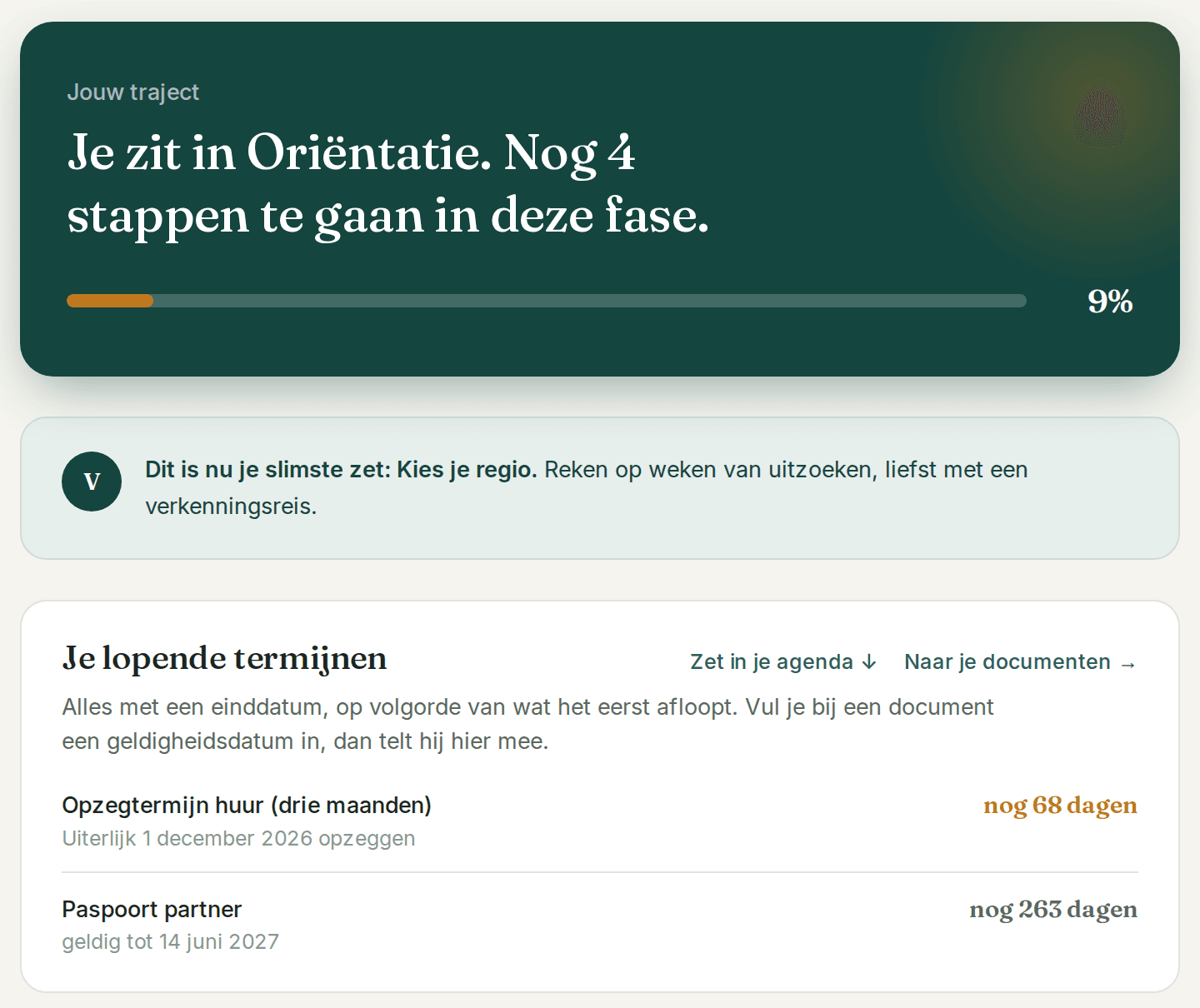
And this is the dashboard that step lives in. The example shows the plan for Spain; your dashboard shows the plan for Italy.
This is step 4.3 of 37. The other 36 are ready for you, each with the same sources, the same offices and a schedule that keeps track of your dates.
See all 37 steps for ItalyWhat you get for € 199
All 37 steps to Italy, for your situation
In order, with the office and the official source at every step. Steps that don't apply to you don't appear.
Your deadlines in one place
For each step you see the latest date to start, and you get a heads-up before something is due or expires. Your documents sit in the vault, with their dates.
A plan that stays right
Twice a month we check the sources. If something changes, it's in your plan and you get a message.
The step-by-step plan for Italy
€ 199
one-off · 37 steps
- Pay once, no subscription
- Destination changes? Within 30 days I switch your plan to another country free of charge
- Stuck on a step? You get a personal answer within two working days
What will your move to Italy cost? Work it out →
Know someone moving to Italy? Give this plan as a gift →
Every step on one list, free
Not ready to start yet? Then you get the departure checklist for Italy: every step in order, to print and tick off. With it, five mails in a week and a half about the pitfalls and the real costs. If the rules for Italy change, you'll hear about it. After that we ask once where your plans stand, send one offer, and now and then one thing that fits your moment. No newsletter, and you can switch it off at any time.
That was the move. And once you live there?
Which country may tax your pension once you live in Italy? Is there a favourable regime, a scheme that lowers your tax? And how do you get insured? That depends on where your income comes from. Tick it and you'll see which rules apply to you, with the source.
See the financial conditionsClosing down the Netherlands: all your letters in one go
Moving to Italy starts with leaving the Netherlands properly. That's why the plan includes the letter tool: you enter your details once and every cancellation and notification letter is ready.
Just the letters, without the plan? That works too, for € 49
- Health insurance, rent, energy, subscriptions, GP, school, bank and pension fund: 16 kinds of letters. You enter your details only once.
- A sending list that counts back from your departure date and your notice period, even when that's three months.
- Also what you need to ask for as an emigrant: your no-claims years in English, your medical file and the school report (the report on your child for the new school).


Auke, maker of Vertrekklaar
On 2 January we're leaving ourselves, on a trip around the world with our family. What I put here, I'm arranging for my own family too.
On 20 September 2026 a customer wrote that the CAK rule for early retirement was missing from his plan. He was right. That evening the step was in thirteen plans, with the source attached.
The knowledge base on Italy
Per phase, the articles that are already there. They're written from the same journey and go deeper than what fits above.
- Working in Italy: the collective agreement is your minimum wage, and two regimes cut your taxItaly has no statutory minimum wage — your CCNL determines pay, thirteenth and fourteenth month. INPS runs automatically, your Dutch unemployment-insurance years count via the U1 form, and two tax regimes are ready: 50% exemption for qualified newcomers in employment, and a flat tax of 15% or even 5% for the self-employed.
- AOW and pension in Italy: everything to the state of residence — and the 7% regimeThe tax treaty of 1990 assigns AOW and private pension exclusively to Italy — the Netherlands must exempt them in full, without thresholds. And whoever moves to a southern Italian municipality of up to 30,000 inhabitants can opt for ten tax years of 7% on all their foreign income: the year of the move and the nine years after it. Only the government pension stays Dutch.
- Your car to Italy: three months, two clocks and no registration taxItaly levies no registration tax on import — the re-registration costs around € 500-700 and the Dutch BPM refund covers that easily. But two clocks are running that you have to start in the right order: the Italian three months after residenza, and the Dutch thirteen weeks after the export notification. Start them the wrong way round and you let hundreds of euros lapse.
- Your dog or cat to Italy: the EU passport, and the dog in the anagrafe within ten daysDog, cat and ferret travel to Italy on the European pet passport: chip, valid rabies vaccination and a 21-day wait after the first jab. A tapeworm treatment Italy does not ask for. What is required, and what most guides miss: every dog belongs in the regional anagrafe canina, and in Rome that has to happen within ten days of arrival — for € 28 at the ASL.
- Your household goods to Italy: no customs, but the Swiss borderWithin the EU a move is administratively nothing: no declaration, no import duties, no VAT. The one border that does count lies in the middle of the route: whoever drives via the Gotthard leaves the EU customs union and has to declare the removal goods in Switzerland for transit — with a deposit once the load is worth more than CHF 5,000. Via the Brenner that problem does not exist.
- Banking and paying in Italy: the conto di base is your right, and cash stops at € 5,000You open an Italian bank account with your passport and your codice fiscale — a residenza is not legally required for that. Every bank has to offer you the conto di base, a refusal must be justified within ten working days, and for low incomes the account is free. Then two rules that surprise the Dutch: cash payments are allowed up to € 5,000, and the government collects through pagoPA.
All 13 articles about Italy
- Renting in Italy: 4+4, cedolare secca and the contract that has to be registered
- Residenza and codice fiscale: the Italian order that determines everything
- The first weeks in Italy: the order the counter expects from you
- Buying a house in Italy: the notaio does a lot — but three choices determine your bill
- Your driving licence in Italy: valid until it expires, and then it becomes Italian
- School in Italy: free from six, enrolment in January, and the 40-hour week you have to ask for
- Healthcare in Italy: the ticket, the classes and the exemptions
Also applies to your move
Ready to begin?
The step-by-step plan for Italy: 37 steps, with your documents and your costs in one place. For each step you see the latest date to start. You pay once and it's yours.