Leaving from Belgium?To the Belgian plan →See the plan for Belgians moving to New Zealand →This plan is for people leaving the Netherlands.

New Zealand · Visa required
Emigrating to New Zealand
For New Zealand you need a visa, and almost every route starts with an employer. There's no ranking and no draw: the country sets a threshold and tells you right after lodging whether you're over it. This page shows which routes there are, in what order, and what works differently than you expect after arrival.
€ 499 one-off · 39 steps · no subscription
- Kind of journey
- Visa: threshold of six points, no ranking
- Lead time
- About 13 months, job search included
- Note
- Almost every route first asks for a job offer
Last updated: 14 October 2026
Will your departure date work? Check it in the free step-by-step plan →
Five phases, from choosing a route to being settled
Here you don't start with a file, but with an employer. That makes the order different from the other visa destinations. Everything that comes after is only valid for a limited time. And all those papers have to be valid at the same moment.
- Orientation
Which route fits, and when does which clock start?
In this phase you choose your route and test yourself against the hard limits. Four routes are realistic. Via tier 1 of the Green List (the list of occupations New Zealand is short of) you get residence right away. Via tier 2 you get residence after 24 months of work. The points route asks for six points and a suitable job. And those aged 18 through 30 can do a working holiday of twelve months. Three limits are hard: you're 55 or younger, you score IELTS 6.5 on average (an English language test), and you pass the medical examination. You also discover the clock that earns you the most money. From the day you become a tax resident, New Zealand doesn't tax your foreign income for four years.Read more
- Job and visa
Without an accredited employer your application doesn't exist
In this phase you find a job and apply for your visa. This is the phase that decides everything and takes the longest. You apply for your work visa with an application link from your employer. Only an accredited employer can give you that link: an employer the immigration service has approved. Since 10 March 2025 there's no median-wage requirement for that work visa anymore (the rule that you earn at least the country's middle wage). For the residence routes the wage does count. If you lodge via the points, you hear right after lodging whether you're through. You then have four months to complete the application. Since 24 August 2026 the points route has three pathways. The standard one asks six points and a suitable job. The two new ones, Skilled Work Experience and Trades and Technician, also ask work experience in New Zealand itself.Read more
- Closing the Netherlands
Treaty country for your AOW, not for your healthcare
In this phase you settle your pension, your healthcare and your tax with the Netherlands. New Zealand is a treaty country for the AOW (the Dutch state pension). As a single person you therefore keep the full single-person pension of 70%. But there's no CAK route, the arrangement under which your healthcare runs via the Netherlands. The country isn't on the treaty-country list, so you arrange your healthcare yourself until you're entitled to the public system. Also keep two things in mind. Your AOW stays taxed in the Netherlands as long as you're not a New Zealand citizen. Your private pension precisely not. And then your protective assessment: the assessment on your pension that the Netherlands imposes on departure and keeps open. Outside the EU you have to apply for deferral yourself, and sometimes provide security.Read more
- The move
The strictest border in the world, and your car stays here
In this phase you move your belongings and your pet. Everything has to be clean: hiking boots, tent, bicycle, garden tools. Everything that could be a risk, you declare. Not declaring costs NZ$ 400 on the spot. Your household goods enter tax-free if you owned and used them yourself before departure. The crossing takes six to nine weeks, the longest of all destinations here. Your pet needs six months' lead time and at least ten days of quarantine. And your car stays here. New Zealand drives on the left, and a left-hand-drive car can't in principle be registered.Read more
- Arrival in New Zealand
Two numbers to arrange, and no house purchase yet
In this phase you arrange your bank account, your IRD number (the New Zealand tax number) and your driving licence. Start with the bank account. Without a New Zealand account you don't get an IRD number from abroad. And without an IRD number your employer withholds 45%. You exchange your driving licence without a test, because the Netherlands is on the exempt list. You can't buy a house yet. On a work visa not at all. With a residence visa only after twelve months of living there, or earlier with paid consent.Read more
This is what one step of your plan looks like
This is the real thing: one of the steps of the New Zealand journey, exactly as it appears in your personal step-by-step plan, with the deadlines, the offices and the sources.
Step 1.2 of your plan
The four years in which your foreign income stays untaxed
- Lead time
- an evening of calculating, and one decision you take only once
- Costs
- none
- Validity
- 48 months from the end of the month in which you become a tax resident
In this step you get to know a tax advantage that's in almost no Dutch guide. Whoever becomes a tax resident of New Zealand for the first time automatically gets a temporary exemption of about four years on almost all their foreign income. Tax resident means you pay tax there as a resident. The condition is that you weren't a tax resident of New Zealand in the ten years before.
The exemption lasts for forty-eight months. In that time this income is untaxed in New Zealand:
- Interest and dividends.
- Rent from your Dutch home.
- Income from foreign investment funds.
You don't have to apply for anything. If you meet the conditions, you get the exemption automatically.
Two things you need to know already, because they change your planning:
- Wages are not covered. The same goes for income from personal services you earn abroad. It's about capital, not about work.
- You can only get the exemption once in your life.
There's also a catch. If you apply for Working for Families, the exemption ends. That's the New Zealand child scheme, including Best Start (an allowance for young children). The exemption also ends if your partner applies for the scheme. For a family with children and little foreign capital that's an easy choice. If you rent out a Dutch home or have an investment portfolio, it can make a difference of thousands of euros a year. So work it out before you apply for anything, not after.
Put the date on which the exemption ends in your diary straight away. After that the ordinary rules apply. Those include the FIF regime, New Zealand's rules for foreign investments. It applies to foreign shares above NZ$ 50,000 purchase value. Further on in the plan you read how that works.
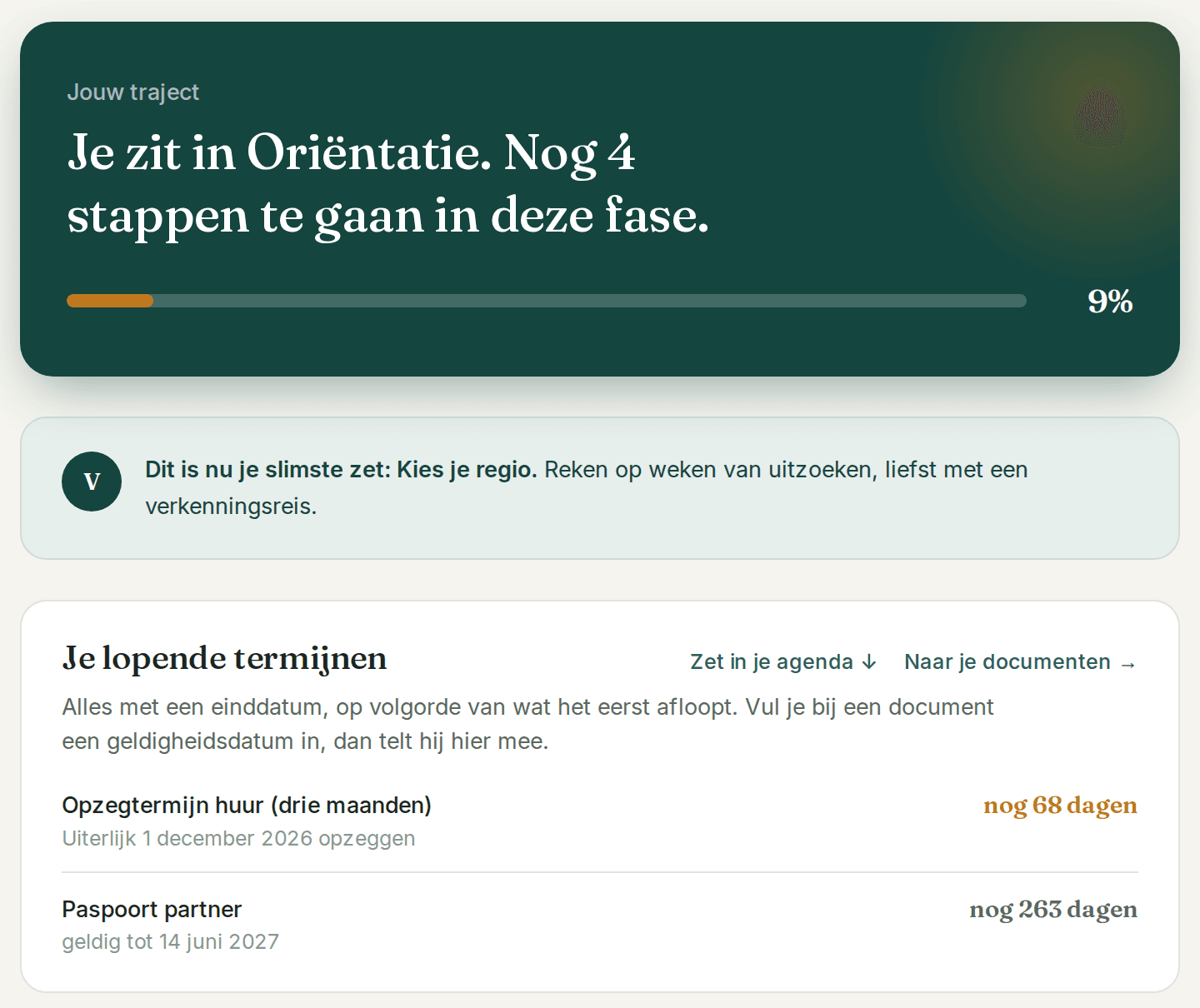
And this is the dashboard that step lives in. The example shows the plan for Spain; your dashboard shows the plan for New Zealand.
This is step 1.2 of 41. The other 40 are ready for you, each with the same sources, the same offices and a schedule that keeps track of your dates.
See all 41 steps for New ZealandWhat you get for € 499
All 41 steps to New Zealand, for your situation
In order, with the office and the official source at every step. Steps that don't apply to you don't appear.
Your deadlines in one place
For each step you see the latest date to start, and you get a heads-up before something is due or expires. Your documents sit in the vault, with their dates.
A plan that stays right
Twice a month we check the sources. If something changes, it's in your plan and you get a message.
The step-by-step plan for New Zealand
€ 499
one-off · 41 steps
- Pay once, no subscription
- Destination changes? Within 30 days I switch your plan to another country free of charge
- Stuck on a step? You get a personal answer within two working days
What will your move to New Zealand cost? Work it out →
Know someone moving to New Zealand? Give this plan as a gift →
Every step on one list, free
Not ready to start yet? Then you get the departure checklist for New Zealand: every step in order, to print and tick off. With it, five mails in a week and a half about the pitfalls and the real costs. If the rules for New Zealand change, you'll hear about it. After that we ask once where your plans stand, send one offer, and now and then one thing that fits your moment. No newsletter, and you can switch it off at any time.
That was the move. And once you live there?
Which country may tax your pension once you live in New Zealand? Is there a favourable regime, a scheme that lowers your tax? And how do you get insured? That depends on where your income comes from. Tick it and you'll see which rules apply to you, with the source.
See the financial conditionsClosing down the Netherlands: all your letters in one go
Moving to New Zealand starts with leaving the Netherlands properly. That's why the plan includes the letter tool: you enter your details once and every cancellation and notification letter is ready.
Just the letters, without the plan? That works too, for € 49
- Health insurance, rent, energy, subscriptions, GP, school, bank and pension fund: 16 kinds of letters. You enter your details only once.
- A sending list that counts back from your departure date and your notice period, even when that's three months.
- Also what you need to ask for as an emigrant: your no-claims years in English, your medical file and the school report (the report on your child for the new school).


Auke, maker of Vertrekklaar
On 2 January we're leaving ourselves, on a trip around the world with our family. What I put here, I'm arranging for my own family too.
On 20 September 2026 a customer wrote that the CAK rule for early retirement was missing from his plan. He was right. That evening the step was in thirteen plans, with the source attached.
The knowledge base on New Zealand
Per phase, the articles that are already there. They're written from the same journey and go deeper than what fits above.
- The four routes to New Zealand: why everything here starts with a jobNew Zealand doesn't rank you and doesn't make you enter a draw: six points is a threshold, and you hear straight after submitting whether you are over it. But almost every door starts with an employer accredited by Immigration New Zealand — and that makes the order different from Canada and Australia.
- The English language requirement for New Zealand: who must take a test, which score, and what your family paysDutch nationals are not exempt from the language requirement in New Zealand. For a skilled residence visa the principal applicant needs IELTS 6.5, taken at a test centre and no more than two years old; for a work visa at skill level 3 to 5, IELTS 4 is enough. Instead of a test, your partner and children aged 16 or over may prepay English lessons, from NZD 1,735 to 6,795.
- The Green List: the difference between immediate residence and two years of waitingNew Zealand keeps a list of occupations it needs people for, in two tiers. If your role is on tier 1, you get residence straight away with a job offer; if it is on tier 2, you work for 24 months first. So it pays to read that list before you start applying for jobs.
- Working in New Zealand: the accredited employer, your partner and registration before your visaWorking in New Zealand almost always starts with an accredited employer: the Accredited Employer Work Visa costs from NZD 1,540 and ties you to that employer. Whether your partner may work depends on your hourly pay. And for regulated occupations, such as nursing, you need your New Zealand registration before you apply for the visa.
- AOW, pension and tax in New Zealand: who levies what, and what comes offNew Zealand is a treaty country, so your accrued AOW travels with you in full. But it stays taxed in the Netherlands as long as you are a Dutch citizen, while your private pension is precisely not — and as soon as you become entitled to NZ Super, your AOW is deducted from it dollar for dollar.
- Household goods, car and pet to New Zealand: the strictest border in the worldYour household goods come in tax-free, but only if you owned and used them yourself — and everything has to be literally clean. Your car stays here, because New Zealand drives on the left. And for your dog or cat you start six months in advance, with ten days of quarantine at the end.
All 13 articles about New Zealand
- Banking and paying in New Zealand: the account in advance, the IRD number and 45% on your interest
- Renting in New Zealand: four weeks' bond, no letting fees and 90 days' notice without a reason
- Your first weeks in New Zealand: bank account, IRD number and 45% if you're late
- Children at school in New Zealand: free as a domestic student, and that depends on your visa
- Four years in which New Zealand doesn't tax your foreign income
- Why you are not allowed to buy a house in New Zealand straight away
- Healthcare in New Zealand: no CAK route, but ACC
Also applies to your move
Ready to begin?
The step-by-step plan for New Zealand: 41 steps, with your documents and your costs in one place. For each step you see the latest date to start. You pay once and it's yours.