Leaving from Belgium?To the Belgian plan →See the plan for Belgians moving to Mexico →This plan is for people leaving the Netherlands.

Mexico · Visa required
Emigrating to Mexico
For Mexico you apply for a residence card through the consulate in The Hague. That's very doable. The rest is harder: Mexico is eleven hours' flying away and on no Dutch treaty list at all. So a policy replaces the CAK, and whoever goes alone gets the lower AOW for married people. And the treaty of 1993 splits your income in three.
€ 399 one-off · 34 steps · no subscription
- Kind of journey
- Residence card via the consulate: temporary, or with a pension permanent at once
- The clock
- Within 30 days of arrival to the INM, the immigration service, for the card
- Note
- No treaty country: a policy instead of the CAK, and for a single person the married rate of the AOW, almost a third less gross
Last updated: 14 October 2026
Will your departure date work? Check it in the free step-by-step plan →
Five phases, from the consulate to the fideicomiso
This journey turns on two cards and three clocks. The first clock is the visa, which is valid 180 days. The second is the thirty days after landing for the canje at the INM: there you exchange your visa for the card. The third is the fifteen days within which the pet's certificate has to have been issued. On top of that there are two things the brochure on Mexico doesn't mention. A tax treaty splits your income in three. And Mexico is no treaty country for healthcare or for the AOW (the Dutch state pension): that double status decides your healthcare and your AOW.
- Orientation
Two cards, thresholds in UMA, and a country outside every treaty list
In this phase you learn how living in Mexico works, and what it does to your income and your healthcare. Whoever stays gets a temporary or a permanent card. You apply for both at the consulate in The Hague. The thresholds are in UMA days, a Mexican unit of account that shifts every year in February. The tax treaty of 1993 divides your income. Your occupational pension goes to Mexico, your AOW is shared with a cap, and your government pension stays Dutch. On top of that, Mexico is no treaty country for healthcare or for the AOW. That means no CAK, the body that arranges your healthcare in treaty countries, but a policy. And whoever goes alone falls back for the AOW to the married rate, the amount for married people. Finally, you explore the region. Keep an eye on the healthcare and on the restricted zone: the strip along the coast and the border where you can only buy through a bank.Read more
- Your visa
Six months of income or twelve months of balance, and an appointment in The Hague
In this phase you apply for your visa at the consulate in The Hague. For the residente temporal, the temporary card, you show more than 680 UMA days a month in income over six months. Or you show a balance of 11,460 UMA days over twelve. In 2026 that's a good 79,771 pesos a month, or 1,344,373 pesos in the bank. If you have a pension and clear 1,140 UMA days a month, you may go permanent at once. You hand in bank statements per month with a stamp from the bank, and an ordinary Spanish translation. You make an appointment. Within ten working days you then have a visa that is valid 180 days, for one entry. Partner and children come along through unidad familiar, the family route.Read more
- Closing the Netherlands
Your pension in three, a policy before deregistering, and the married rate
In this phase you work through the familiar list for closing down in the Netherlands, with a Mexican twist. First your pension. Article 18 paragraph 1 of the treaty places your occupational pension and your annuity exclusively with Mexico. So apply for the wage tax exemption. Paragraph 3 lets the Netherlands tax your AOW up to 17.5 percent of the gross, and Mexico credits that against its own tax. Article 19 keeps your government pension Dutch. Then healthcare. There is no CAK, so your policy has to be accepted before you deregister. Contact the SVB in time. And know that whoever goes alone gets the married rate of the AOW: 50 instead of 70 percent of the net minimum wage, for as long as you live there. Finally, check what a house in the Netherlands does to your tax liability in Mexico.Read more
- The move
The stamped list, the car that can't stay, and fifteen days for the pet
In this phase you move the household goods, the car and the pet. The household goods go by sea container to the Gulf or the Pacific, in six to ten weeks. They enter the country free with a consular certificate, a statement from the consulate. With it goes a list with brand, model and serial number for each appliance. For the car it works the other way round. With a residente temporal you may import it temporarily, with a residente permanente you may not. Definitive import is only possible for cars from North America. So count on selling and buying again. The pet needs only a health certificate at most fifteen days old. A chip or a titre test, a blood test for rabies, is not needed.Read more
- Arrival in Mexico
Thirty days to the INM, then CURP, bank, policy, SAT and the fideicomiso
In this phase you arrange your card, your numbers, your bank and your healthcare after landing. Everything hangs on one date. Within thirty days of landing you lodge the canje at the INM: you exchange your visa for the card. The fees are 11,140.74 pesos for one year temporary, or 13,578.96 pesos for permanent. Then come the CURP (your Mexican personal number), the proof of address, the bank, and the policy or the IMSS package of Mexican social security. You get a Mexican driving licence, which is arranged per state. At the SAT, the Mexican tax authority, you apply for a tax number for the annual return in April. If you buy on the coast or near the border, you do so through a fideicomiso: a bank holds the title, fifty years and renewable.Read more
This is what one step of your plan looks like
This is the real thing: one of the steps of the journey to Mexico, exactly as it appears in your personal step-by-step plan, with the deadlines, the offices and the sources.
Step 2.2 of your plan
Prove your means: six months of income or twelve months of balance
- Lead time
- gathering takes weeks; the bank statement is the slowest
- Costs
- bank statements and copies
In this step you gather the proof that you have enough income or savings. That is the core of your application.
The UMA stands in 2026 at 117.31 pesos a day. That turns the thresholds into concrete amounts. At a rate around twenty-one pesos to the euro you get the following:
- Temporary card, on income. A good 79,771 pesos net a month, six months in a row. That is roughly 3,800 euros a month.
- Temporary card, on balance. An average balance of a good 1,344,373 pesos over twelve months. That is roughly 64,000 euros in the bank.
- Permanent card, on income. 133,733 pesos a month, a good 6,300 euros.
- Permanent card, on balance. A balance of 5,378,664 pesos, a quarter of a million euros.
Watch out for two pitfalls:
- Net here means free of charges. The consulate looks at what arrives on your account. So show the withholding as well as the amount that remains.
- The bank statements have to be per month, with a declaration or stamp from the bank. A printout from the app isn't enough.
Request that bank declaration now. It is the slowest item of this phase.
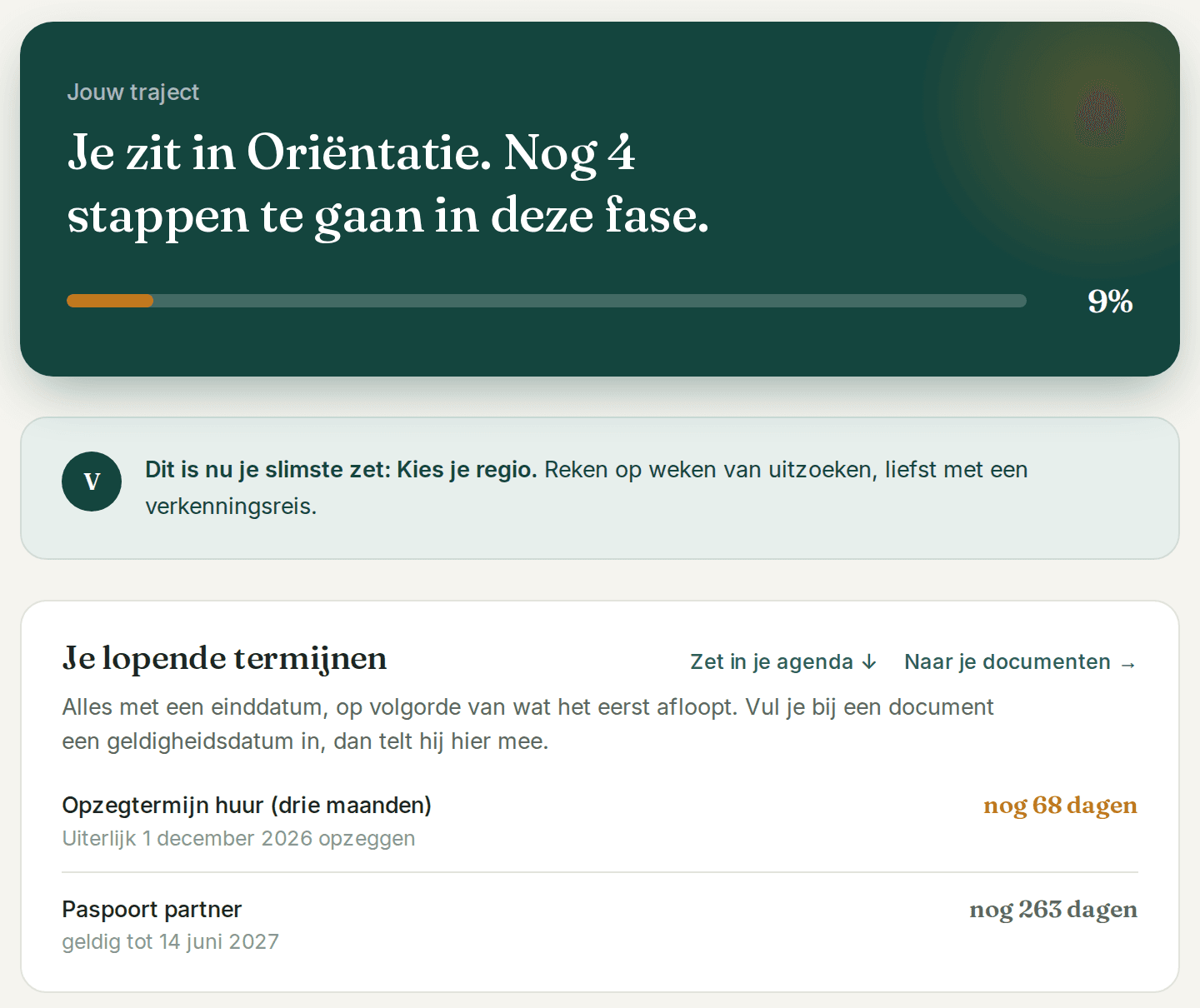
And this is the dashboard that step lives in. The example shows the plan for Spain; your dashboard shows the plan for Mexico.
This is step 2.2 of 36. The other 35 are ready for you, each with the same sources, the same offices and a schedule that keeps track of your dates.
See all 36 steps for MexicoWhat you get for € 399
All 36 steps to Mexico, for your situation
In order, with the office and the official source at every step. Steps that don't apply to you don't appear.
Your deadlines in one place
For each step you see the latest date to start, and you get a heads-up before something is due or expires. Your documents sit in the vault, with their dates.
A plan that stays right
Twice a month we check the sources. If something changes, it's in your plan and you get a message.
The step-by-step plan for Mexico
€ 399
one-off · 36 steps
- Pay once, no subscription
- Destination changes? Within 30 days I switch your plan to another country free of charge
- Stuck on a step? You get a personal answer within two working days
What will your move to Mexico cost? Work it out →
Know someone moving to Mexico? Give this plan as a gift →
Every step on one list, free
Not ready to start yet? Then you get the departure checklist for Mexico: every step in order, to print and tick off. With it, five mails in a week and a half about the pitfalls and the real costs. If the rules for Mexico change, you'll hear about it. After that we ask once where your plans stand, send one offer, and now and then one thing that fits your moment. No newsletter, and you can switch it off at any time.
That was the move. And once you live there?
Which country may tax your pension once you live in Mexico? Is there a favourable regime, a scheme that lowers your tax? And how do you get insured? That depends on where your income comes from. Tick it and you'll see which rules apply to you, with the source.
See the financial conditionsClosing down the Netherlands: all your letters in one go
Moving to Mexico starts with leaving the Netherlands properly. That's why the plan includes the letter tool: you enter your details once and every cancellation and notification letter is ready.
Just the letters, without the plan? That works too, for € 49
- Health insurance, rent, energy, subscriptions, GP, school, bank and pension fund: 16 kinds of letters. You enter your details only once.
- A sending list that counts back from your departure date and your notice period, even when that's three months.
- Also what you need to ask for as an emigrant: your no-claims years in English, your medical file and the school report (the report on your child for the new school).


Auke, maker of Vertrekklaar
On 2 January we're leaving ourselves, on a trip around the world with our family. What I put here, I'm arranging for my own family too.
On 20 September 2026 a customer wrote that the CAK rule for early retirement was missing from his plan. He was right. That evening the step was in thirteen plans, with the source attached.
The knowledge base on Mexico
Per phase, the articles that are already there. They're written from the same journey and go deeper than what fits above.
- Healthcare in Mexico: a policy instead of the CAK, and the age limit you have to know before departureNo CAK route, no treaty contribution: in Mexico you insure yourself — with a Mexican insurer, internationally, or through the voluntary IMSS package with its fixed annual premium and its long list of exclusions. The Mexican insurers take new customers up to 64 years, up to 70 with a medical file, and above that hardly at all. Why the acceptance question comes before every irreversible step.
- The residence routes to Mexico: two cards, thresholds in UMA and thirty days after landingMexico gives whoever stays a temporary or a permanent residence card, and both start at the consulate in The Hague. The thresholds are in UMA days and change every year in February: 680 a month for the temporary card, 1,140 for whoever wants to go permanent at once as a pensioner. After landing a clock of thirty days runs to the INM.
- Working in Mexico: the work permit hangs on the employer, and the ninety percent rule on the lawA residente temporal may work as soon as the INM adds a work permit to the card, and that permit hangs on a job offer from an employer who is registered with the INM. Whoever comes on that basis has paid half the fees since November 2025. Around it the rules your employer knows and you don't yet: ninety percent Mexican staff, eight hours a day, twelve days' holiday, an aguinaldo of fifteen days and a minimum wage of 315.04 pesos a day.
- AOW, pension and tax in Mexico: three articles, three directionsThe treaty of 1993 splits your income in three. Your occupational pension and your annuity go exclusively to Mexico, your AOW the Netherlands may keep taxing up to a cap of 17.5 percent, and your government pension stays Dutch. Around that two things that have nothing to do with the treaty and still decide your monthly income: outside a treaty country the single AOW falls back to the married rate, and Mexico taxes residents on their worldwide income.
- Household goods, car and pet to Mexico: the stamped list, the car that may never go definitively, and a certificate of fifteen daysUsed household goods enter Mexico free of duties with a consular certificate to a list with brand, model and serial number for every appliance. The car is the opposite: a residente temporal may import it temporarily, a residente permanente may not, and definitive import is only possible for cars built in North America. The pet needs only a health certificate at most fifteen days old.
- Banking and paying in Mexico: what the bank must ask of you, and the limits on cashYou open a Mexican account with your residence card or passport, a proof of address and, if you already have them, your CURP and your RFC. What the bank must put in your file is in the provisions under article 115 of the banking law, and that list is shorter than what the counter often asks. After that: paying through SPEI, a guarantee on deposits up to 400,000 UDI per bank, and a law that forbids paying cash for a house or a car above a threshold.
All 11 articles about Mexico
- CURP, RFC and the residence card: registering in Mexico, in the right order
- Buying a house in Mexico: the restricted zone, the fideicomiso and the acquisition tax per state
- Renting in Mexico: one year fixed, a deposit or a fiador, and a law that differs per state
- Your first weeks in Mexico: thirty days for the card, and then the chain
- School in Mexico: free and compulsory up to and including upper secondary, with a school year that starts at the end of August
Also applies to your move
Ready to begin?
The step-by-step plan for Mexico: 36 steps, with your documents and your costs in one place. For each step you see the latest date to start. You pay once and it's yours.