Leaving from Belgium?To the Belgian plan →See the plan for Belgians moving to Indonesia →This plan is for people leaving the Netherlands.

Indonesia · Visa required
Emigrating to Indonesia
For Indonesia you arrange a visa, which becomes your residence permit on arrival. After that you also register with the civil registry. Bali is the most popular dream destination in the Netherlands, and the rules are real: Bali deports hundreds of people a year. Whoever follows the rules lives there beautifully. This page shows how it works.
€ 399 one-off · 37 steps · no subscription
- Kind of journey
- Visa: annual, or based on a deposit
- The chain
- eVisa → ITAS → registration at the civil registry (SKTT, 14 days)
- Note
- No land ownership, and a nominee construction is void
Last updated: 14 October 2026
Will your departure date work? Check it in the free step-by-step plan →
Five phases, from the route choice to the two bans
This journey revolves around deadlines and two bans. The deadlines: ninety days for the eVisa, ninety days for the deposit, fourteen days for the registration duty, the last thirty days for the extension and eighteen months' validity for the passport. The tax treaty lets the Netherlands keep taxing: that's in article 19, not in 18. The two bans make the news on Bali. Don't work on a route that forbids it, and never buy land via a nominee (someone who is the owner on paper).
- Orientation
Visa, ITAS and duty to report, and enforcement that's real
In this phase you get to know the chain and choose your route. The chain has three links newcomers mix up. You must use the eVisa to enter the country within ninety days of issue. On arrival it becomes an ITAS, your residence permit. After that you report to the civil registry within fourteen days: the SKTT duty to report. Without that proof Immigration now refuses your extension. Bali enforces visibly: hundreds of deportations a year. Whoever stays too long (overstay) pays a million rupiah a day. In this phase you also have the two conversations that can be dealbreakers: healthcare in old age, and the pet.Read more
- Your visa
US$ 3,000 a month or a deposit, and the agent as a fixed cost
In this phase you apply for your visa. The retirement route asks US$ 3,000 a month in demonstrable income, a bank balance, insurance and a recognised agent as sponsor: an agency that vouches for you with Immigration. Count those agent costs as an annual item, because that's how the system works here. The Second Home route locks US$ 130,000 at a state bank. You pay it in within ninety days of arrival, and you may not touch it. The remote route asks US$ 60,000 a year and runs for a year; you extend it in Indonesia. On every extension your passport must still be valid for eighteen months. If it expires within two years, renew it before departure.Read more
- Closing the Netherlands
No healthcare treaty, and article 19: the Netherlands simply keeps taxing
In this phase you work through the familiar list, with two hard lessons. The first: there's no healthcare treaty. So before departure you arrange an international policy with evacuation cover. Keep an eye on insurers' age limits, the silent dealbreaker of this destination. The second: the tax treaty works like South Africa's. Article 19 lets the Netherlands keep taxing AOW, pension and annuity, without threshold. The AOW you've built up does come along at the full hundred percent. And for the protective assessment (a tax assessment the Netherlands fixes on departure but doesn't collect straight away) the tax authorities may ask for security outside the EU.Read more
- The move
Suitcases rather than a container, and the detour for the pet
In this phase you move, and the most honest moving rule on the site is: take suitcases, not a container. For foreigners the exemption for removal goods only applies to work or study, and you always pay VAT. Bali rents furnished. And the car can't come along. It falls outside the removal-goods scheme, and importing a used car is prohibited in Indonesia. So you sell it in the Netherlands. The pet can only go via the Jakarta detour. That means a prior notice, a titre test (a blood test for rabies antibodies), one to two weeks' quarantine and thousands of euros. Or you make the honest decision to give the animal a familiar home in the Netherlands.Read more
- Arrival in Indonesia
The SKTT, the year's rent up front and the two bans
In this phase you register, arrange bank and home, and learn the bans that make the news on Bali. Within fourteen days you register for the SKTT at Dukcapil, the civil registry. Your extension rests on that step. Then you open a bank account with your KITAS. The NPWP, your Indonesian tax number, you arrange as soon as the 183 days come into view. The Indonesian driving licence you get before you ride the scooter. The home you rent per year, and you pay it in advance. If you want to invest, do it legally: leasehold (a long-term lease) or a right of use in your own name, never via a nominee. The court has declared those constructions void, and the money put in was gone. Don't work without the right permission. On the retirement route, work for Indonesian employers and clients is forbidden, and on the deposit routes it is only allowed after reporting it to Immigration, and for an Indonesian employer also with a work permit. That isn't a paper rule: the task force deports hundreds a year for it.Read more
This is what one step of your plan looks like
This is the real thing: one of the steps of the Indonesia journey, exactly as it appears in your personal step-by-step plan, with the deadlines, the offices and the sources.
Step 5.3 of your plan
Housing: a year's rent in advance, and never through a nominee
- Lead time
- searching 2-6 weeks; the rent you pay per year
- Costs
- see the cost indication
In this step you find a home, and you stay clear of the most expensive mistake on the island. Two rules carry this step.
The first is practical: a year's rent in advance. On Bali that's the norm. A villa or house you rent per year, paid in one go, plus deposit. Count that into your first-year budget. Negotiate on the contract: what's included, who maintains the pool, and what happens on sale?
The second is legal and absolute: foreigners cannot own land in Indonesia. The well-known detour is land in the name of an Indonesian friend or partner: the "nominee". That detour is void and perilous. The highest court has repeatedly annulled those constructions, with the foreigner losing their stake.
What does work:
- Leasehold of 25 to 30 years, a long-term lease, with renewal options and recorded by a notary.
- A right of use (hak pakai) in your own name, for permit holders.
Rent for a year first. If you then want to invest, do it with your own notary and within the law.
What this step rests on
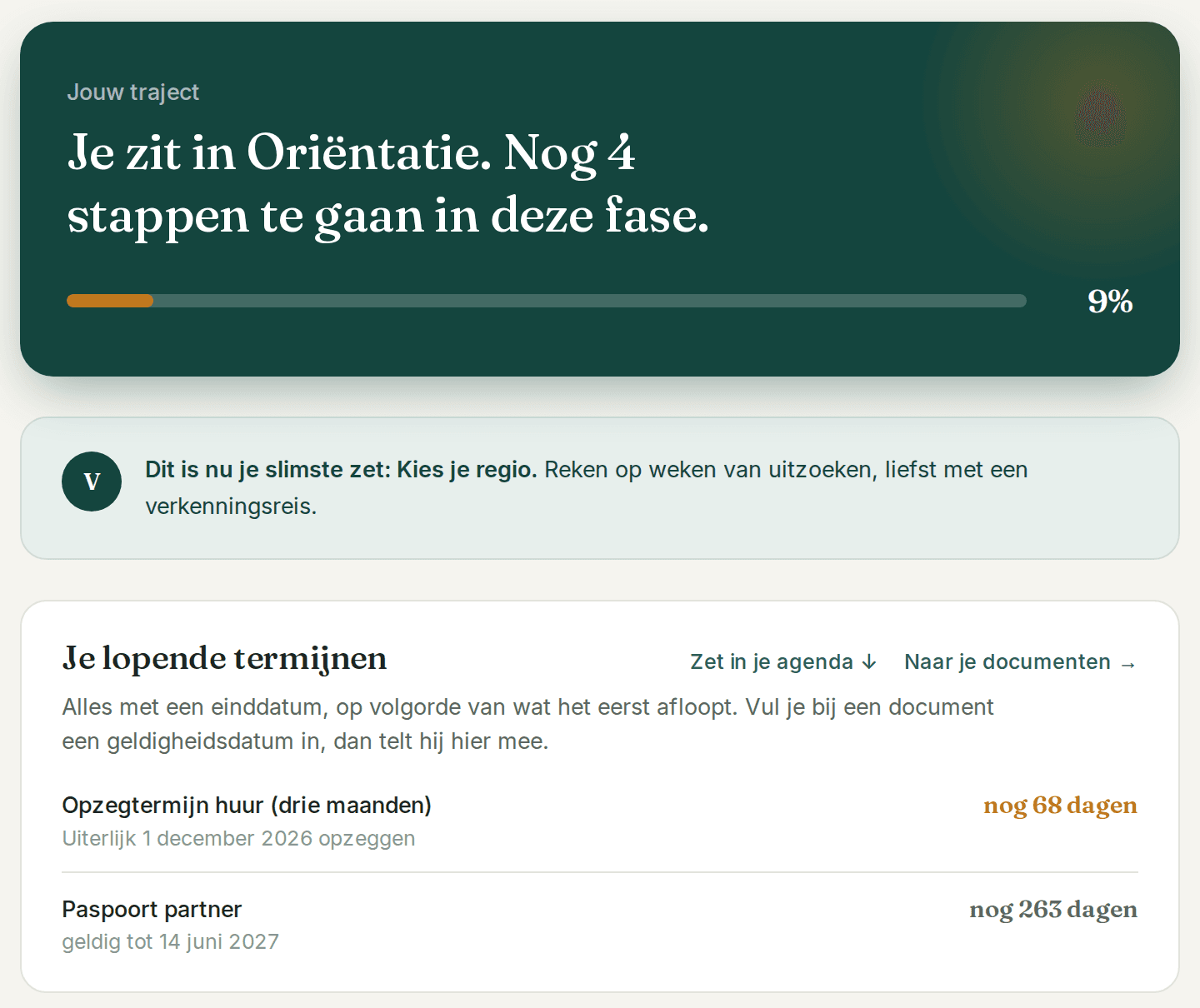
And this is the dashboard that step lives in. The example shows the plan for Spain; your dashboard shows the plan for Indonesia.
This is step 5.3 of 39. The other 38 are ready for you, each with the same sources, the same offices and a schedule that keeps track of your dates.
See all 39 steps for IndonesiaWhat you get for € 399
All 39 steps to Indonesia, for your situation
In order, with the office and the official source at every step. Steps that don't apply to you don't appear.
Your deadlines in one place
For each step you see the latest date to start, and you get a heads-up before something is due or expires. Your documents sit in the vault, with their dates.
A plan that stays right
Twice a month we check the sources. If something changes, it's in your plan and you get a message.
The step-by-step plan for Indonesia
€ 399
one-off · 39 steps
- Pay once, no subscription
- Destination changes? Within 30 days I switch your plan to another country free of charge
- Stuck on a step? You get a personal answer within two working days
What will your move to Indonesia cost? Work it out →
Know someone moving to Indonesia? Give this plan as a gift →
Every step on one list, free
Not ready to start yet? Then you get the departure checklist for Indonesia: every step in order, to print and tick off. With it, five mails in a week and a half about the pitfalls and the real costs. If the rules for Indonesia change, you'll hear about it. After that we ask once where your plans stand, send one offer, and now and then one thing that fits your moment. No newsletter, and you can switch it off at any time.
That was the move. And once you live there?
Which country may tax your pension once you live in Indonesia? Is there a favourable regime, a scheme that lowers your tax? And how do you get insured? That depends on where your income comes from. Tick it and you'll see which rules apply to you, with the source.
See the financial conditionsClosing down the Netherlands: all your letters in one go
Moving to Indonesia starts with leaving the Netherlands properly. That's why the plan includes the letter tool: you enter your details once and every cancellation and notification letter is ready.
Just the letters, without the plan? That works too, for € 49
- Health insurance, rent, energy, subscriptions, GP, school, bank and pension fund: 16 kinds of letters. You enter your details only once.
- A sending list that counts back from your departure date and your notice period, even when that's three months.
- Also what you need to ask for as an emigrant: your no-claims years in English, your medical file and the school report (the report on your child for the new school).


Auke, maker of Vertrekklaar
On 2 January we're leaving ourselves, on a trip around the world with our family. What I put here, I'm arranging for my own family too.
On 20 September 2026 a customer wrote that the CAK rule for early retirement was missing from his plan. He was right. That evening the step was in thirteen plans, with the source attached.
The knowledge base on Indonesia
Per phase, the articles that are already there. They're written from the same journey and go deeper than what fits above.
- Working in Indonesia: an employer with a plan, five years' experience, and no work on a retirement visaWorking in Indonesia runs through an employer that has a plan for foreign employees approved by the Ministry of Manpower, and through the E23 work visa. The employee has matching education, at least five years' experience and transfers their knowledge to an Indonesian colleague. On the retirement visa and the remote worker visa, work for Indonesian clients is prohibited.
- The residence routes to Indonesia: KITAS, Second Home and the clocksVisa, ITAS and the registration with Dukcapil are three different things, and whoever mixes them up gets stuck. The routes in a row, as the immigration service describes them: the E33F retirement visa from 55 with 3,000 dollars of income a month, the Silver Hair and the Second Home with a deposit, the remote worker, and the clocks that tick through all of them.
- AOW, pension and tax in Indonesia: article 19 is the lessonThe pension article sits at number 19 in this treaty, and it works the other way round from southern Europe: the Netherlands may keep taxing AOW, pension and annuity, and Indonesia gives a credit. The four-year expat scheme doesn't apply to retirees and doesn't combine with the treaty, the accrued AOW does travel with you in full, and the protective assessment gets no automatic deferral outside the EU.
- Healthcare in Indonesia: no treaty, no state insurance for retirees, and a visa that doesn't ask for itIndonesia is not a treaty country: no S1, no CAK. The Indonesian JKN system, run by BPJS Kesehatan, names as participants foreigners who work there for at least six months, not retirees. And the E33F retirement visa does not ask for health insurance. Your healthcare is therefore a private policy you choose yourself, and nobody checks whether it's any good.
- Your pet to Bali: the titre test, the prior notice and an island closed since 2008For a dog or cat from abroad the Indonesian quarantine agency asks for a health certificate, the vaccination book, the result of a rabies titre test and a prior notice before departure. Bali itself has had a governor's regulation since 2008 that temporarily closes the entry of dogs, cats and monkeys. So first find out where your animal may enter, and read this chapter first, not last.
- Your household goods to Indonesia: exemption only for work or study, VAT always, and the car is left outSince 2025 a new Indonesian regulation covers household effects: exemption from import duty for used household goods that arrive within ninety days before or after you. The taxes on import, such as VAT, remain due. Cars and motorcycles are excluded. And foreigners only get the exemption if they come to work or study: those who come to retire fall outside it.
All 13 articles about Indonesia
- A bank account in Indonesia: passport plus one document, and a state-owned bank for your visa
- Buying a house in Indonesia: a right of use, not ownership, and on Bali from five billion rupiah
- Your first weeks in Indonesia: fourteen days for Dukcapil, ninety for the deposit
- With children to Indonesia: the child visa, the sworn translation and a child benefit that stops
- Driving licence in Indonesia: no exchange, an exam instead, and the rules do not name your retirement ITAS
- SKTT and NPWP in Indonesia: your ITAS is not your registration
- Living on Bali: your rental contract is also a residence and tax document
Also applies to your move
Ready to begin?
The step-by-step plan for Indonesia: 39 steps, with your documents and your costs in one place. For each step you see the latest date to start. You pay once and it's yours.