Leaving from Belgium?To the Belgian plan →See the plan for Belgians moving to Spain →This plan is for people leaving the Netherlands.

Spain · No visa required
Emigrating to Spain
For Spain you need no visa, just the right order: each counter wants another's papers. This page shows which order works.
€ 199 one-off · 32 steps · no subscription
- Kind of journey
- No visa needed
- Obligation
- Staying over three months: register within three months of arrival
- Lead time
- Three to nine months (indicative)
Last updated: 17 October 2026
Will your departure date work? Check it in the free step-by-step plan →
Five phases, from orientation to being settled
Without a visa you wait for nobody's permission, so you set the pace yourself. Only the registration has to go strictly in order. There every document is the key to the next, and one missing paper means a new appointment.
- Orientation
Register after three months, with income and healthcare cover
In this phase you find out whether you meet the requirements for registration, and you choose your region. As an EU citizen you may live and work in Spain without a visa. But stay longer than three months and you have to register, within three months of arrival. For that you have to show income or assets, and have healthcare cover. If you work in Spain, that's arranged automatically. If you work remotely for a Dutch employer, or live off assets or a pension, your first homework is here. Choosing your region is more than a matter of taste: education, healthcare and tax are arranged regionally.Read more
- Closing the Netherlands
What's easier to arrange from here
In this phase you make your file complete, so that that one scarce appointment in Spain works first time. That's your head start. Your NIE, the identification number you need for almost everything, you only get in Spain, at your registration. The consulate only issues it to people staying less than three months. You also deregister with the municipality and arrange health insurance, benefits and the tax return for the year of emigration. Just as important: knowing what you deliberately should not do yet from here.Read more
- The move
By road, so more choice
In this phase you choose how your household contents, pets and car come along. Spain is reachable by road, and that gives options a shipment doesn't have: a full lorry, a part-load, driving yourself, or selling everything and starting again there. It doesn't have to be in one go. Going with suitcases first and having your household contents come later is common, and sometimes the wisest. Pets simply come along, with an EU pet passport, a valid rabies vaccination and a microchip. No quarantine is needed. You may drive your own car there for a limited time; then it has to go on Spanish plates.Read more
- Registration in Spain
Every document is the key to the next
In this phase you start with the empadronamiento: your registration at your address at the town hall. That paper is the condition for almost everything after: health card, school, buying a car and the green registration certificate. You then apply for that certificate with proof of your income and healthcare cover. Every family member needs their own copy. One missing document means a new appointment, and appointments are scarce.Read more
- Arrival
With your padrón to school, health card and GP
In this phase you arrange school, healthcare and tax. With your padrón (the proof of your registration at your address) you enrol the children definitively; public schools allocate by address. Bear the language in mind. Young children pick it up surprisingly fast. For teenagers the transition is harder and extra support is no luxury. Then health card, GP, and the question of where you'll pay tax. That last one deserves more attention than it usually gets.Read more
This is what one step of your plan looks like
This is the real thing: one of the steps of the Spain journey, exactly as it appears in your personal step-by-step plan, with the deadlines, the offices and the sources.
Step 4.3 of your plan
Get your evidence ready and pay the fee
- Lead time
- a week of collecting
- Costs
- fees — about ten euros per person, to be paid in advance with modelo 790, code 012
With this step your file is complete and ready for the registration appointment. People often skip this step, and then it costs them an appointment.
What you bring depends on your situation. You worked that out earlier in the plan, under "Know how you'll meet the income and healthcare requirement".
- Working in Spain? Your employment contract, or your registration as an autónomo (self-employed).
- Not working in Spain? Proof of sufficient means, and your health policy that covers all risks in Spain. As proof of means, a bank statement counts, not a screenshot of your balance.
- Retired? Your S1 form, which entitles you to healthcare in Spain at the Netherlands' expense.
Also pay the fee in advance, the cost of the application. You do that with form modelo 790, código 012. The proof of payment goes into your file.
Only make the appointment once all of this is ready. One missing paper means starting from the beginning, and appointments are scarce.
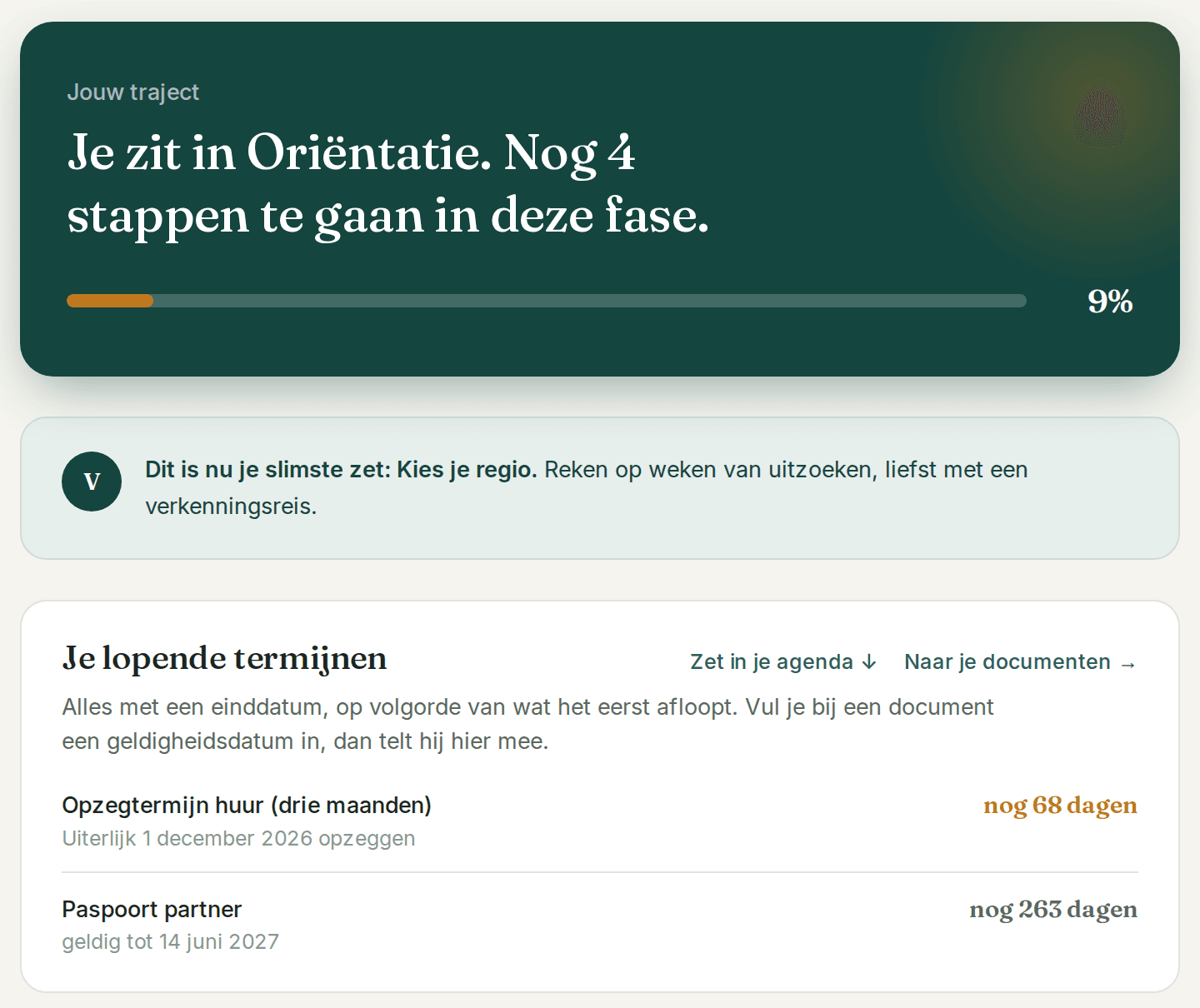
And this is the dashboard that step lives in, here with the plan for Spain.
This is step 4.3 of 34. The other 33 are ready for you, each with the same sources, the same offices and a schedule that keeps track of your dates.
See all 34 steps for SpainWhat you get for € 199
All 34 steps to Spain, for your situation
In order, with the office and the official source at every step. Steps that don't apply to you don't appear.
Your deadlines in one place
For each step you see the latest date to start, and you get a heads-up before something is due or expires. Your documents sit in the vault, with their dates.
A plan that stays right
Twice a month we check the sources. If something changes, it's in your plan and you get a message.
The step-by-step plan for Spain
€ 199
one-off · 34 steps
- Pay once, no subscription
- Destination changes? Within 30 days I switch your plan to another country free of charge
- Stuck on a step? You get a personal answer within two working days
What will your move to Spain cost? Work it out →
Know someone moving to Spain? Give this plan as a gift →
Every step on one list, free
Not ready to start yet? Then you get the departure checklist for Spain: every step in order, to print and tick off. With it, five mails in a week and a half about the pitfalls and the real costs. If the rules for Spain change, you'll hear about it. After that we ask once where your plans stand, send one offer, and now and then one thing that fits your moment. No newsletter, and you can switch it off at any time.
That was the move. And once you live there?
Which country may tax your pension once you live in Spain? Is there a favourable regime, a scheme that lowers your tax? And how do you get insured? That depends on where your income comes from. Tick it and you'll see which rules apply to you, with the source.
See the financial conditionsClosing down the Netherlands: all your letters in one go
Moving to Spain starts with leaving the Netherlands properly. That's why the plan includes the letter tool: you enter your details once and every cancellation and notification letter is ready.
Just the letters, without the plan? That works too, for € 49
- Health insurance, rent, energy, subscriptions, GP, school, bank and pension fund: 16 kinds of letters. You enter your details only once.
- A sending list that counts back from your departure date and your notice period, even when that's three months.
- Also what you need to ask for as an emigrant: your no-claims years in English, your medical file and the school report (the report on your child for the new school).


Auke, maker of Vertrekklaar
On 2 January we're leaving ourselves, on a trip around the world with our family. What I put here, I'm arranging for my own family too.
On 20 September 2026 a customer wrote that the CAK rule for early retirement was missing from his plan. He was right. That evening the step was in thirteen plans, with the source attached.
The knowledge base on Spain
Per phase, the articles that are already there. They're written from the same journey and go deeper than what fits above.
- The NIE: where and when you get itIf you are going to live in Spain, you get your identification number when you register in Spain. The consulate in Amsterdam only issues an NIE to people staying less than three months, and such a consular NIE is not valid for residing.
- Renting in Spain: five years of protection, one month's deposit, and the costs the landlord bearsSpanish tenancy law protects you better than its reputation: five years of security of tenure, a deposit capped by law, and since 2023 the agency fees are the landlord's. Plus the scam signals you need all the more as a foreigner.
- The Spanish healthcare system: three routes in, and one safety net that costs moneyWhoever works in Spain is automatically in public healthcare, pensioners come in with the S1 — and since 2018 legal residents without work have access too. For whoever falls under nothing there's the convenio especial: € 60 a month, with one important exception. And at the pharmacy you contribute, with a monthly ceiling that for pensioners can be as low as € 8.23.
- The Beckham regime: 24% flat tax, six years long — and why it isn't for pensionersWhoever moves to Spain to work or run a business there can opt for the regime of article 93: taxed as a non-resident, 24% on your Spanish employment income up to € 600,000, and your foreign income largely stays out of reach. You opt in with modelo 149 and file with modelo 151. The condition that excludes most Dutch emigrants: you have to come to work.
- The income and health-cover requirement: what Spain wants to see before you may stayWhoever stays longer than three months and doesn't work in Spain has to demonstrate two things — sufficient means and full health cover. What exactly is tested, which evidence counts, against which threshold the means are measured, and why there's no amount here.
- Being allowed to stay is not the same as being sortedAs a Dutch citizen you may live in Spain without a visa. That's exactly why people underestimate this process: there's no authority that stops you, and so nobody who tells you what you have to arrange.
All 21 articles about Spain
- Why you don't buy a house in your first year
- Working in Spain: no work permit, but a number, a minimum wage and a qualification that has to be recognised
- Taking your car to Spain: importing, matriculación and what it costs
- Taking your pet to Spain: chip, jab, passport — and 21 days of patience
- Your household contents to Spain: full load, part load or sell
- Cita previa: getting an appointment when there are none
- Empadronamiento: the registration everything else hangs on
- The green registration certificate: what you bring to the appointment
- Becoming an autónomo in Spain: since 2023 your contribution hangs on your real income
- Banking and paying in Spain: opening an account with your NIE, and what a basic account may cost
- Buying a house in Spain: there's no notary who arranges everything for you
- Your first weeks in Spain: the order that shapes the year after
- Your driving licence in Spain: the two-year myth, and what's really required
- Going to school in Spain: three kinds of school, and an address that chooses
- Where do you pay tax when you live in Spain?
Also applies to your move
Ready to begin?
The step-by-step plan for Spain: 34 steps, with your documents and your costs in one place. For each step you see the latest date to start. You pay once and it's yours.