Skip to content

Leaving from Belgium?To the Belgian plan →See the plan for Belgians moving to Ireland →This plan is for people leaving the Netherlands.

Step-by-step plan · No visa required

The step-by-step plan for Ireland

From "we want this" to being settled, in 37 steps. Read phase 1 in full here. Test your departure date along the way. Then you'll know whether you want the rest.

37 steps5 phases68 official sources10 only for your situationchecked on 14 October 2026

Phase 1 starts below ↓The whole plan: € 199 one-off, no subscription.

A plan that keeps track of what needs to happen now.

Every step sits in its place in the order, with the lead time, the counter and the official source. You and your partner tick off what is done. The plan counts back from your departure date and shows what has to start when and what is running now.

Below is phase 1, exactly as it appears in the plan.

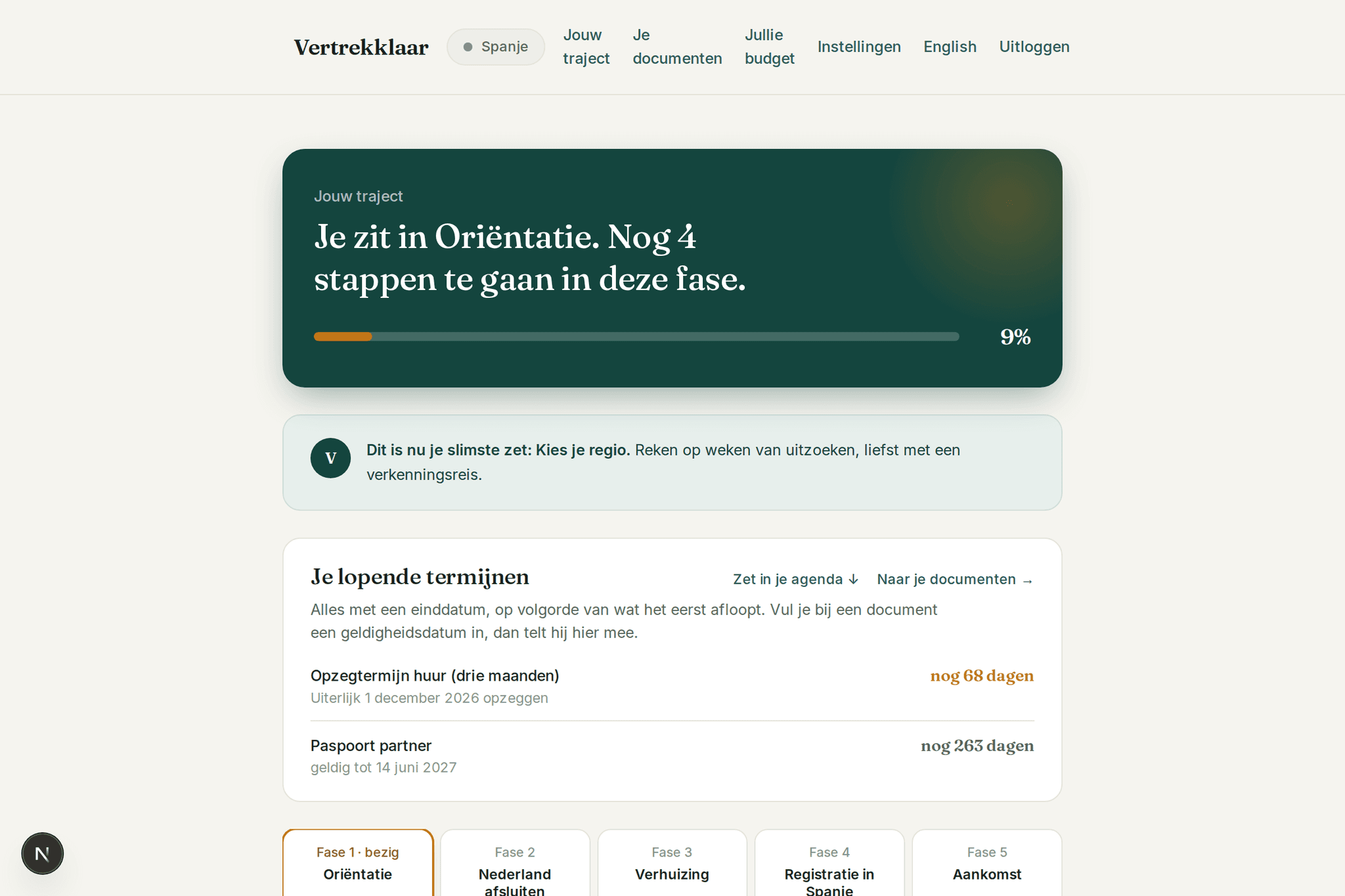
The dashboard of the step-by-step plan for Ireland: the current phase, the open steps, the next step and the deadline bar.

The route

  1. Orientation

    5 steps

    Open · You are here

  2. Closing the Netherlands

    15 steps

    In your plan

  3. The move

    3 steps

    In your plan

  4. Arrival

    8 steps

    In your plan

Phase 1 is the question "can we, and do we want to?". From phase 2 the arranging begins.

Phase 1 · Orientation

5 of 5 steps open

In Ireland you don't report anywhere: there's no counter and no register. That sounds like a convenience, but it's the theme of this whole journey. Without a register everything turns on proofs of address. Beyond that the question isn't whether you'll find a home, but how. This is the tightest rental market in the EU, with completely new rules since 1 March 2026.

By the end of phase 1 you know the Irish chain (the order in which you arrange everything, starting with an address), you know how the rental market and the new rules work, you've chosen your region and the family stands behind the decision.

Doing this together?

Invite your partner with a link. You then each tick your own steps, on your own phone or laptop, and see at every step whether the other has already done it. No account needed.

We only store which step numbers you ticked, under a random code. No name, no email. Anyone with the link can see the ticks. After six months without use we delete it.

Step 1.1

Understand the system: no register, so everything is proof of address

Lead time:
reading step
Costs:
none

In this step you learn why everything in Ireland turns on proof of address. It sets the order of your whole move.

As an EU citizen you don't have to register anywhere in Ireland. There's no immigration office, no municipality and no residence card. Ireland doesn't even have a population register like the Dutch BRP (the Personal Records Database, where your municipality records where you live). After three months you do have to meet the EU conditions: you work, or you have sufficient means plus health cover. Nobody checks that at a counter.

That sounds easy, but it turns on its head. Because there's no register, there's also no official proof that you live somewhere. So every body asks for proofs of address at most three months old: bills or official post in your name, at your address. That goes for the PPS counter (where you get your PPS number, the Irish citizen service number), for the bank and for the healthcare service. As a newcomer you don't have those yet.

That chicken-and-egg puzzle, and the official ways out of it, are the real system of this journey. You'll meet them later in the plan.

One more thing: Ireland is not in Schengen, the European area without passport checks at the border. So bring your passport or ID card, even on a flight from Amsterdam.

Checked against the official source

The official sources for this step

Step 1.2

Choose your Ireland: Dublin, the cities or the west

Lead time:
an evening of research, and the conversation about it
Costs:
none

In this step you choose where in Ireland you'll live. That choice shapes your housing search, and with it a large part of your costs.

  • Dublin is the jobs machine, with the European headquarters of the tech sector. It's also the most expensive and tightest housing market in the country.
  • Cork, Galway and Limerick offer city with a bit more air.
  • The west, with Kerry, Clare and Mayo, is the Ireland of the postcard: rugged, green and wet. It's far from the jobs that can't be done remotely.

The choice is sharper here than elsewhere. If you come for work, you'll almost certainly end up in the Dublin region. Then you have to cope with the rental market there. If you come on a pension or work remotely, you can head into the country and halve your housing costs. So make this choice before you start looking for a home. The choice is the housing search.

Step 1.3

Get a picture of what it's going to cost

Lead time:
1-2 hours with the calculator
Costs:
none

In this step you see what the move is going to cost you. The good news: the paperwork here is free. The PPS number costs nothing, and a registration doesn't exist.

The money goes mainly to three things:

  • The home. A new rental contract costs € 1,755 on average nationally, well above that in Dublin.
  • The crossing, if the car comes along.
  • The energy bill, because Ireland has the most expensive electricity in the EU.

Work it out with your own choices.

Step 1.4

Take the decision together

Lead time:
three evenings, and weeks to let it sink in
Costs:
none

In this step you decide together whether it's going to be Ireland. You end up with a few conditions on paper that you both stand behind.

Going alone? Then have this conversation with the people you leave behind. The questions below work for them too.

Take three evenings. One conversation is too short for a decision like this. Agree on three evenings, with a week in between:

  • Evening 1, why. What do we hope to find in Ireland? What are we leaving behind here? Would that really be different there?
  • Evening 2, what we give up. Who and what will we miss? What are we dreading most? What do we do if it disappoints?
  • Evening 3, the conditions. What has to be arranged for each of us to say yes? When do we check together whether it's going well, for example after six and after twelve months? And what would be a reason for us to go back?

Write the conditions down. On the kitchen-table card it all fits on one A4 sheet.

Ireland feels familiar: English, EU, an hour and a half's flight. Still, four things need to be on the table:

  • The rental market. This is the tightest in the EU, and the search can take months. If you have no buffer for an expensive bridging period, you need to know that beforehand.
  • The climate. Mild but wet, with a winter that's above all dark.
  • The costs. Groceries, healthcare without a medical card (the Irish healthcare card) and above all electricity are above Dutch levels.
  • Healthcare. Without a card the GP costs € 60 to € 80 per visit there. For pensioners the S1 route solves that surprisingly well. The S1 is a form from the CAK, the Dutch body for the healthcare of people living abroad on a Dutch pension.

Divide the work. Agree who takes on which part of this plan: the papers, the house and the cancellations, the school, the move. That way not one of you carries everything. Invite your partner into your plan; then you can both see what's done.

Is one of you going without an income of your own? Whoever lives in Ireland and doesn't work in the Netherlands usually no longer builds up AOW. For every year you're not insured, you later get 2 percent less AOW. From the moment you're no longer insured, you have one year to take out voluntary insurance with the SVB. Also discuss who carries the income in the first months, whether the partner without an income keeps an account and money of their own, and how you decide together on big expenses.

Married, registered or living together? It can make a difference for your partner's residence permit, for co-insurance in healthcare and for inheritance. If you're both Dutch, each of you lives in Ireland in your own right. If your partner has a nationality from outside the EU, they apply for a residence card in Ireland. A spouse or registered partner does so with the regular form, EUTR1. An unmarried partner in a durable relationship applies with EUTR1A for an assessment. Check at your healthcare further on in your plan what else applies to you.

Are children coming? How you tell them depends on their age:

  • Up to about four: tell them shortly before the move and keep fixed habits, like the bedtime ritual and the cuddly toy in the hand luggage.
  • Primary school: tell them well in advance and let them look along: photos of the school, the neighbourhood and the house. Let them choose something, like their room.
  • Teenagers: involve them in the decision itself. For them, saying goodbye to friends weighs heaviest. Agree how they keep in touch and when they see their friends again.

In Ireland you apply to each school separately, not through the council. The round for the next school year already opens on 1 October.

Who learns the language, and when? In Ireland daily life is in English. At school Irish is a core subject too. If your child went to school abroad for three years or more, and is 12 or over or has already finished primary school, they can get an exemption. Is the English of one of you rusty, often that of the partner without work and without colleagues? Then plan together how to brush it up, preferably before you leave.
Step 1.6

Choose your target date

Lead time:
five minutes, below
Costs:
none

Choose below the date on which you want to be in Ireland. The step-by-step plan works out whether that's feasible with what still has to happen. From that moment it guards the clocks that exist:

  • The seven days and thirty days around the car.
  • The 24-to-120-hour window for the dog's tapeworm treatment.
  • The three months for which every proof of address stays valid.

Is your situation slightly different?

A partner who stays in the Netherlands, work that carries on, a house you keep, children who stay at school here: I'm happy to talk those through, even before you have the plan. Email me what's going on for you. I read it myself and reply within two working days.

If you then take the plan, I'll work what we discussed into your personal plan.

Email me about your situation → info@vertrekklaar.nl

You know what you're getting into. Now the arranging begins.

You've read phase 1 of the step-by-step plan for Ireland. The full plan has another 32 steps ready for you: Closing the Netherlands, The move, Getting the basics in order in Ireland and Arrival.

The plan counts everything back from your departure date and watches your deadlines and documents. You only see the steps that apply to you.

The step-by-step plan for Ireland

€ 199

one-off · no subscription · instant access

Also included: deadlines watched · documents with expiry dates · only your steps · your partner ticks along · all cancellation letters · questions to me.

✎ I read along

Stuck somewhere? Ask your question at the step. I read it myself and answer within two working days. Or talk to me for fifteen minutes. Usually within a day of that call your situation is in the plan.

Not ready yet? Send yourself your date and phase 1 →

Phase 2 · Closing the Netherlands0 of 15 steps open

The familiar list, with two Irish particulars. The tax treaty resembles the one with Cyprus, but the threshold is higher. Up to € 25,000 total gross only Ireland taxes your pension and AOW. Above that the Netherlands may tax too. And the S1 route yields something special here: a medical card (the Irish healthcare card) without a means test. Without that card you pay the GP per visit.

  1. 2.1Arrange your healthcare: the S1 that's worth a medical cardstart 2-3 months before departure; the CAK application takes ± 4 weeks
  2. 2.2Pension and the treaty: the threshold of € 25,000the sum is an evening; work it out before every decision
  3. 2.3The tax wind-up: M return and the protective assessmentthe M return follows in the year after departure
  4. 2.4Stopping allowances and child benefitan hour
  5. 2.5Deregister with the municipalitypossible from 5 days before departure, up to and including departure day
  6. 2.6DigiD, bank and your vote: keep the lines with the Netherlandsan afternoon
  7. 2.7Documents: few, but the right onesextracts within a week
  8. 2.8Partner comes along without a job of their ownonly if this applies to you
  9. 2.9Living partly in the Netherlands: the eight-month ruleonly if this applies to you
  10. 2.10The house in the Netherlands: sell, rent out or keeponly if this applies to you
  11. 2.11Children staying in the Netherlands: DUO, healthcare and the houseonly if this applies to you
  12. 2.12Cancel what stops: job, rent, energy, subscriptions and schoolstart three months before departure; most notice periods are one month
  13. 2.15Prepare your child for the moveonly if this applies to you
  14. 2.13Stay reachable: DigiD, your phone number, your bank and your postarrange it before you leave; afterwards it takes weeks
  15. 2.14Student debt, remote work or your own business: what moves with youreport it before you leave; the consequences run for years
Phase 3 · The move0 of 3 steps open

No direct boat sails from the Netherlands to Ireland. You take the long ferry from France, or the land bridge through Great Britain. That route has needed customs papers since Brexit. On arrival three deadlines start for the car straight away: seven days, thirty days and twelve months. The dog has a window of 24 to 120 hours for its tapeworm treatment.

  1. 3.1Plan the journey: the long boat, or the land bridgequotes 4-6 weeks ahead
  2. 3.2The car: the VRT sum and the series of clocksonly if this applies to you
  3. 3.3The pet: the tapeworm clockonly if this applies to you
Phase 4 · Getting the basics in order in Ireland0 of 6 steps open

There's nothing to register, but there is a basis to build. The order here is the reverse of the rest of Europe: first the address, only then everything else. You can only apply for the PPS number (the Irish citizen service number) after arrival. The bank wants a proof of address at most three months old. And the official way out of that chicken-and-egg puzzle is simply on the government site.

  1. 4.1Find your home: the tightest market in the EU, with new rulescount on weeks to months; start before arrival
  2. 4.2The PPS number: only here, and with the chicken-and-egg trickapplication online, appointment in person; count on a few weeks
  3. 4.3The bank account: the same proof of address, the same solutiondays once the proof of address is there
  4. 4.4Revenue: register and collect your tax creditsonline, as soon as your PPS number is in
  5. 4.5Healthcare: submit the S1, or apply for the cardsthe S1 processing takes weeks; start straight away
  6. 4.6Utilities: build your proof-of-address filea week
Phase 5 · Arrival0 of 8 steps open

The basis is there; now it becomes a life. The car meets its deadlines. The tax return has its Irish peculiarities, such as no USC (an extra levy on income) on your AOW, and the remittance basis for whoever knows how to use it. The school is Catholic in 88% of cases, with the right to opt your child out of religion. And you learn to keep your energy bill in check.

  1. 5.1The car: through the series of clocksonly if this applies to you
  2. 5.2Work: the jobs machine, looked at honestlyongoing
  3. 5.3Tax in practice: USC, PRSI and the remittance basisthe return follows annually
  4. 5.4Family: choosing a school in a Catholic systemonly if this applies to you
  5. 5.5The house through the year: the most expensive electricity in the EUarrange it in your first month
  6. 5.6Driving: on the left, and your driving licence simply stays validtakes two weeks to get used to
  7. 5.7The small print: the rhythm of the islandspread over the first year
  8. 5.8Help your child settle in: the first monthsonly if this applies to you

10 of these 32 steps only appear when your answers call for them: a pet, a car, a partner without a job, children staying in the Netherlands.

Every step on one list, free

Not ready to start yet? Then you get the departure checklist for Ireland: every step in order, to print and tick off. With it, five mails in a week and a half about the pitfalls and the real costs. If the rules for Ireland change, you'll hear about it. After that we ask once where your plans stand, send one offer, and now and then one thing that fits your moment. No newsletter, and you can switch it off at any time.

Then we count back to when you need to start at the latest, and you get a nudge at that moment. And one more, a month before you leave.

We use your address, and your departure date if you fill it in, only for the checklist, the guide and the mails after it. You can unsubscribe under every mail.

Three questions

Can't I find all this for free?

Yes. Everything in the plan comes from official sources, and they're listed at every step. You can check that yourself in phase 1 above. What you buy is the work around it: which of the 32 following steps apply to you, in which order, with which deadline, and a nudge when something needs doing.

Does this apply to my situation too?

The plan first asks who is coming along, what is coming along and how you're leaving the Netherlands. It then leaves out what doesn't apply to you, and adds what only fits your situation. Is your situation slightly different from what's written? Ask your question at the step. You'll get an answer within two working days.

What if the rules change after I buy?

Then your plan changes with them. Twice a month we check every source. Whatever changes is in your plan the same week, with the date. Your access lasts for your whole departure.

Ready to begin?

The step-by-step plan for Ireland: 37 steps, with your documents and your costs in one place. For each step you see the latest date to start. You pay once and it's yours.