Skip to content

Leaving from Belgium?To the Belgian plan →See the plan for Belgians moving to Costa Rica →This plan is for people leaving the Netherlands.

Step-by-step plan · Visa required

The step-by-step plan for Costa Rica

From "we want this" to being settled, in 37 steps. Read phase 1 in full here. Test your departure date along the way. Then you'll know whether you want the rest.

37 steps5 phases68 official sources8 only for your situationchecked on 14 October 2026

Phase 1 starts below ↓The whole plan: € 399 one-off, no subscription.

A plan that keeps track of what needs to happen now.

Every step sits in its place in the order, with the lead time, the counter and the official source. You and your partner tick off what is done. The plan counts back from your departure date and shows what has to start when and what is running now.

Below is phase 1, exactly as it appears in the plan.

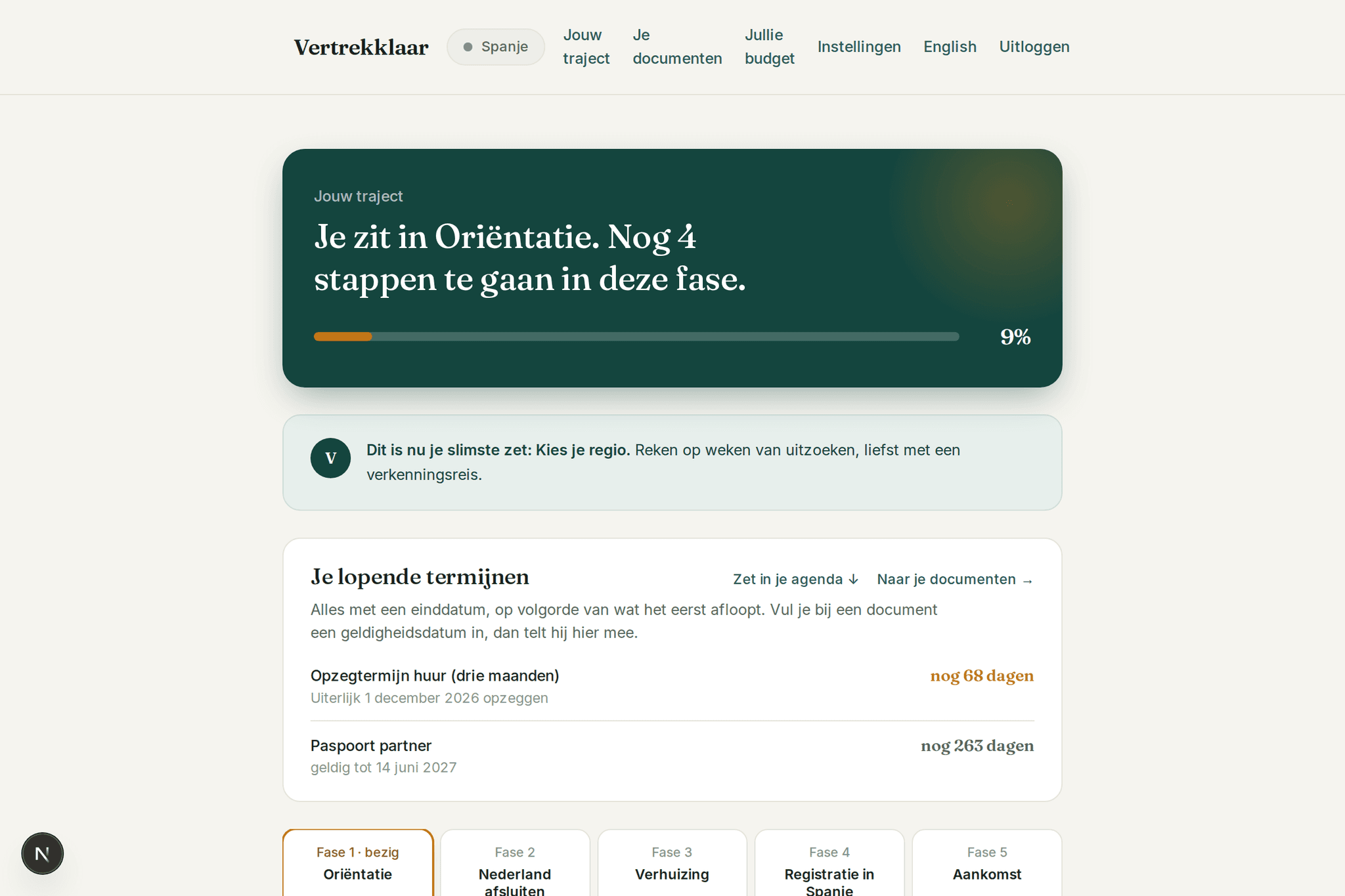
The dashboard of the step-by-step plan for Costa Rica: the current phase, the open steps, the next step and the deadline bar.

The route

  1. Orientation

    6 steps

    Open · You are here

  2. Your right of residence

    6 steps

    In your plan

  3. Closing the Netherlands

    12 steps

    In your plan

  4. The move

    4 steps

    In your plan

  5. Arrival in Costa Rica

    9 steps

    In your plan

Phase 1 is the question "can we, and do we want to?". From phase 2 the arranging begins.

Phase 1 · Orientation

6 of 6 steps open

Costa Rica has no treaty at all with the Netherlands: not for tax, not for social security and not for healthcare. That doesn't make the journey harder. But it does make the sum come out differently from what every brochure says. Moreover, the brochure still reckons with a law that has been closed since July 2026.

At the end of phase 1 you know the three residence cards, you know what happens to your income, your AOW and your healthcare, and the family stands behind the decision.

Doing this together?

Invite your partner with a link. You then each tick your own steps, on your own phone or laptop, and see at every step whether the other has already done it. No account needed.

We only store which step numbers you ticked, under a random code. No name, no email. Anyone with the link can see the ticks. After six months without use we delete it.

Step 1.1

Understand the system: three cards, an income test in dollars, and a law that has just closed

Lead time:
reading step
Costs:
none

In this step you learn which residence cards there are. You also read which promise from the brochures no longer applies.

Whoever stays to live in Costa Rica chooses from three cards. All three are in the migration law of 2009:

  • As a pensionado (retiree) you show a lifelong pension of at least 1,000 dollars a month.
  • As a rentista (someone living on fixed income) you show fixed income of at least 2,500 dollars a month.
  • As an inversionista (investor) you make an investment.

All three first give you a temporary residence, a residence permit for two years. You can renew it. After three years you get the permanent residence.

Then what the brochures haven't yet processed. A law of 2021 gave newcomers two advantages. You could import your household goods and two cars tax-free. And you got twenty percent off the transfer tax, the tax you pay when you buy a house. That applied only to applications in the first five years. Those five years expired on 14 July 2026.

So whoever comes now pays duties on their household goods and the full tax on a car. That is why this plan counts on selling and buying again.

Step 1.2

Know what happens to your income, your AOW and your healthcare

Lead time:
an evening of research
Costs:
none

In this step you see what it means that there are no treaties. It's about your income, your AOW and your healthcare. Three times no treaty, and three times a consequence.

The tax. The Netherlands has no tax treaty with Costa Rica. Then the main rule applies, as NederlandWereldwijd explains it: the Netherlands may tax. So your AOW, your occupational pension and your government pension stay taxed in the Netherlands. Because you live outside the EU, you usually don't get the tax credits, the reductions on your tax that you do get in the Netherlands. Costa Rica taxes only income from a Costa Rican source. So you pay nothing there on your Dutch income.

The AOW itself. Costa Rica isn't among the 36 countries the Netherlands has a social security treaty with. Your accrued AOW does come along, but at most up to the married rate: the amount for someone who is married or living together. For a couple nothing changes. Whoever goes alone falls back from seventy to fifty percent of the net minimum wage.

The healthcare. Costa Rica isn't on the CAK list, the list of countries where you can stay insured through the CAK. So your Dutch basic insurance ends when you deregister. An own policy then is your health insurance. But unlike in Panama or Mexico something comes on top. As a resident you have to affiliate to the Caja, the Costa Rican state healthcare system. You pay a percentage of your declared income for it.

Your AOW accrual stops. That's something different from the payment. What you've built up until you leave stays yours. But as soon as you're no longer insured in the Netherlands, you build up nothing more. For most emigrants that is the moment of departure. Every year until your AOW age then costs you 2% of your later AOW. Voluntary continued insurance with the SVB is possible, for ten years at most. But the application has to be in within one year of your insurance ending. After that the door is closed. If you already receive AOW, this no longer applies.

Step 1.3

Explore the region, and look beyond the beach

Lead time:
weeks, preferably with a scouting trip
Costs:
a scouting trip is a serious cost item

In this step you choose where in Costa Rica you want to live. Look beyond your holiday when you do.

On holiday you mostly see the coast. To live, most Dutch people choose the Central Valley, with San José, Escazú, Santa Ana, Heredia, Grecia and Atenas. There it's always spring, and there are the hospitals and the airport. The coast of Guanacaste has the sun and the prices of Florida. The Caribbean side has the rain and the quiet.

Factor into that choice what doesn't stand out on holiday:

  • The rainy season runs from May to November. In the mountains it is then very different from dry Guanacaste.
  • The good hospitals are in the valley.
  • On the coast a boundary applies that you won't meet anywhere else. The first two hundred metres from the high-water line belong to the state. More on that in phase 5.

Step 1.4

Get a picture of what it's going to cost

Lead time:
1-2 hours with the calculator
Costs:
none

In this step you see what the move is going to cost. On the application side Costa Rica is cheap in fees (the government's charges), but expensive in lawyer. Almost everyone has the file lodged by a Costa Rican lawyer. That is the largest item before departure.

After that come these items:

  • The contribution to the Caja, which returns every month.
  • The move across the ocean, with duties on the household goods.
  • The car, which you don't take along here.

Step 1.5

The family conversation

Lead time:
three evenings, and weeks to let it sink in
Costs:
none

In this conversation you decide together whether it will be Costa Rica. You set down what each of you needs to say yes.

Going alone? Then have this conversation with the people you leave behind. The questions below work for them too.

Take three evenings. One conversation is too short for a decision like this. Agree on three evenings, a week apart:

  • Evening 1, why. What do we hope to find in Costa Rica? What are we leaving behind here? Would that really be different there?
  • Evening 2, what we give up. Who and what will we miss? What are we dreading most? What do we do if it disappoints?
  • Evening 3, the conditions. What has to be in place for each of us to say yes? When do we check together whether it's going well, for example after six and after twelve months? And what would be a reason for us to go back?

Write the conditions down. On the kitchen-table card it all fits on one A4.

With Costa Rica comes a sum you need to see together:

  • Whoever goes alone gives up twenty percentage points of AOW.
  • Whoever is older has to be insured twice. Their own policy, because the Caja isn't everything. And the Caja, because the law requires it.

Work that out before you decide, not after.

Also discuss the distance and the pace. You fly eleven to thirteen hours, with a layover. The time difference is seven or eight hours. And the government counts in months, where the Netherlands counts in weeks.

Divide the work. Agree who takes on which part of this plan: the papers for the visa, the house and the cancellations, the school, the move. That way not one of you carries everything. Invite your partner into your plan; then you both see what's done.

Is one of you going without an income of your own? Whoever lives in Costa Rica and doesn't work in the Netherlands usually no longer builds up AOW, the Dutch state pension. For every year you're not insured, you later get 2 percent less AOW. You can insure yourself voluntarily with the SVB. You have one year for that, counted from the moment you're no longer insured. Also discuss whether that partner keeps an account and money of their own, and how you decide together on large expenses.

Married, registered or living together? That can make a difference for your partner's residence permit, for co-insurance in healthcare and for inheritance. For the pensionado and the rentista, the Costa Rican migration law names your spouse and your children under 25 as the family members who come along on your card. An unmarried partner isn't named there. If you're not married, read at partner and children further on in your plan what that means, and ask before you apply.

Are children coming? How you tell them depends on their age:

  • Up to about four. Tell them shortly before the move and keep fixed routines, such as the bedtime ritual and the cuddly toy in the hand luggage.
  • Primary school. Tell them well in advance and let them look along: photos of the school, the neighbourhood and the house. Let them choose something, such as their room.
  • Teenagers. Involve them in the decision itself. For them, saying goodbye to friends weighs the most. Agree how they keep in touch and when they'll see their friends again.

How school works in Costa Rica, and when the school year starts, is in the article about school with this step.

Who learns the language, and when? In Costa Rica life runs in Spanish, right down to the translation of your own papers. Often the partner without work needs the language most, and that's exactly the one without colleagues to practise with. Agree who will learn Spanish, and how. Plan it together, preferably before you leave.
Step 1.6

Choose your target date

Lead time:
decision moment
Costs:
none

With this step you choose the date on which you want to live in Costa Rica. From here everything counts back. Keep an eye on the clocks of this journey:

  • The tightest clock is the 180 days you get as a tourist. Within that time your application has to be lodged.
  • The longest clock is the waiting time for the decision: months, sometimes more than a year. That decides when your card and your Caja can happen.

Is your situation slightly different?

A partner who stays in the Netherlands, work that carries on, a house you keep, children who stay at school here: I'm happy to talk those through, even before you have the plan. Email me what's going on for you. I read it myself and reply within two working days.

If you then take the plan, I'll work what we discussed into your personal plan.

Email me about your situation → info@vertrekklaar.nl

You know what you're getting into. Now the arranging begins.

You've read phase 1 of the step-by-step plan for Costa Rica. The full plan has another 31 steps ready for you: Your right of residence, Closing the Netherlands, The move and Arrival in Costa Rica.

The plan counts everything back from your departure date and watches your deadlines and documents. You only see the steps that apply to you.

The step-by-step plan for Costa Rica

€ 399

one-off · no subscription · instant access

Also included: deadlines watched · documents with expiry dates · only your steps · your partner ticks along · all cancellation letters · questions to me.

✎ I read along

Stuck somewhere? Ask your question at the step. I read it myself and answer within two working days. Or talk to me for fifteen minutes. Usually within a day of that call your situation is in the plan.

Not ready yet? Send yourself your date and phase 1 →

Phase 2 · Your right of residence0 of 6 steps open

The income test is simple. The work is in the documents: an apostilled pension statement, a birth certificate and a police certificate that may not be older than six months when you lodge, an official translation, and a lawyer who lodges the file in Costa Rica.

  1. 2.1Choose your category: pensionado, rentista or inversionistareading step
  2. 2.2Prove your income: the pension statement, apostilled and translatedthe statement days; apostille and translation weeks
  3. 2.3Gather the certificates: birth certificate and police certificate, each at most six months oldthe police certificate two to four weeks; the certificate days; apostille on top
  4. 2.4Choose where you lodge: in Costa Rica as a tourist, or at the consulatedecision moment
  5. 2.5Know the 180 days, and the waiting time afterreading step
  6. 2.6Partner and children: dependientes on your cardonly if this applies to you
Phase 3 · Closing the Netherlands0 of 12 steps open

In this phase you make the sum that matters most: what remains net. The Netherlands lets go of nothing. So you don't apply for an exemption, but reckon with the Dutch tax without credits and with the married rate for your AOW. And your health policy has to be settled before you deregister.

  1. 3.1Arrange your healthcare before you deregister: no CAK, but a policy, and soon the Caja on topacceptance takes weeks; start three months before departure
  2. 3.2Know where you pay tax: the Netherlands keeps taxing, without tax creditsone good conversation with a tax adviser
  3. 3.3Know the Costa Rican side: a territorial system, and the law that is closedan evening of reading, and a conversation with the lawyer
  4. 3.4Deregister and inform the SVB, with the married rate in handderegistering is possible from 5 days before departure; the whole takes 4-8 weeks
  5. 3.5If children come along, the child benefit stopsonly if this applies to you
  6. 3.6Partner comes along without a job of their ownonly if this applies to you
  7. 3.7The house in the Netherlands: sell, let or keeponly if this applies to you
  8. 3.8Annuity or company: the protective assessment without automatic deferrala conversation with your tax adviser, before departure
  9. 3.9Cancel what stops: job, rent, energy, subscriptions and schoolstart three months before departure; most notice periods are one month
  10. 3.12Prepare your child for the moveonly if this applies to you
  11. 3.10Stay reachable: DigiD, your phone number, your bank and your postarrange it before you leave; afterwards it takes weeks
  12. 3.11Student debt, remote work or your own business: what moves with youreport it before you leave; the consequences run for years
Phase 4 · The move0 of 4 steps open

Since 14 July 2026 your household goods no longer enter the country free, and your car not at all. Count on duties and VAT on what you ship. You sell your car here, and buy another one there. Your pet needs a chip, the vaccinations and an examination within two weeks before departure.

  1. 4.1Choose your form of move and request quotesquotes 2-3 weeks; the transport itself five to eight weeks
  2. 4.2The household goods: duties and VAT, now that the exemption of 2021 is closedthe inventory takes days; the clearance a week
  3. 4.3The car: more than half the value in tax, so sellonly if this applies to you
  4. 4.4Pet along: chip, vaccinations and an examination within two weeksonly if this applies to you
Phase 5 · Arrival in Costa Rica0 of 9 steps open

After landing everything hangs on one decision by the immigration service, and it takes months. In the first weeks you have your fingerprints taken and lodge your application. Then you wait. As soon as the approval is there, you go to the Caja in the same week and then collect your card. Your driving licence and your bank don't have to wait for the card.

  1. 5.1Lodge: fingerprints at the ministry, the file at the DGMEthe fingerprints a morning; the lodging an appointment; the decision months
  2. 5.2The DIMEX: collect your card, and the Caja within the terma few weeks after approval
  3. 5.3Affiliate to the Caja: the reference income and the percentagean appointment at the sucursal, a calculation, a monthly debit
  4. 5.4Bank, cédula number and addressdays to weeks
  5. 5.5The driving licence: homologation without exam, already with a pending applicationan appointment, a medical, an afternoon
  6. 5.6Living and buying: the two hundred metres and the five yearsweeks to months
  7. 5.7Renew after two years, permanent after threerecurring; the application before the card expires
  8. 5.9Help your child settle in: the first monthsonly if this applies to you
  9. 5.8Landedthe moment itself

8 of these 31 steps only appear when your answers call for them: a pet, a car, a partner without a job, children staying in the Netherlands.

Every step on one list, free

Not ready to start yet? Then you get the departure checklist for Costa Rica: every step in order, to print and tick off. With it, five mails in a week and a half about the pitfalls and the real costs. If the rules for Costa Rica change, you'll hear about it. After that we ask once where your plans stand, send one offer, and now and then one thing that fits your moment. No newsletter, and you can switch it off at any time.

Then we count back to when you need to start at the latest, and you get a nudge at that moment. And one more, a month before you leave.

We use your address, and your departure date if you fill it in, only for the checklist, the guide and the mails after it. You can unsubscribe under every mail.

Three questions

Can't I find all this for free?

Yes. Everything in the plan comes from official sources, and they're listed at every step. You can check that yourself in phase 1 above. What you buy is the work around it: which of the 31 following steps apply to you, in which order, with which deadline, and a nudge when something needs doing.

Does this apply to my situation too?

The plan first asks who is coming along, what is coming along and how you're leaving the Netherlands. It then leaves out what doesn't apply to you, and adds what only fits your situation. Is your situation slightly different from what's written? Ask your question at the step. You'll get an answer within two working days.

What if the rules change after I buy?

Then your plan changes with them. Twice a month we check every source. Whatever changes is in your plan the same week, with the date. Your access lasts for your whole departure.

Ready to begin?

The step-by-step plan for Costa Rica: 37 steps, with your documents and your costs in one place. For each step you see the latest date to start. You pay once and it's yours.