Skip to content

Leaving from Belgium?To the Belgian plan →See the plan for Belgians moving to Austria →This plan is for people leaving the Netherlands.

Step-by-step plan · No visa required

The step-by-step plan for Austria

From "we want this" to being settled, in 37 steps. Read phase 1 in full here. Test your departure date along the way. Then you'll know whether you want the rest.

37 steps5 phases89 official sources11 only for your situationchecked on 14 October 2026

Phase 1 starts below ↓The whole plan: € 199 one-off, no subscription.

A plan that keeps track of what needs to happen now.

Every step sits in its place in the order, with the lead time, the counter and the official source. You and your partner tick off what is done. The plan counts back from your departure date and shows what has to start when and what is running now.

Below is phase 1, exactly as it appears in the plan.

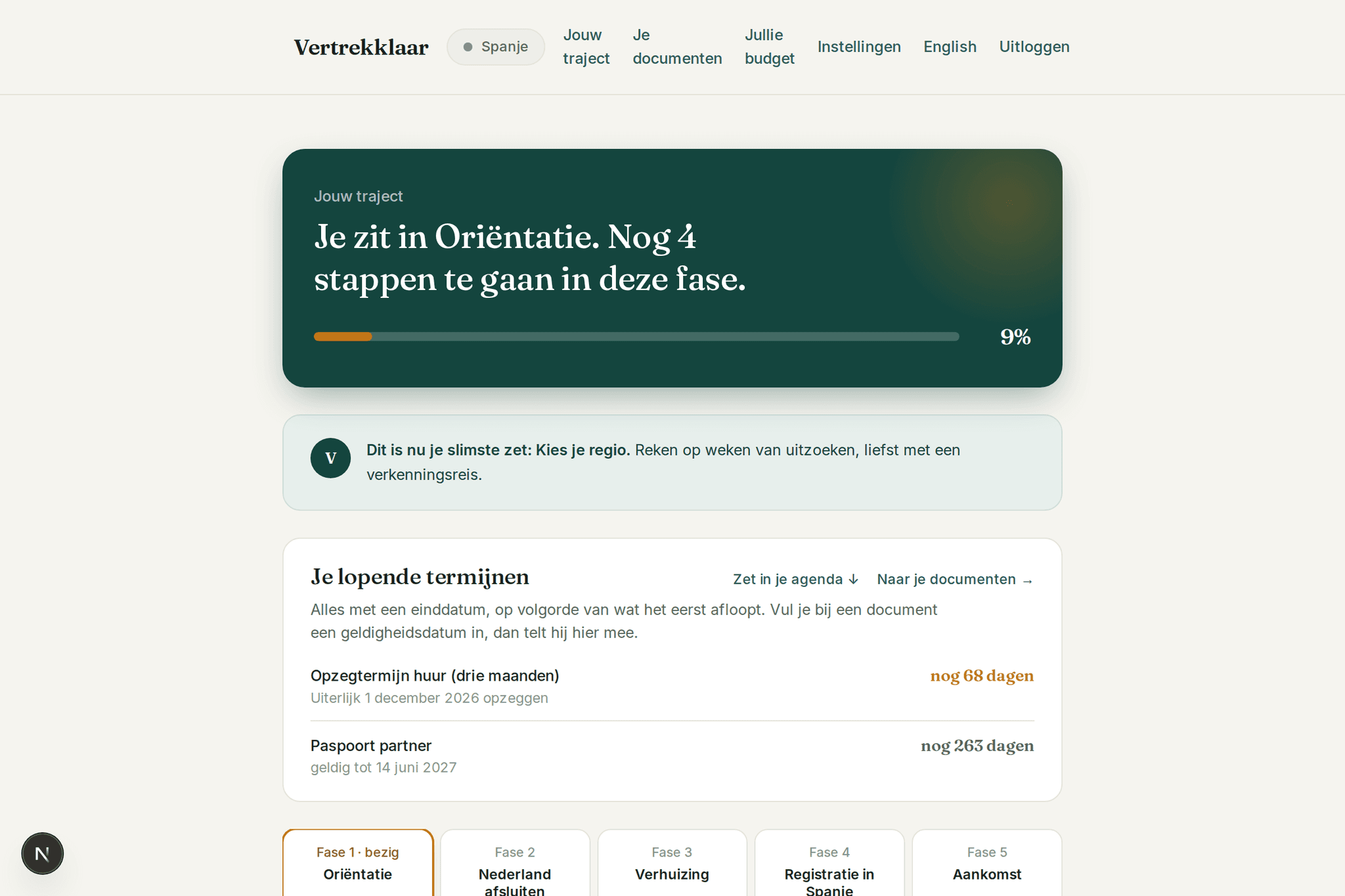
The dashboard of the step-by-step plan for Austria: the current phase, the open steps, the next step and the deadline bar.

The route

  1. Orientation

    5 steps

    Open · You are here

  2. Closing the Netherlands

    15 steps

    In your plan

  3. Move

    3 steps

    In your plan

  4. Registration in Austria

    6 steps

    In your plan

  5. Arrival

    8 steps

    In your plan

Phase 1 is the question "can we, and do we want to?". From phase 2 the arranging begins.

Phase 1 · Orientation

5 of 5 steps open

For Austria you need no permit, but you do need punctuality. Three deadlines apply: three days for your registration, one month for your car and four months for your residence document. That last deadline already starts counting at the border. Whoever knows the deadlines is settled in weeks. Whoever misses them pays fines fixed by law.

By the end of phase 1 you know the three deadlines, you know whether it pays to bring your car, and the family stands behind the decision.

Doing this together?

Invite your partner with a link. You then each tick your own steps, on your own phone or laptop, and see at every step whether the other has already done it. No account needed.

We only store which step numbers you ticked, under a random code. No name, no email. Anyone with the link can see the ticks. After six months without use we delete it.

Step 1.1

Understand the system: three clocks, one order

Lead time:
reading step
Costs:
none

In this step you get to know the deadlines that shape your whole planning. As an EU citizen you don't need a permit in Austria. The law does give you three deadlines, which this plan calls the three clocks:

  • The Meldezettel. This is your registration at your home address. You register within three days of moving into your home, with your landlord's signature on the form.
  • The Anmeldebescheinigung. This is the residence document for EU citizens. You apply for it within four months. That period runs from your entry, not from your registration.
  • The car. You may drive on Dutch plates for one month. After that the car has to be registered in Austria.

Around these runs a fixed order. First the Meldezettel, then social insurance via your employer, then ID Austria (the Austrian digital identity) and finally the Anmeldebescheinigung. The step-by-step plan keeps track of the order and the clocks for you.

Checked against the official source

The official sources for this step

Step 1.2

The car: do the sum before you decide

Lead time:
an evening of calculating
Costs:
none

In this step you work out whether it pays to bring your car. Do that before you decide.

The biggest myth of this route is: "as removal goods your car is exempt". That's not true. Austria levies the NoVA, a tax at a car's first registration in Austria. You pay it even when you move from an EU country. The six-month rule that circulates online is the customs exemption for people coming from a country outside the EU.

The rules that do apply:

  • A fully electric car pays 0%.
  • For a used car, the NoVA rate of the moment of its first Dutch registration applies. So a car from before mid-2021 falls under the old, milder rate.
  • Against that, the Netherlands refunds the remaining BPM, because you export the car within the EU. The remaining BPM is the part of the Dutch car tax that's still in your car's value.
  • The cost of re-registering to Austrian plates is modest.

Work your own car through before you decide. For an economical or electric car, bringing it is usually favourable. For an older car that uses a lot of fuel and emits a lot of CO2, rarely.

Checked against the official source

The official sources for this step

Step 1.3

Get a picture of what it's going to cost

Lead time:
1-2 hours with the calculator
Costs:
none

In this step you see what the move is going to cost you. The paperwork costs little here: the Meldezettel is free and the Anmeldebescheinigung costs € 44.

The money is mainly in these items:

  • The home, with a deposit of up to three, sometimes six months' rent.
  • The drive, with the vignette (the toll pass for the Austrian motorways).
  • The car, if you bring it. You do that sum in the step about the car.

Austria offers something in return: fourteen months' salary, two of them at six per cent tax. Work it out with your own choices in the calculator.

Step 1.4

Take the decision together

Lead time:
three evenings, and weeks to let it sink in
Costs:
none

With this step you decide together whether you go. Austria feels close: same time zone, eight hours' drive. Still, a few things deserve an honest conversation before you decide.

Going alone? Then have this conversation with the people you're leaving behind. The questions below work for them too.

Take three evenings. One conversation is too short for a decision like this. Set aside three evenings, a week apart. Talk with your partner, and depending on their age with your children too:

  • Evening 1, why. Why do we want this? What do we hope to find in Austria? What are we leaving behind here? Would that really be different there?
  • Evening 2, what we give up. Who and what will we miss? What are we dreading most? What do we do if it disappoints?
  • Evening 3, the conditions. What needs to be in place for each of us to say yes? When do we check together whether it's going well, for example after six and after twelve months? And what would be a reason for us to come back?

Write the conditions down. On the kitchen-table card it all fits on one A4 sheet.

Take the mountains into those evenings too. Winter is a lifestyle there, and it costs money: winter tyres, vignettes, and a mountain you only go up insured.

Divide the work. Agree who takes on which part of this plan: the papers, the house and the cancellations, the school, the move. That way not one of you carries everything. Invite your partner into your plan; then you both see what's done.

Is one of you going without an income of your own? Someone who lives in Austria and doesn't work in the Netherlands usually stops building up AOW. AOW is the Dutch state pension. For every year you're not insured, you later get 2 percent less AOW. From the moment you're no longer insured, you have one year to take out voluntary insurance with the SVB.

Also discuss whether that partner keeps an account and money of their own, and how you decide together on big expenses. And who earns the income in the first months?

Married, registered or living together? That can matter for your partner's right of residence, for being insured together for healthcare and for inheritance. If your partner is an EU citizen, your partner has a right of residence of their own. If your partner has a nationality from outside the EU, your partner lives in Austria as a family member of an EU citizen. Not every EU country treats a registered partnership as a marriage. If you're neither married nor registered, the country decides case by case, on the basis of a durable relationship. Check in the step on your healthcare further on in your plan what applies to you.

Are children coming? How you tell them depends on their age:

  • Up to about four. Tell them shortly before the move and keep fixed routines, such as the bedtime ritual and the cuddly toy in the hand luggage.
  • Primary school. Tell them well in advance and let them look along: photos of the school, the neighbourhood and the house. Let them choose something, such as their room.
  • Teenagers. Involve them in the decision itself. For them, saying goodbye to friends weighs heaviest. Agree how they'll stay in touch and when they'll see their friends again.

Mind the school choice at ten. After four years of Volksschule (primary school) the system already chooses between Gymnasium and Mittelschule. That's four years earlier than in the Netherlands, and the Volksschule report has a say. If you move with a child of eight or nine, start with German from day one. For children who arrive without German there are Deutschförderklassen, separate classes to learn German.

Who learns the language, and when? Every counter works in German, "Sie" is the standard and titles matter. Whoever speaks German integrates quickly here. Whoever doesn't stays on the outside. Often the partner without work needs the language most, and that's exactly the one with no colleagues to practise with. Plan it together, preferably before you leave.
Step 1.6

Choose your target date

Lead time:
five minutes, below
Costs:
none

Choose below the date on which you want to be standing in Austria. The step-by-step plan works out whether that's feasible with what still has to happen. If it gets tight, it says so honestly. A target date is yours: you can always move it, and moving it is a perfectly fine outcome.

Is your situation slightly different?

A partner who stays in the Netherlands, work that carries on, a house you keep, children who stay at school here: I'm happy to talk those through, even before you have the plan. Email me what's going on for you. I read it myself and reply within two working days.

If you then take the plan, I'll work what we discussed into your personal plan.

Email me about your situation → info@vertrekklaar.nl

You know what you're getting into. Now the arranging begins.

You've read phase 1 of the step-by-step plan for Austria. The full plan has another 32 steps ready for you: Closing the Netherlands, Move, Registration in Austria and Arrival.

The plan counts everything back from your departure date and watches your deadlines and documents. You only see the steps that apply to you.

The step-by-step plan for Austria

€ 199

one-off · no subscription · instant access

Also included: deadlines watched · documents with expiry dates · only your steps · your partner ticks along · all cancellation letters · questions to me.

✎ I read along

Stuck somewhere? Ask your question at the step. I read it myself and answer within two working days. Or talk to me for fifteen minutes. Usually within a day of that call your situation is in the plan.

Not ready yet? Send yourself your date and phase 1 →

Phase 2 · Closing the Netherlands0 of 15 steps open

The familiar list, with the friendliest pension rules of the whole site. Under the 1970 tax treaty only Austria may tax your occupational pension. There's no threshold and no withholding tax, and a new treaty isn't in sight. If you're leaving on a pension, you want this worked out properly once.

  1. 2.1Arrange your healthcare: the basic insurance stops on moving daystart 2-3 months before departure; the CAK application takes ± 4 weeks
  2. 2.2AOW and pension: the friendliest treaty on the sitean afternoon of research, and one conversation with a tax adviser
  3. 2.3The tax wrap-up: M return and the protective assessmentthe return comes after the emigration year; preparing can be done now
  4. 2.4Stop allowances and child benefitan hour, online
  5. 2.5Deregister with the municipalitypossible from 5 days before departure, up to and including departure day
  6. 2.6DigiD, bank and your vote: keep the lines with the Netherlandsan afternoon
  7. 2.7Documents: multilingual extracts, no apostille and no translation agency1-2 weeks for applying for extracts
  8. 2.8Partner comes along without a job of their ownonly if this applies to you
  9. 2.9Living partly in the Netherlands: the eight-month ruleonly if this applies to you
  10. 2.10The house in the Netherlands: sell, rent out or keeponly if this applies to you
  11. 2.11Children staying in the Netherlands: DUO, healthcare and the houseonly if this applies to you
  12. 2.12Cancel what stops: job, rent, energy, subscriptions and schoolstart three months before departure; most notice periods are one month
  13. 2.15Prepare your child for the moveonly if this applies to you
  14. 2.13Stay reachable: DigiD, your phone number, your bank and your postarrange it before you leave; afterwards it takes weeks
  15. 2.14Student debt, remote work or your own business: what moves with youreport it before you leave; the consequences run for years
Phase 3 · Move0 of 3 steps open

Of all the countries that don't border the Netherlands, this is the shortest removal drive: nine hundred to twelve hundred kilometres, with one vignette. Do watch two deadlines. The car gets only one month after arrival, and the dog has to be in the national register within a month.

  1. 3.1Plan the drive: one vignette, no customsquotes 2-4 weeks ahead; driving yourself is always possible
  2. 3.2The car: prepare the export for the one monthonly if this applies to you
  3. 3.3The pet: EU passport, and the dog into the registeronly if this applies to you
Phase 4 · Registration in Austria0 of 6 steps open

Registering your address is free here and done in ten minutes. What's strict is the deadline: within three days of moving into your home, with your landlord's signature. And everything that comes after hangs on it: your e-card, your digital identity, your bank account and the residence document. For that document the four-month clock is already running.

  1. 4.1Find your home: know the rules of the game before you signcount on weeks; the market is tight in the cities
  2. 4.2The Meldezettel: three days, one signaturethe clock is three days after moving into the home
  3. 4.3Social insurance: your employer arranges it before day onethe registration is before your first working day; the e-card follows by post
  4. 4.4ID Austria: the digital key, by appointmentappointment at police, Finanzamt or municipality; active straight away
  5. 4.5The Anmeldebescheinigung: the clock was already runningapplication by appointment; with a complete file often ready straight away
  6. 4.6Bank account: with the Meldezettel it's done in no time1-2 weeks
Phase 5 · Arrival0 of 8 steps open

You're registered, and now the systems start running for you. One clock is still ticking hard: the car has to go through the chain within the month. After that Austria is generous. You get fourteen months' salary, two of them taxed at six per cent. Child benefit comes with five years' retroactive effect. And the GP is free, provided you know the panel doctors: the doctors with a contract with the health insurance fund.

  1. 5.1Re-registering the car: through the chain within the monthonly if this applies to you
  2. 5.2Work: fourteen salaries, and the collective agreement is your minimum wagereading step at the first contract
  3. 5.3Get to know the healthcare system: panel doctor or private doctorreading step
  4. 5.4Family: the Familienbeihilfe works five years backonly if this applies to you
  5. 5.5Tax: know your brackets and your Familienbonusreading step; the return runs via FinanzOnline
  6. 5.6The winter: tyres, chains and the mountainarrange before 1 November
  7. 5.7The small print: ORF, energy and your driving licencereading step, and two ten-minute arrangements
  8. 5.8Help your child settle in: the first monthsonly if this applies to you

10 of these 32 steps only appear when your answers call for them: a pet, a car, a partner without a job, children staying in the Netherlands.

Every step on one list, free

Not ready to start yet? Then you get the departure checklist for Austria: every step in order, to print and tick off. With it, five mails in a week and a half about the pitfalls and the real costs. If the rules for Austria change, you'll hear about it. After that we ask once where your plans stand, send one offer, and now and then one thing that fits your moment. No newsletter, and you can switch it off at any time.

Then we count back to when you need to start at the latest, and you get a nudge at that moment. And one more, a month before you leave.

We use your address, and your departure date if you fill it in, only for the checklist, the guide and the mails after it. You can unsubscribe under every mail.

Three questions

Can't I find all this for free?

Yes. Everything in the plan comes from official sources, and they're listed at every step. You can check that yourself in phase 1 above. What you buy is the work around it: which of the 32 following steps apply to you, in which order, with which deadline, and a nudge when something needs doing.

Does this apply to my situation too?

The plan first asks who is coming along, what is coming along and how you're leaving the Netherlands. It then leaves out what doesn't apply to you, and adds what only fits your situation. Is your situation slightly different from what's written? Ask your question at the step. You'll get an answer within two working days.

What if the rules change after I buy?

Then your plan changes with them. Twice a month we check every source. Whatever changes is in your plan the same week, with the date. Your access lasts for your whole departure.

Ready to begin?

The step-by-step plan for Austria: 37 steps, with your documents and your costs in one place. For each step you see the latest date to start. You pay once and it's yours.