Skip to content

Leaving from Belgium?To the Belgian plan →See the plan for Belgians moving to Denmark →This plan is for people leaving the Netherlands.

Step-by-step plan · No visa required

The step-by-step plan for Denmark

From "we want this" to being settled, in 39 steps. Read phase 1 in full here. Test your departure date along the way. Then you'll know whether you want the rest.

39 steps5 phases95 official sources10 only for your situationchecked on 14 October 2026

Phase 1 starts below ↓The whole plan: € 199 one-off, no subscription.

A plan that keeps track of what needs to happen now.

Every step sits in its place in the order, with the lead time, the counter and the official source. You and your partner tick off what is done. The plan counts back from your departure date and shows what has to start when and what is running now.

Below is phase 1, exactly as it appears in the plan.

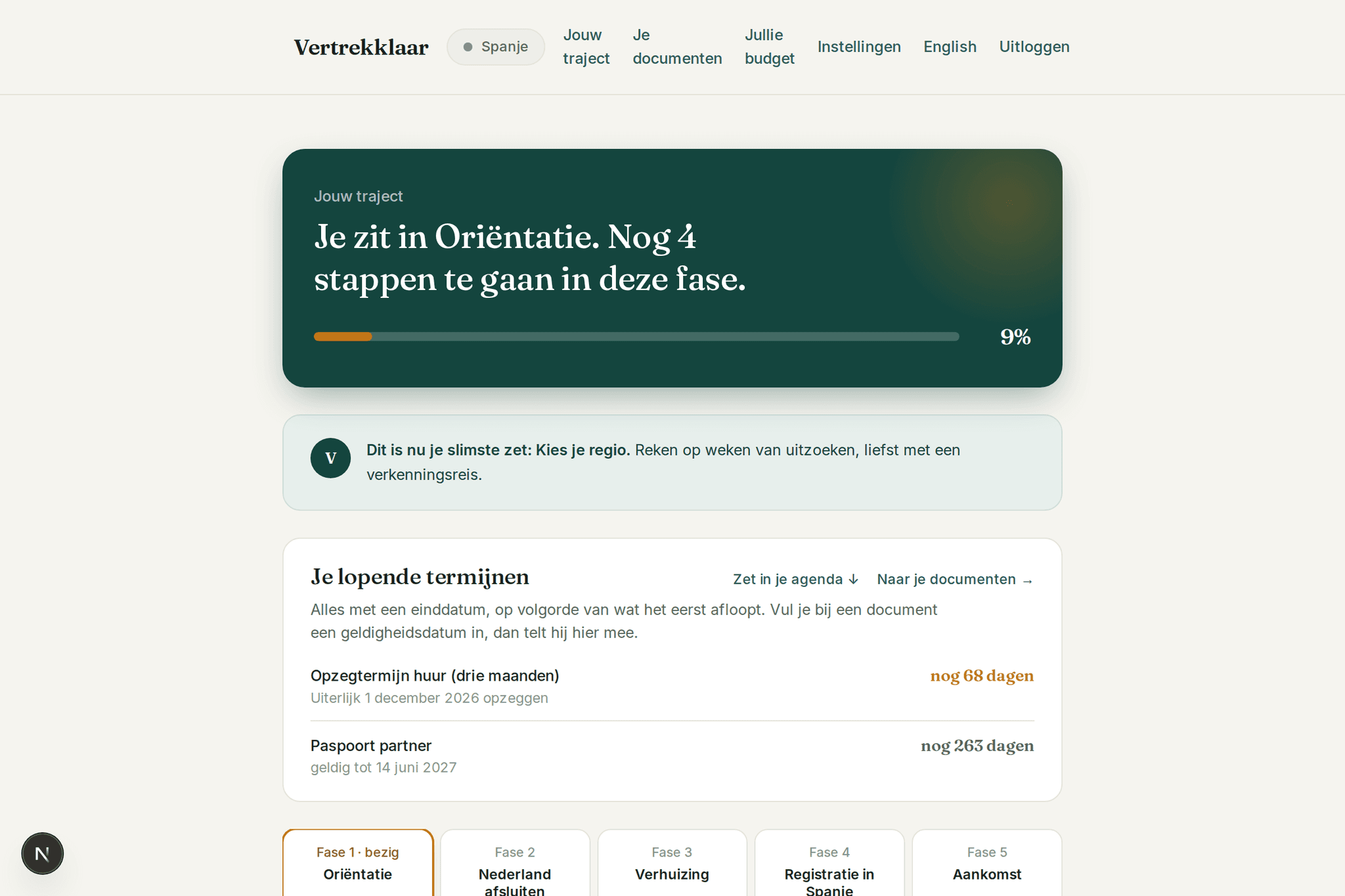
The dashboard of the step-by-step plan for Denmark: the current phase, the open steps, the next step and the deadline bar.

The route

  1. Orientation

    5 steps

    Open · You are here

  2. Closing the Netherlands

    16 steps

    In your plan

  3. The move

    3 steps

    In your plan

  4. Registration in Denmark

    6 steps

    In your plan

  5. Arrival

    9 steps

    In your plan

Phase 1 is the question "can we, and do we want to?". From phase 2 the arranging begins.

Phase 1 · Orientation

5 of 5 steps open

For Denmark you apply for no visa and no permit. You only register a right you already have. Even so, it is the most expensive EU entry on the site: the car can cost up to 150% tax, and the home up to six months' rent in advance. Do those two sums before departure, and you arrive without surprises.

By the end of phase 1 you know how the registration process fits together, you've done the car sum and the housing sum, and the family stands behind the decision.

Doing this together?

Invite your partner with a link. You then each tick your own steps, on your own phone or laptop, and see at every step whether the other has already done it. No account needed.

We only store which step numbers you ticked, under a random code. No name, no email. Anyone with the link can see the ticks. After six months without use we delete it.

Step 1.1

Understand what you're going to do: register, not apply

Lead time:
reading step
Costs:
none

Good news to start with: for Denmark you don't apply for anything. As a Dutch citizen you may live and work there from the day you arrive. You already have that right. The papers only establish it.

You do arrange two registrations, in a fixed order:

  • First the EU residence document from SIRI, the Danish immigration service. It's free and you apply online. For employees the decision period is literally zero days.
  • Then the CPR number at the municipality. That's your registration in the Danish population register, comparable to the Dutch BSN (citizen service number). For it you need that residence document and a residential address.

That order is the whole journey. Almost everything that comes after hangs on the CPR number: health card, tax card, bank, school. And that number hangs on a home. So the home is the bottleneck, not the government.

Step 1.2

Do the car sum before you decide anything else

Lead time:
an evening of calculating
Costs:
none

In this step you work out what it costs to take your car to Denmark. That sum decides whether it comes along or whether you sell it here.

On import of your own car Denmark levies the full registreringsafgift: the Danish registration tax. It is calculated over the Danish market value of the car, in brackets:

  • 25% over the first bracket.
  • 85% over the second bracket.
  • 150% over everything above that.
  • On top of that, a CO2 surcharge per gram.

There is no exemption for removal goods, not for EU immigrants either. For an ordinary Dutch family car that runs into thousands to tens of thousands of euros.

Against that stands one thing: on export the Netherlands refunds the remaining BPM. That's the part of the Dutch car tax (BPM) still in your car's value. That refund almost never covers the Danish levy. You only get it if the car is actually registered in Denmark. If you sell it here, there is no refund. So compare what it fetches here with the refund minus the Danish tax.

So do this sum now, with your own number plate. For most households the outcome is: sell the car here, and buy (or lease) one there.

If you drive electric, the sum turns out milder. Zero-emission cars pay only 40% of the calculated tax in 2026, and get a hefty extra deduction.

Step 1.3

Get a picture of what it's going to cost

Lead time:
1-2 hours with the calculator
Costs:
none

In this step you see what the move is going to cost you. The good news: the paperwork is free here. Residence document, CPR and health card cost zero kroner.

The money is in three other things:

  • The home: up to three months' deposit plus three months' rent in advance.
  • The car: the sum from the previous step.
  • The first months, because the price level is above the Dutch one.

Work it out in the calculator, with your own choices. Do that before you're committed to anything.

Step 1.4

Take the decision together

Lead time:
three evenings, and weeks to let it sink in
Costs:
none

In this step you decide together whether it will be Denmark. Denmark feels close: one day's drive, a culture that resembles ours. That makes it easy to underestimate the differences.

Going alone? Then have this conversation with the people you leave behind. The questions below work for them too.

Take three evenings. One conversation is too short for a decision like this. Agree on three evenings, a week apart:

  • Evening 1, why. What do we hope to find in Denmark? What are we leaving behind here? Would that really be different there?
  • Evening 2, what we give up. Who and what will we miss? What are we dreading most? What do we do if it disappoints?
  • Evening 3, the conditions. What has to be in place for each of us to say yes? When do we check together whether it's going well, for example after six and after twelve months? And what would be a reason for us to go back?

Write the conditions down. On the kitchen-table card it all fits on one A4.

On those evenings, also discuss two differences that are easy to underestimate:

  • The money in the first months. You pay up to six months' rent in advance. And as long as your tax card isn't sorted, an employer withholds the emergency rate: an extra-high deduction from your pay.
  • The welfare state that works just differently. The dentist is largely uninsured for adults. And unemployment insurance is voluntary. Whoever doesn't take it out has no safety net on dismissal.

Divide the work. Agree who takes on which part of this plan: the papers, the house and the cancellations, the school, the move. That way not one of you carries everything. Invite your partner into your plan; then you both see what's done.

Is one of you going without an income of your own? Whoever lives in Denmark and doesn't work in the Netherlands usually no longer builds up AOW, the Dutch state pension. For every year you're not insured, you later get 2 percent less AOW. You can insure yourself voluntarily with the SVB. You have one year for that, counted from the moment you're no longer insured. Also discuss whether that partner keeps an account and money of their own, and how you decide together on large expenses.

Married, registered or living together? That can make a difference for your partner's residence permit, for co-insurance in healthcare and for inheritance. Check at the registration and at your healthcare further on in your plan what applies to you.

Are children coming? How you tell them depends on their age:

  • Up to about four. Tell them shortly before the move and keep fixed routines, such as the bedtime ritual and the cuddly toy in the hand luggage.
  • Primary school. Tell them well in advance and let them look along: photos of the school, the neighbourhood and the house. Let them choose something, such as their room.
  • Teenagers. Involve them in the decision itself. For them, saying goodbye to friends weighs the most. Agree how they keep in touch and when they'll see their friends again.

How the folkeskole works, the ordinary Danish school, and how childcare is arranged, is in the article about school with this step.

Who learns the language, and when? Reading Danish comes quickly, understanding spoken Danish is another story. At work and at school Danish is the norm. Often the partner without work needs the language most, and that's exactly the one without colleagues to practise with. Plan it together, preferably before you leave.
Step 1.6

Choose your target date

Lead time:
five minutes, below
Costs:
none

In this step you choose the date on which you want to be in Denmark. Fill it in below. The step-by-step plan then works out whether that's feasible with what still has to happen. If it gets tight, it says so honestly. A target date is yours: you can always move it, and moving it is a perfectly fine outcome.

Is your situation slightly different?

A partner who stays in the Netherlands, work that carries on, a house you keep, children who stay at school here: I'm happy to talk those through, even before you have the plan. Email me what's going on for you. I read it myself and reply within two working days.

If you then take the plan, I'll work what we discussed into your personal plan.

Email me about your situation → info@vertrekklaar.nl

You know what you're getting into. Now the arranging begins.

You've read phase 1 of the step-by-step plan for Denmark. The full plan has another 34 steps ready for you: Closing the Netherlands, The move, Registration in Denmark and Arrival.

The plan counts everything back from your departure date and watches your deadlines and documents. You only see the steps that apply to you.

The step-by-step plan for Denmark

€ 199

one-off · no subscription · instant access

Also included: deadlines watched · documents with expiry dates · only your steps · your partner ticks along · all cancellation letters · questions to me.

✎ I read along

Stuck somewhere? Ask your question at the step. I read it myself and answer within two working days. Or talk to me for fifteen minutes. Usually within a day of that call your situation is in the plan.

Not ready yet? Send yourself your date and phase 1 →

Phase 2 · Closing the Netherlands0 of 16 steps open

Denmark is in the EU, so everything runs via the familiar routes. Only the windfalls you see with other countries are missing. The Netherlands keeps taxing your pension, and your healthcare contribution via the CAK is at exactly the Dutch level. One clock is new here: if you go into employment, you have eight weeks after the end of your Dutch insurance for the a-kasse, the Danish unemployment insurance.

  1. 2.1Arrange your healthcare: the basic insurance stops on moving daystart 3 months before departure; the CAK application takes about 4 weeks
  2. 2.2AOW and pension: what you built up comes along, the Netherlands keeps taxingan afternoon of research, apply in time
  3. 2.3The tax wind-up: M return and the protective assessmentthe return comes after the emigration year; preparing is possible now
  4. 2.4Stop allowances and child benefitan hour, online
  5. 2.5Going into employment? Then an eight-week clock runs for the a-kassearranging can be done in an afternoon; the term is eight weeks
  6. 2.6Deregister with the municipalitypossible from 5 days before departure, up to and including departure day
  7. 2.7DigiD, bank and your vote: keep the lines to the Netherlandsan afternoon
  8. 2.8Documents: multilingual extracts, no apostille needed1-2 weeks for applying for extracts
  9. 2.9Partner comes along without a job of their ownonly if this applies to you
  10. 2.10Partly staying in the Netherlands: the eight-month ruleonly if this applies to you
  11. 2.11The house in the Netherlands: sell, let or keeponly if this applies to you
  12. 2.12Children staying in the Netherlands: DUO, healthcare and the houseonly if this applies to you
  13. 2.13Cancel what stops: job, rent, energy, subscriptions and schoolstart three months before departure; most notice periods are one month
  14. 2.16Prepare your child for the moveonly if this applies to you
  15. 2.14Stay reachable: DigiD, your phone number, your bank and your postarrange it before you leave; afterwards it takes weeks
  16. 2.15Student debt, remote work or your own business: what moves with youreport it before you leave; the consequences run for years
Phase 3 · The move0 of 3 steps open

Within the EU, moving involves nothing administratively: no customs, no declaration, no exemption to apply for. Everything that costs money and attention here, you already decided in phase 1. In this phase you carry it out.

  1. 3.1Plan the move: one long day's drive, no paperworkquotes 2-4 weeks ahead; driving yourself is always possible
  2. 3.2The car: carrying out what you decided in phase 1only if this applies to you
  3. 3.3The pet: EU passport, and for dogs two Danish rulesonly if this applies to you
Phase 4 · Registration in Denmark0 of 6 steps open

In this phase you come to exist administratively in Denmark. The order is fixed: home, then EU residence document, then CPR number, then everything else. Each step waits for the previous one. That's why the home sets the pace of your whole first month.

  1. 4.1Find your home: the registration waits for itcount on weeks to months, depending on the city
  2. 4.2The EU residence document at SIRIemployees almost immediately; self-employed about 2 months
  3. 4.3The CPR number at the Citizen Serviceonline application 2-3 weeks' processing, then the appointment
  4. 4.4MitID and Digital Post: compulsory, and immediately usefulat the CPR appointment or right after
  5. 4.5The yellow health card and your GPthe card comes 2-3 weeks after the CPR registration
  6. 4.6The tax card: arrange it before your first working dayapplying is possible up to a month before your first working day
Phase 5 · Arrival0 of 9 steps open

You now exist administratively. This phase is about the everyday system behind it: the money, the work, the school and the healthcare costs, which work just differently from home. And about one hard clock: the car has thirty days.

  1. 5.1The car on Danish plates: thirty daysonly if this applies to you
  2. 5.2Bank account and NemKonto1-2 weeks once you have CPR and tax card
  3. 5.3Work: finish the a-kasse, and know what you're building upan afternoon
  4. 5.4School and childcareonly if this applies to you
  5. 5.5Healthcare costs in practice: know where your own money goesreading step
  6. 5.6Tax: set your advance right, and understand the structurean evening with MitID
  7. 5.7Learn Danish: it's arranged for freesign up via the municipality; modules of months
  8. 5.8Your driving licence: nothing is required, exchanging is allowedreading step
  9. 5.9Help your child settle in: the first monthsonly if this applies to you

10 of these 34 steps only appear when your answers call for them: a pet, a car, a partner without a job, children staying in the Netherlands.

Every step on one list, free

Not ready to start yet? Then you get the departure checklist for Denmark: every step in order, to print and tick off. With it, five mails in a week and a half about the pitfalls and the real costs. If the rules for Denmark change, you'll hear about it. After that we ask once where your plans stand, send one offer, and now and then one thing that fits your moment. No newsletter, and you can switch it off at any time.

Then we count back to when you need to start at the latest, and you get a nudge at that moment. And one more, a month before you leave.

We use your address, and your departure date if you fill it in, only for the checklist, the guide and the mails after it. You can unsubscribe under every mail.

Three questions

Can't I find all this for free?

Yes. Everything in the plan comes from official sources, and they're listed at every step. You can check that yourself in phase 1 above. What you buy is the work around it: which of the 34 following steps apply to you, in which order, with which deadline, and a nudge when something needs doing.

Does this apply to my situation too?

The plan first asks who is coming along, what is coming along and how you're leaving the Netherlands. It then leaves out what doesn't apply to you, and adds what only fits your situation. Is your situation slightly different from what's written? Ask your question at the step. You'll get an answer within two working days.

What if the rules change after I buy?

Then your plan changes with them. Twice a month we check every source. Whatever changes is in your plan the same week, with the date. Your access lasts for your whole departure.

Ready to begin?

The step-by-step plan for Denmark: 39 steps, with your documents and your costs in one place. For each step you see the latest date to start. You pay once and it's yours.