Skip to content

Step-by-step plan · No visa required

The step-by-step plan for Belgium

From "we want this" to being settled, in 37 steps. Read phase 1 in full here. Test your departure date along the way. Then you'll know whether you want the rest.

37 steps5 phases83 official sources9 only for your situationchecked on 14 October 2026

Phase 1 starts below ↓The whole plan: € 199 one-off, no subscription.

A plan that keeps track of what needs to happen now.

Every step sits in its place in the order, with the lead time, the counter and the official source. You and your partner tick off what is done. The plan counts back from your departure date and shows what has to start when and what is running now.

Below is phase 1, exactly as it appears in the plan.

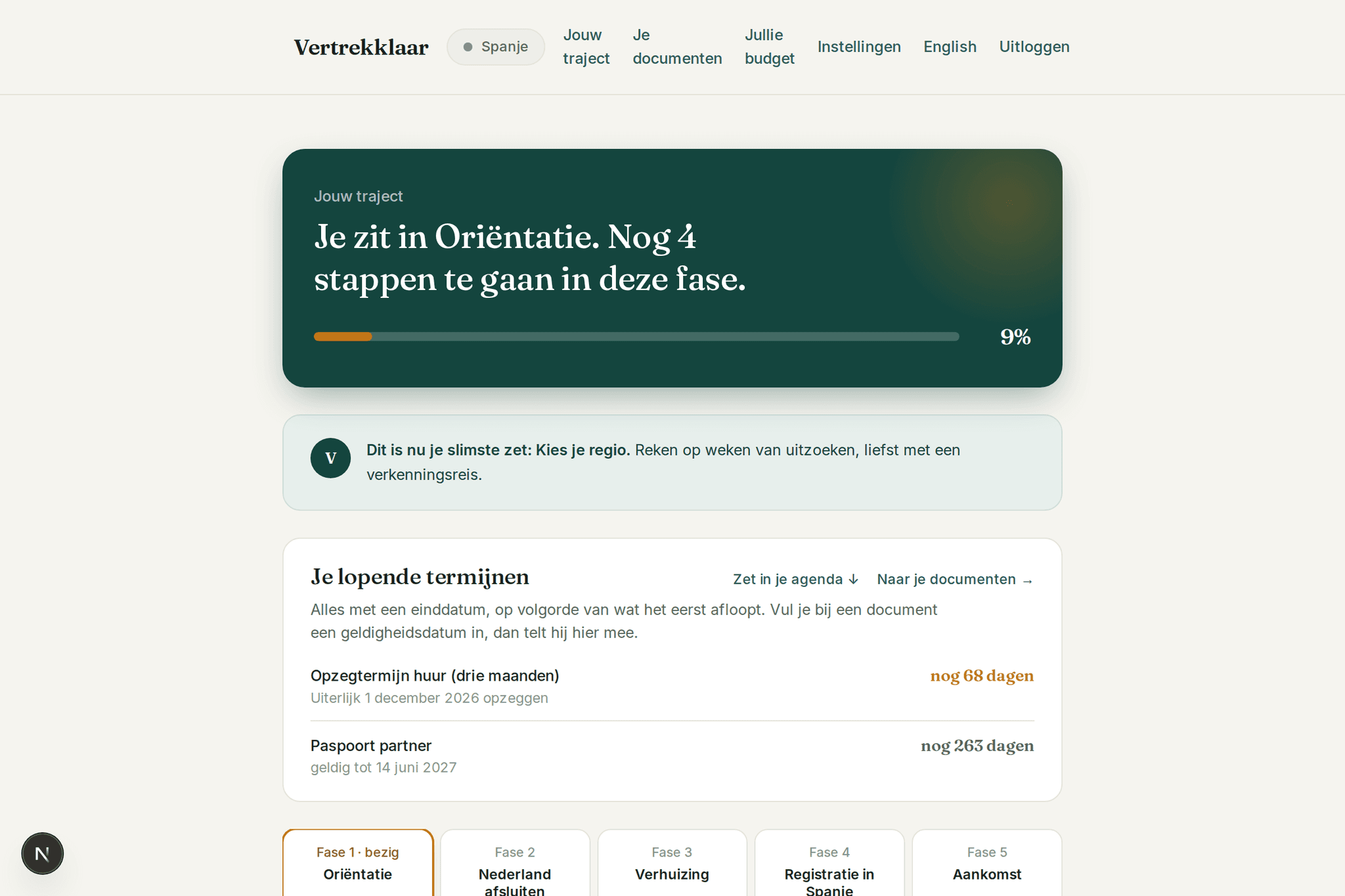
The dashboard of the step-by-step plan for Belgium: the current phase, the open steps, the next step and the deadline bar.

The route

  1. Orientation

    6 steps

    Open · You are here

  2. Winding up the Netherlands

    15 steps

    In your plan

  3. The move

    5 steps

    In your plan

  4. Registration in Belgium

    5 steps

    In your plan

  5. Arrival

    6 steps

    In your plan

Phase 1 is the question "can we, and do we want to?". From phase 2 the arranging begins.

Phase 1 · Orientation

6 of 6 steps open

Belgium is close by and Dutch-speaking, and still it's a real emigration. Whoever believes "nothing's needed" finds out when the neighbourhood police officer rings the bell. You take the most important decision here: do you keep working in the Netherlands or switch to a Belgian salary? That one answer decides your healthcare, your AOW and your allowances.

By the end of phase 1 you know which scenario fits you: cross-border work or a Belgian salary. You know which region you're choosing, and so which rules apply. You know roughly what the journey costs. And the family stands behind the decision.

Doing this together?

Invite your partner with a link. You then each tick your own steps, on your own phone or laptop, and see at every step whether the other has already done it. No account needed.

We only store which step numbers you ticked, under a random code. No name, no email. Anyone with the link can see the ticks. After six months without use we delete it.

Step 1.1

Free movement is not free of formalities

Lead time:
reading step
Costs:
none

This step shows you what Belgium asks of you, even as an EU citizen. You may live and work there. But "may" is not "sorted".

If you stay longer than three months, a fixed chain follows:

  • You apply at the municipality for a declaration of registration, at the latest when that period expires. The proof you then receive is called annex 19.
  • The neighbourhood police officer, the local police officer for your area, visits for the residence check. They check that you really live at that address.
  • Only then do you receive the electronic EU card, your Belgian residence card.

Since 1 September 2025 the municipality has been stricter. It only accepts your application if your file of evidence is complete. Sending documents on afterwards is no longer possible.

Meanwhile, for every Dutch authority this is an ordinary emigration. You deregister, your allowances stop, and you get a tax life in two countries. Emigrating nearby is still emigrating.

Step 1.2

Choose your scenario: cross-border work or a Belgian salary

Lead time:
an evening — this is the decision of this route
Costs:
none

This step is where you choose the scenario that decides everything else. In Belgium your emigration is a menu of choices. The question is: will you work in the Netherlands or in Belgium?

If you keep working in the Netherlands, you stay socially insured there. That means:

  • Your AOW accrual (the Dutch state pension) simply continues.
  • You keep your Dutch health insurance and your healthcare allowance.
  • The Netherlands taxes your salary.

If you switch to a Belgian employer, everything moves with you:

  • Your healthcare runs through a mutualiteit (a Belgian health fund) instead of a health insurer.
  • You build up a Belgian rustpensioen, Belgium's statutory pension. Your AOW stays at what you had already built up.
  • You get a payslip with a logic of its own. The charges are higher, but you also get double holiday pay, a thirteenth month and automatic indexation: your salary rises with prices by itself.

Work out both scenarios before you sign anything. The difference is bigger than any gross salary suggests.

Step 1.3

Choose your region — and with it your rules

Lead time:
an evening of comparing
Costs:
none

This step is where you choose where in Belgium you'll live, and with it which rules apply to you. Belgium has regions, each with rules of its own: Flanders, Brussels and Wallonia. Which region you pick is not a matter of taste but a choice of rules. These things differ per region, sometimes considerably:

  • the BIV, the tax you pay when you register your car in Belgium
  • child benefit
  • the registration duties on a purchased home, the Belgian property transfer tax
  • the low-emission zones, which keep older cars out
  • the language of administration

For most Dutch people the Flemish border area wins, on language and on rates. The registration duty on your only own home is 2% there.

If you're looking at Brussels, know two things:

  • Dutch-language education there reserves 65% of places for children of Dutch-speaking parents. That's a big advantage, but you do have to be able to prove it.
  • Since 2026 the low-emission zone there bars every diesel older than Euro 6.

Choose the region before the neighbourhood, and the neighbourhood before the house.

Checked against the official source

The official sources for this step

Step 1.4

Get a picture of what it's going to cost

Lead time:
1-2 hours with the calculator
Costs:
none

This step shows you where the money in this move really goes. The paperwork here is a matter of tens of euros: the EU card costs around twenty euros. The money is in the home and in the car:

  • The home. A rental deposit of two to three months, on a blocked account, plus the first rent. If you buy, you pay registration duties that run from 2% to 12.5% per region.
  • The car. What you get back in Dutch BPM partly goes out again in Belgian BIV.

The calculator lines it up for your situation. If you're also comparing salaries, remember the step about your scenario: gross says little here.

Step 1.5

Take the decision together

Lead time:
three evenings, and weeks to let it sink in
Costs:
none

This step makes sure the whole family knows what changes, and stands behind it. The pitfall of Belgium is that it doesn't look like a pitfall. Family stays within driving distance and the language stays yours.

Going alone? Then have this conversation with the people you leave behind. The questions below work for them too.

Take three evenings. One conversation is too short for a decision like this. Agree on three evenings, a week apart:

  • Evening 1, why. What do we hope to find in Belgium? What are we leaving behind here? Would that really be different there?
  • Evening 2, what we give up. Who and what will we miss? What are we dreading most? What do we do if it disappoints?
  • Evening 3, the conditions. What has to be in place for each of us to say yes? When do we check together whether it's going well, for example after six and after twelve months? And what would be a reason for us to go back?

Write the conditions down. On the kitchen-table card it all fits on one A4.

On those evenings, discuss precisely what does change:

  • Whoever goes to work in Belgium has hardly any accrued holidays in year one. The system accrues your holiday in the previous year.
  • Social life really does move with you. A Dutch person in Belgium lives close by. But they are administratively, fiscally and in the long run also emotionally an emigrant there.

Say that honestly. It prevents the quiet disappointment of year two.

Divide the work. Agree who takes on which part of this plan: the papers, the house and the cancellations, the school, the move. That way not one of you carries everything. Invite your partner into your plan; then you both see what's done.

Is one of you going without an income of your own? Whoever lives in Belgium and doesn't work in the Netherlands usually no longer builds up AOW, the Dutch state pension. For every year you're not insured, you later get 2 percent less AOW. You can insure yourself voluntarily with the SVB. You have one year for that, counted from the moment you're no longer insured. Also discuss whether that partner keeps an account and money of their own, and how you decide together on large expenses.

Married, registered or living together? That can make a difference for your partner's residence permit, for co-insurance in healthcare and for inheritance. Check at your registration with the municipality and at your healthcare further on in your plan what applies to you.

Are children coming? How you tell them depends on their age:

  • Up to about four. Tell them shortly before the move and keep fixed routines, such as the bedtime ritual and the cuddly toy in the hand luggage.
  • Primary school. Tell them well in advance and let them look along: photos of the school, the neighbourhood and the house. Let them choose something, such as their room.
  • Teenagers. Involve them in the decision itself. For them, saying goodbye to friends weighs the most. Agree how they keep in touch and when they'll see their friends again.

The children switch school systems. In Antwerp, Ghent and Brussels you enrol them digitally, within fixed periods. Whoever is late misses out at the popular schools. How that enrolment works is in the article about school with this step.

Who learns the language, and when? In Flanders you already speak the language. But the administrative language differs per region: if you choose Brussels or Wallonia, you'll deal with French too. Often the partner without work needs the language most, and that's exactly the one without colleagues to practise with. Plan it together, preferably before you leave.
Step 1.6

Choose your target date

Lead time:
five minutes, below
Costs:
none

This step sets when you want to live in Belgium. Choose below the date on which you want to be standing there. The step-by-step plan works out whether that's feasible with what still has to happen.

The journey to Belgium is short. Without buying a house a few months is realistic. The fixed deadlines sit mainly after the move: the application, the neighbourhood police officer and the card.

A target date is yours. Moving it is always allowed, and moving it is a perfectly good outcome.

Is your situation slightly different?

A partner who stays in the Netherlands, work that carries on, a house you keep, children who stay at school here: I'm happy to talk those through, even before you have the plan. Email me what's going on for you. I read it myself and reply within two working days.

If you then take the plan, I'll work what we discussed into your personal plan.

Email me about your situation → info@vertrekklaar.nl

You know what you're getting into. Now the arranging begins.

You've read phase 1 of the step-by-step plan for Belgium. The full plan has another 31 steps ready for you: Winding up the Netherlands, The move, Registration in Belgium and Arrival.

The plan counts everything back from your departure date and watches your deadlines and documents. You only see the steps that apply to you.

The step-by-step plan for Belgium

€ 199

one-off · no subscription · instant access

Also included: deadlines watched · documents with expiry dates · only your steps · your partner ticks along · all cancellation letters · questions to me.

✎ I read along

Stuck somewhere? Ask your question at the step. I read it myself and answer within two working days. Or talk to me for fifteen minutes. Usually within a day of that call your situation is in the plan.

Not ready yet? Send yourself your date and phase 1 →

Phase 2 · Winding up the Netherlands0 of 15 steps open

Which half of the Netherlands you take along, you chose earlier in the plan, with your scenario. In this phase you carry out that choice. Cross-border workers keep more than they think: their health insurance, healthcare allowance, AOW accrual and mortgage interest deduction. Whoever switches fully closes off neatly. And for everyone: the file of evidence for the Belgian application has to cross the border complete.

  1. 2.1The healthcare route that belongs to your scenario1-2 weeks of research and applying
  2. 2.2AOW and pension: check the treatyan afternoon of research; with pension assets: an adviser
  3. 2.3The tax authorities: qualifying, deferring, and one free helpdeskan afternoon; the income statement becomes an annual ritual
  4. 2.4Child benefit and allowances: the EU order of priorityan hour, partly by phone
  5. 2.5Deregister with the municipalitypossible from 5 days before departure, up to and including departure day
  6. 2.6DigiD, bank and your votean afternoon
  7. 2.7Get the file for annex 19 ready1-2 weeks
  8. 2.8Partner comes along without a job of their ownonly if this applies to you
  9. 2.9Living partly in the Netherlands: the eight-month ruleonly if this applies to you
  10. 2.10The house in the Netherlands: sell, rent out or keeponly if this applies to you
  11. 2.11Children staying in the Netherlands: DUO, healthcare and the houseonly if this applies to you
  12. 2.12Cancel what stops: job, rent, energy, subscriptions and schoolstart three months before departure; most notice periods are one month
  13. 2.15Prepare your child for the moveonly if this applies to you
  14. 2.13Stay reachable: DigiD, your phone number, your bank and your postarrange it before you leave; afterwards it takes weeks
  15. 2.14Student debt, remote work or your own business: what moves with youreport it before you leave; the consequences run for years
Phase 3 · The move0 of 5 steps open

The move itself is a drive within the EU, without customs. The real chapters are the car and the home. With the car you get BPM back, pay BIV ahead, and a 13-week clock runs in between. With the home, the deposit belongs on a blocked account, and the low-emission zone helps decide which neighbourhood you live in.

  1. 3.1The move itself: a drive, not an operationplan 2-4 weeks ahead
  2. 3.2The car: BPM back, BIV ahead, with a clock of 13 weeksonly if this applies to you
  3. 3.3Check the LEZ before you choose the neighbourhoodonly if this applies to you
  4. 3.4Renting the Belgian way: the deposit on the right accountsearching and signing, 2-6 weeks
  5. 3.5Buying can come later, and the duties differ per regionreading step — deliberately no action this year
Phase 4 · Registration in Belgium0 of 5 steps open

The chain is short but precise: annex 19 with the complete file, the neighbourhood police officer, the EU card, and then the digital keys. Whoever comes complete is sorted in weeks. And you get your national register number, the Belgian counterpart of the BSN, on day one already.

  1. 4.1Apply: annex 19, with the complete fileone municipality visit; at the latest three months after arrival
  2. 4.2The neighbourhood police officer really comesusually within a few weeks of the application
  3. 4.3Get your EU cardproduction and PIN codes: count on 2-3 weeks
  4. 4.4Activate itsme and the digital keysan evening, with a card reader or via the bank
  5. 4.5Connect your healthcare: mutualiteit, or precisely not1-2 weeks
Phase 5 · Arrival0 of 6 steps open

Being sorted is quick here, becoming Belgian takes longer. The last phase gets daily life on track: the salary package with its own logic, the school with its enrolment windows, the bank and the two tax returns. And the clocks that belong to your card.

  1. 5.1Work and pay the Belgian way, or the border commutethe first working month
  2. 5.2School and childcare: enrol, don't walk inonly if this applies to you
  3. 5.3Bank, Bancontact and the fixed costsa week
  4. 5.4The returns: two countries, one yearthe M return comes next spring; Tax-on-web the year after
  5. 5.5The driving licence and the clocks of your cardreading step — with two diary items
  6. 5.6Help your child settle in: the first monthsonly if this applies to you

9 of these 31 steps only appear when your answers call for them: a pet, a car, a partner without a job, children staying in the Netherlands.

Every step on one list, free

Not ready to start yet? Then you get the departure checklist for Belgium: every step in order, to print and tick off. With it, five mails in a week and a half about the pitfalls and the real costs. If the rules for Belgium change, you'll hear about it. After that we ask once where your plans stand, send one offer, and now and then one thing that fits your moment. No newsletter, and you can switch it off at any time.

Then we count back to when you need to start at the latest, and you get a nudge at that moment. And one more, a month before you leave.

We use your address, and your departure date if you fill it in, only for the checklist, the guide and the mails after it. You can unsubscribe under every mail.

Three questions

Can't I find all this for free?

Yes. Everything in the plan comes from official sources, and they're listed at every step. You can check that yourself in phase 1 above. What you buy is the work around it: which of the 31 following steps apply to you, in which order, with which deadline, and a nudge when something needs doing.

Does this apply to my situation too?

The plan first asks who is coming along, what is coming along and how you're leaving the Netherlands. It then leaves out what doesn't apply to you, and adds what only fits your situation. Is your situation slightly different from what's written? Ask your question at the step. You'll get an answer within two working days.

What if the rules change after I buy?

Then your plan changes with them. Twice a month we check every source. Whatever changes is in your plan the same week, with the date. Your access lasts for your whole departure.

Ready to begin?

The step-by-step plan for Belgium: 37 steps, with your documents and your costs in one place. For each step you see the latest date to start. You pay once and it's yours.