Skip to content

Step-by-step plan · Visa required

The step-by-step plan for Bolivia

From "we want this" to being settled, in 37 steps. Read phase 1 in full here. Test your departure date along the way. Then you'll know whether you want the rest.

37 steps5 phases128 official sources12 only for your situationchecked on 16 October 2026

Phase 1 starts below ↓The whole plan: € 399 one-off, no subscription.

A plan that keeps track of what needs to happen now.

Every step sits in its place in the order, with the lead time, the counter and the official source. You and your partner tick off what is done. The plan counts back from your departure date and shows what has to start when and what is running now.

Below is phase 1, exactly as it appears in the plan.

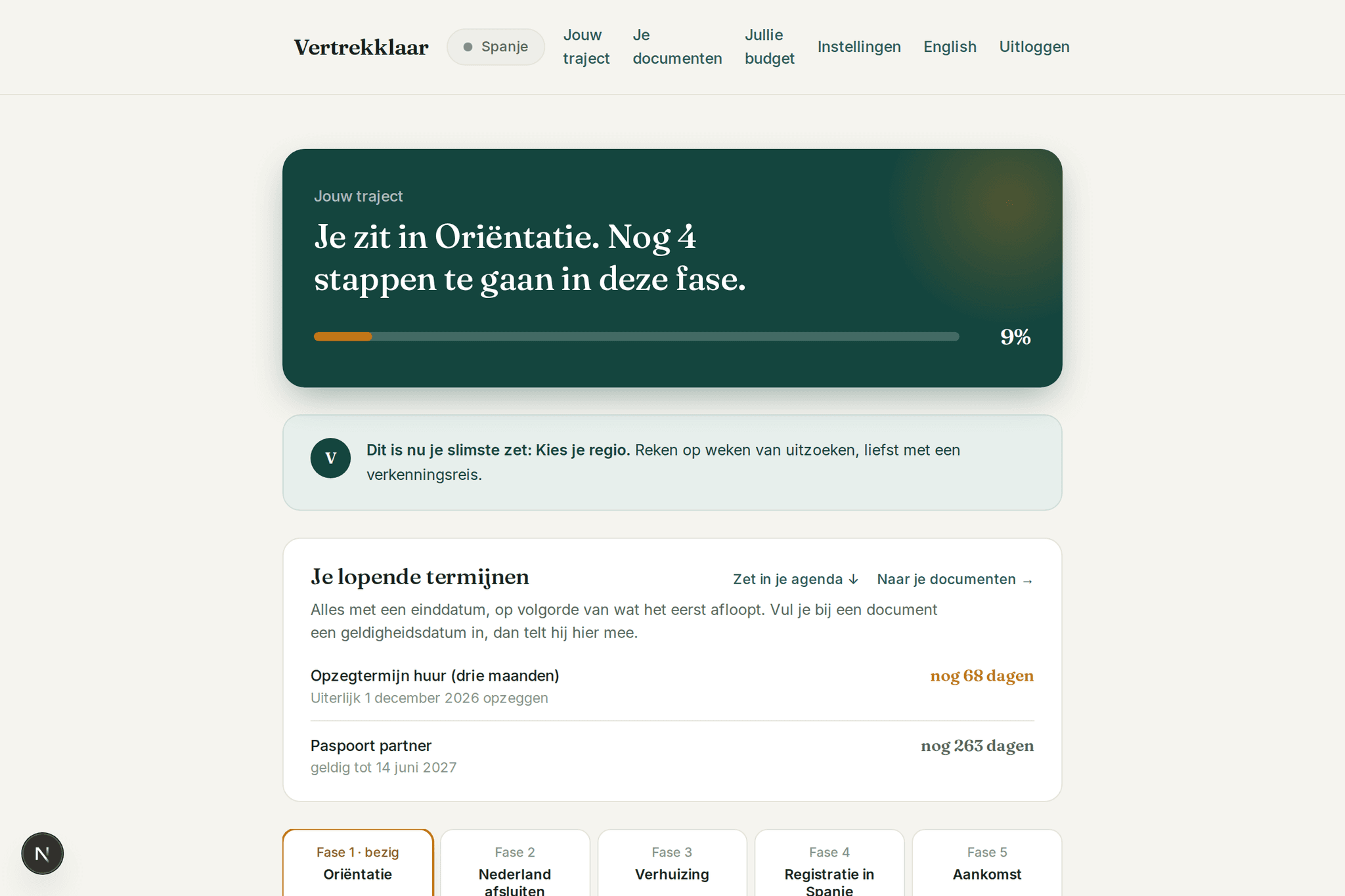
The dashboard of the step-by-step plan for Bolivia: the current phase, the open steps, the next step and the deadline bar.

The route

  1. Orientation

    6 steps

    Open · You are here

  2. Your visa

    8 steps

    In your plan

  3. Closing the Netherlands

    11 steps

    In your plan

  4. The move

    4 steps

    In your plan

  5. Arrival in Bolivia

    8 steps

    In your plan

Phase 1 is the question "can we, and do we want to?". From phase 2 the arranging begins.

Phase 1 · Orientation

6 of 6 steps open

Bolivia lets you in without a visa, but has no pension visa. You stay with a permanencia for work or family, and you prove your means with a sworn statement. What really determines your planning are the treaties that aren't there: no tax treaty, and a social security treaty that never entered into force.

At the end of phase 1 you know the route that suits you, you know what happens to your income and your healthcare, and the family stands behind the decision.

Doing this together?

Invite your partner with a link. You then each tick your own steps, on your own phone or laptop, and see at every step whether the other has already done it. No account needed.

We only store which step numbers you ticked, under a random code. No name, no email. Anyone with the link can see the ticks. After six months without use we delete it.

Step 1.1

Understand the system: enter without a visa, stay with a permanencia

Lead time:
reading step
Costs:
none

In this step you learn how you may come to live in Bolivia. The system is in the migration law, Ley 370 of 2013, and in the regulation that goes with it. It has three tiers:

  • Permanencia transitoria. A short stay with a purpose, at most 180 days. A stay as a tourist belongs here too.
  • Permanencia temporal. A temporary stay of one, two or three years. The law names four purposes: study, work, health and family.
  • Permanencia definitiva. Permanent residence, to apply for after at least three years.

You apply for your permanencia at the DIGEMIG, the Dirección General de Migración. You do that in Bolivia itself. With a Dutch passport you need no visa to enter as a tourist, and as a tourist you're in the country for at most 90 days a year. According to the regulation you may switch from that stay to a permanencia for work, family, study or health.

What stands out: a pension visa with a fixed income amount, as Colombia and Panama have, isn't in the law. Whoever wants to live off their pension in Bolivia reads step 2.2.

Not retired yet? Whoever is going to work in Bolivia, for an employer or for themselves, has the clearest route: the permanencia temporal for work. Whoever has a Bolivian partner or family in Bolivia goes through the permanencia for family.

Step 1.2

Know what happens to your income, your AOW and your healthcare

Lead time:
an evening of research
Costs:
none

In this step you see what emigrating to Bolivia does to your tax, your AOW and your healthcare.

The tax. The Netherlands and Bolivia have no tax treaty. Bolivia isn't in the Belastingdienst table and isn't on the NederlandWereldwijd list. Without a treaty the Netherlands keeps taxing your AOW, your pension and your annuity. How that works out is in steps 3.2 and 3.3.

The AOW. The Netherlands and Bolivia did sign a social security treaty in 2005. But according to the treaty database that treaty won't enter into force. So Bolivia isn't among the 36 countries the full AOW goes to. The AOW does go along, but up to the married rate. For a couple nothing changes. Whoever goes alone drops from seventy to fifty percent of the minimum wage.

Healthcare. Bolivia isn't on the list of treaty countries for healthcare. So there's no CAK, and your Dutch basic insurance stops when you deregister. Against that stands something: under article 5 of Ley 475, as amended by Ley 1152, foreigners from 60 who aren't insured through an employer get free care in the public health system. See step 3.1.

Your AOW build-up stops. Whoever lives outside the Netherlands is usually no longer insured. Each year until your AOW age then costs 2 percent of your later AOW. You can insure yourself voluntarily with the SVB. The application has to be in within one year.

Step 1.3

Explore the country, and reckon with the altitude

Lead time:
weeks, preferably with a scouting trip
Costs:
a scouting trip is a serious expense

In this step you choose where you want to live. Bolivia is big, and the differences are big. La Paz, El Alto, Oruro and Potosí lie high on the Altiplano. Cochabamba, Sucre and Tarija lie in the valleys, Santa Cruz in the lowlands. NederlandWereldwijd warns of altitude sickness in the areas above 3,000 metres.

At every place, look at three things:

  • The altitude and your health. If you have heart or lung complaints, discuss the altitude with your doctor first. Live for a few weeks in the place you choose.
  • Healthcare. At every place, ask where the nearest hospital is, and where the neighbourhood health centre is.
  • The offices. You arrange your permanencia at a DIGEMIG office, your cédula at the SEGIP. Ask in advance where those offices are near you.

Mind the border too. Within fifty kilometres of the border you may not own land or a house as a foreigner. See step 5.6.

Step 1.4

Map out what it's going to cost

Lead time:
1-2 hours with the calculator
Costs:
none

In this step you see what the move is going to cost you. On the application side Bolivia is affordable. A visa de objeto determinado costs 100 dollars at the embassy in The Hague. The cédula de extranjero costs 600 bolivianos, about 46 euros. You ask for the fees of the DIGEMIG itself at the office or the embassy.

The money sits in three other items:

  • The health policy that replaces the CAK, certainly if you're under sixty.
  • The move to a country without a sea: your shipment goes through a port in a neighbouring country and then overland.
  • The car, because a passenger car older than one year, counted from the model year, may not enter Bolivia.

Reckon with the exchange rate too. Since April 2026 Bolivia has had a flexible rate. On 15 October 2026 a dollar was 11.68 bolivianos. Your income comes in euros, life runs in bolivianos.

Step 1.5

The family conversation

Lead time:
weeks, not hours
Costs:
none

In this conversation you decide together whether Bolivia fits, and when. With this country come three things you need to see together.

  • The AOW. The drop to the married rate only affects whoever goes alone. If one of you dies, the other becomes single. Even then it stays the lower AOW for as long as you live in Bolivia.
  • The language. At the offices, the bank and the doctor everything goes in Spanish. Agree who's going to learn Spanish, and how.
  • The distance. Family and grandchildren in the Netherlands are no longer a quick visit away. Agree how often you'll come back. Note: with a permanencia temporal you may be outside Bolivia for at most 90 days a year without permission. See step 5.2.

Step 1.6

Choose your target date

Lead time:
decision point
Costs:
none

Choose the day you want to leave. The plan counts back from that date: when the papers from the Netherlands need to be in, when you apply for the visa at the embassy and when you deregister.

Count in three clocks. A visa de objeto determinado is valid for thirty days. As a tourist you have at most ninety days a year to apply for your permanencia. And after the DIGEMIG's decision you have 25 working days for your cédula at the SEGIP.

Is your situation slightly different?

A partner who stays in the Netherlands, work that carries on, a house you keep, children who stay at school here: I'm happy to talk those through, even before you have the plan. Email me what's going on for you. I read it myself and reply within two working days.

If you then take the plan, I'll work what we discussed into your personal plan.

Email me about your situation → info@vertrekklaar.nl

You know what you're getting into. Now the arranging begins.

You've read phase 1 of the step-by-step plan for Bolivia. The full plan has another 31 steps ready for you: Your visa, Closing the Netherlands, The move and Arrival in Bolivia.

The plan counts everything back from your departure date and watches your deadlines and documents. You only see the steps that apply to you.

The step-by-step plan for Bolivia

€ 399

one-off · no subscription · instant access

Also included: deadlines watched · documents with expiry dates · only your steps · your partner ticks along · all cancellation letters · questions to me.

✎ I read along

Stuck somewhere? Ask your question at the step. I read it myself and answer within two working days. Or talk to me for fifteen minutes. Usually within a day of that call your situation is in the plan.

Not ready yet? Send yourself your date and phase 1 →

Phase 2 · Your visa0 of 8 steps open

You need no visa to get in, but you do need a permanencia to stay. You choose your route first, because the law only knows work, family, study and health. If you take a container, you get the visa at the embassy in The Hague in advance: customs asks for it to let your household goods in duty-free.

  1. 2.1Choose your route: work, family, or a pension without a category of its ownreading step
  2. 2.2Retired or living off capital: the law has no category of its ownonly if this applies to you
  3. 2.3Work: employed or for yourselfonly if this applies to you
  4. 2.4Family in Bolivia: the permanencia por familiaonly if this applies to you
  5. 2.5The visa at the embassy in The Hague: needed for your household goodsonly if this applies to you
  6. 2.6The papers: VOG, certificates, apostille and translation3-5 weeks
  7. 2.7The application at the DIGEMIG, within your days as a tourist or on your visadepends on the office; start in your first weeks
  8. 2.8Partner and children: each their own permanenciaonly if this applies to you
Phase 3 · Closing the Netherlands0 of 11 steps open

In this phase sits the money of this journey. There's no tax treaty, so the Netherlands keeps its taxing, and the 2005 social security treaty never entered into force. Without a healthcare treaty there's no CAK. If you're under sixty, your policy is accepted before you deregister.

  1. 3.1Arrange your healthcare before you deregister: no CAK, but the SUS from sixtyacceptance takes weeks; start three months before leaving
  2. 3.2Know where you pay tax: no treaty, so the Netherlands keeps taxingone good conversation with a tax adviser
  3. 3.3Know the Bolivian side: tax on income from Boliviaa conversation with a Bolivian tax adviser
  4. 3.4Deregister and tell the SVB, with the married rate in handderegistering is possible from 5 days before leaving; the whole takes 4-8 weeks
  5. 3.5If children come along: child benefit stops, and the schoolonly if this applies to you
  6. 3.6Partner comes along without a job of their ownonly if this applies to you
  7. 3.7The house in the Netherlands, and what it does to your tax liabilityonly if this applies to you
  8. 3.8Annuity or company: the protective assessment without automatic deferrala conversation with your tax adviser, before leaving
  9. 3.9Cancel what stops: work, rent, energy, subscriptions and schoolstart three months before leaving; most notice periods are one month
  10. 3.10Stay reachable: DigiD, your bank and your postarrange it before you leave; afterwards it takes weeks
  11. 3.11Student debt, remote work or your own business: what moves with youreport it before you leave; the consequences run for years
Phase 4 · The move0 of 4 steps open

In this phase you arrange what comes along. Your household goods enter the country tax-free up to 35,000 dollars, but only with the embassy's visa. A passenger car older than one year may not enter Bolivia. And for your pet you apply in advance for a permit from SENASAG.

  1. 4.1Choose your way of moving and request quotesonly if this applies to you
  2. 4.2Household goods: tax-free up to 35,000 dollars, but only with the visaonly if this applies to you
  3. 4.3The car: at most one year old, and no diesel up to 4,000 cconly if this applies to you
  4. 4.4Taking a pet: apply in advance for SENASAG's import permitonly if this applies to you
Phase 5 · Arrival in Bolivia0 of 8 steps open

After the DIGEMIG's decision everything hangs on one deadline: within 25 working days you get your cédula at the SEGIP. Then you report every new address within 48 hours, you keep an eye on your 90 days a year outside Bolivia, and you arrange your healthcare, your bank and your licence.

  1. 5.1Within 25 working days to the SEGIP: your cédula de extranjeroone appointment, with a pre-registration online
  2. 5.2Report every new address within 48 hours, and count your days outside Boliviaa fixed rhythm, all year
  3. 5.3Your healthcare: the SUS from sixty, or your own policyseveral weeks
  4. 5.4A Bolivian bank, and the NIT if you're going to earn in Boliviadays to weeks, once your cédula is there
  5. 5.5The driving licence: first with an international licence, then a Bolivian oneweeks; the driving school and the medical set the pace
  6. 5.6Living: renting, or buying outside the border zoneweeks to months
  7. 5.7After three years: the permanencia definitivaan application at the DIGEMIG; plan it well before your permanencia expires
  8. 5.8Landedthe moment itself

12 of these 31 steps only appear when your answers call for them: a pet, a car, a partner without a job, children staying in the Netherlands.

Every step on one list, free

Not ready to start yet? Then you get the departure checklist for Bolivia: every step in order, to print and tick off. With it, five mails in a week and a half about the pitfalls and the real costs. If the rules for Bolivia change, you'll hear about it. After that we ask once where your plans stand, and now and then we send one thing that fits your moment. No newsletter, and you can switch it off at any time.

Then we count back to when you need to start at the latest, and you get a nudge at that moment. And one more, a month before you leave.

We use your address, and your departure date if you fill it in, only for the checklist, the guide and the mails after it. You can unsubscribe under every mail.

Three questions

Can't I find all this for free?

Yes. Everything in the plan comes from official sources, and they're listed at every step. You can check that yourself in phase 1 above. What you buy is the work around it: which of the 31 following steps apply to you, in which order, with which deadline, and a nudge when something needs doing.

Does this apply to my situation too?

The plan first asks who is coming along, what is coming along and how you're leaving the Netherlands. It then leaves out what doesn't apply to you, and adds what only fits your situation. Is your situation slightly different from what's written? Ask your question at the step. You'll get an answer within two working days.

What if the rules change after I buy?

Then your plan changes with them. Twice a month we check every source. Whatever changes is in your plan the same week, with the date. Your access lasts for your whole departure.

Ready to begin?

The step-by-step plan for Bolivia: 37 steps, with your documents and your costs in one place. For each step you see the latest date to start. You pay once and it's yours.