Scotland · Visa required
Emigrating to Scotland
Scotland is the United Kingdom, so you need a British visa: through work, a British partner, talent or a business of your own. There's no route on benefits or a pension. Once you're there, Scottish rules apply to renting, buying, school and tax.
€ 399 one-off · 48 steps · no subscription
- Kind of journey
- Visa route: a British visa through work, a partner, talent or a business of your own; no route on benefits or a pension
- Biggest cost item
- The health surcharge (IHS): £1,035 per adult per year, £776 per child, paid up front with the visa
- Different from England
- Its own rules for renting and buying, school from age 4½, and the Scottish income tax of 19 to 48 percent
Last updated: 27 October 2026
Will your departure date work? Check it in the free step-by-step plan →
Five phases, from the visa route to your first months in Scotland
For Scotland you need the same visa as for the rest of the United Kingdom. As a visitor you can usually stay up to six months, but you can't live there and you can't claim benefits. Living there is only possible with a visa tied to a reason: a job with an approved employer, a British partner, talent or a business of your own. After arrival you'll notice that Scotland has its own rules: a different tenancy, a different way of buying, its own school system and its own income tax.
- Orientation
Half a year as a visitor, living there only with a visa
In this phase you find out whether there's a route for you. As a visitor you can usually be in the United Kingdom for up to six months. You may not live there by coming back again and again, and you get no benefits. A visa based on a pension or benefits doesn't exist. The EU Settlement Scheme, the scheme for EU citizens, only applies if you already lived there before 2021, or as the family member of someone who did. Your AOW goes along in full, because the UK is a treaty country. And you choose where to live: Edinburgh, Glasgow, Aberdeen, Dundee or the Highlands.Read more
- Your visa
Choosing a route, passing the language test and paying the health surcharge up front
In this phase you choose your route and apply for the visa. For work you need a job with a licensed sponsor, an employer approved by the British government, with a salary of at least £41,700 or the going rate for your job. With a British partner or a partner with settled status, the two of you usually earn at least £29,000 a year together. Talent goes through Global Talent or the High Potential Individual visa, a business of your own through the Innovator Founder visa with an endorsement, an approval from a recognised body. You pass the language test at the level of your route and pay the fee plus the health surcharge up front. Your status is then an eVisa, a digital visa.Read more
- Closing the Netherlands
A real emigration, with an AOW that goes along in full
In this phase you close down in the Netherlands. Your AOW goes along in full, even if you go alone, because the UK is a treaty country. Your AOW build-up stops, and so do child benefit and the allowances. With an AOW or pension you stay insured for healthcare through the CAK, because the UK is on the list of treaty countries. The 2008 tax treaty gives your AOW and your pension to the UK. You deregister with the municipality, file the M form, the tax return for your emigration year, and keep DigiD and a Dutch bank account.Read more
- The move
By ferry to Newcastle, and the ToR for your household goods
In this phase you move household goods, car and pet. The shortest sea route towards Scotland is the ferry from IJmuiden to Newcastle. Since Brexit your household goods are an import. With ToR relief (Transfer of Residence) from HMRC, the British tax authority, you pay no import duty and VAT; you apply before the removal van leaves. The car is a sum, because you drive on the left there. Your dog or cat travels with a microchip and a rabies jab via an approved route, and a dog gets a tapeworm treatment shortly before arrival.Read more
- Arrival in Scotland
Renting and buying the Scottish way, the council, the GP and school
In this phase you arrange life in Scotland. Renting goes with a private residential tenancy, the Scottish tenancy. The deposit is at most two months' rent and goes to an approved deposit scheme within 30 working days. Letting fees aren't allowed. Buying goes through a solicitor, with the Home Report and LBTT, the Scottish property transaction tax. You apply for your National Insurance Number, register with a GP and report to the council for council tax. Your payslip shows an S code: you pay Scottish income tax. And children start P1 between 4½ and 5½, in August.Read more
This is what one step of your plan looks like
This is the real thing: one of the steps of the journey to Scotland, exactly as it appears in your personal step-by-step plan, with the deadlines, the offices and the sources.
Step 5.2 of your plan
If you buy a house: Home Report, offers over and the missives
- Lead time
- weeks to months
- Costs
- LBTT based on the price; plus 8 percent ADS if you own another home
With this step you know how buying a house works in Scotland. It works differently from the Netherlands and from England, and the tax is Scottish.
The Home Report. Whoever sells a house must have a sales pack in advance: a report on the condition, the value and the energy efficiency of the house, and a questionnaire from the seller. If you ask for it, you get a copy within nine days. Read it before you bid.
Bidding. Houses are often for sale at "offers over" an amount: that is a starting price, not an asking price. If there are several buyers, the agent often sets a closing date: a day on which everyone makes one offer. You bid through a solicitor, a Scottish lawyer who also handles the deed. Engage one before you start bidding.
When it is binding. Under Scottish law, buying a house must be in writing. That written exchange between the solicitors is called the missives. Only when the missives are concluded is the purchase binding. Your solicitor tells you when that is.
The tax. Instead of stamp duty you pay the Land and Buildings Transaction Tax (LBTT) to Revenue Scotland:
| Part of the price | LBTT |
|---|---|
| up to £145,000 | 0% |
| £145,001 to £250,000 | 2% |
| £250,001 to £325,000 | 5% |
| £325,001 to £750,000 | 10% |
| over £750,000 | 12% |
If you are buying a home for the first time, the first-time buyer relief applies: the nil band goes up to £175,000, which saves up to £600. If you own another home, anywhere in the world, an 8 percent Additional Dwelling Supplement (ADS) comes on top. If you sell your previous main residence within 36 months, you can claim it back.
What this step rests on
- Housing (Scotland) Act 2006, sections 98 and 99 — the seller has the Home Report documents and gives you a copy
- Housing (Scotland) Act 2006 (Prescribed Documents) Regulations 2008, regulation 4 — the report and the questionnaire
- Requirements of Writing (Scotland) Act 1995, section 1 — buying land or a house must be in writing
- Revenue Scotland — LBTT for homes: rates and first-time buyer relief
- Revenue Scotland — Additional Dwelling Supplement (8 percent)
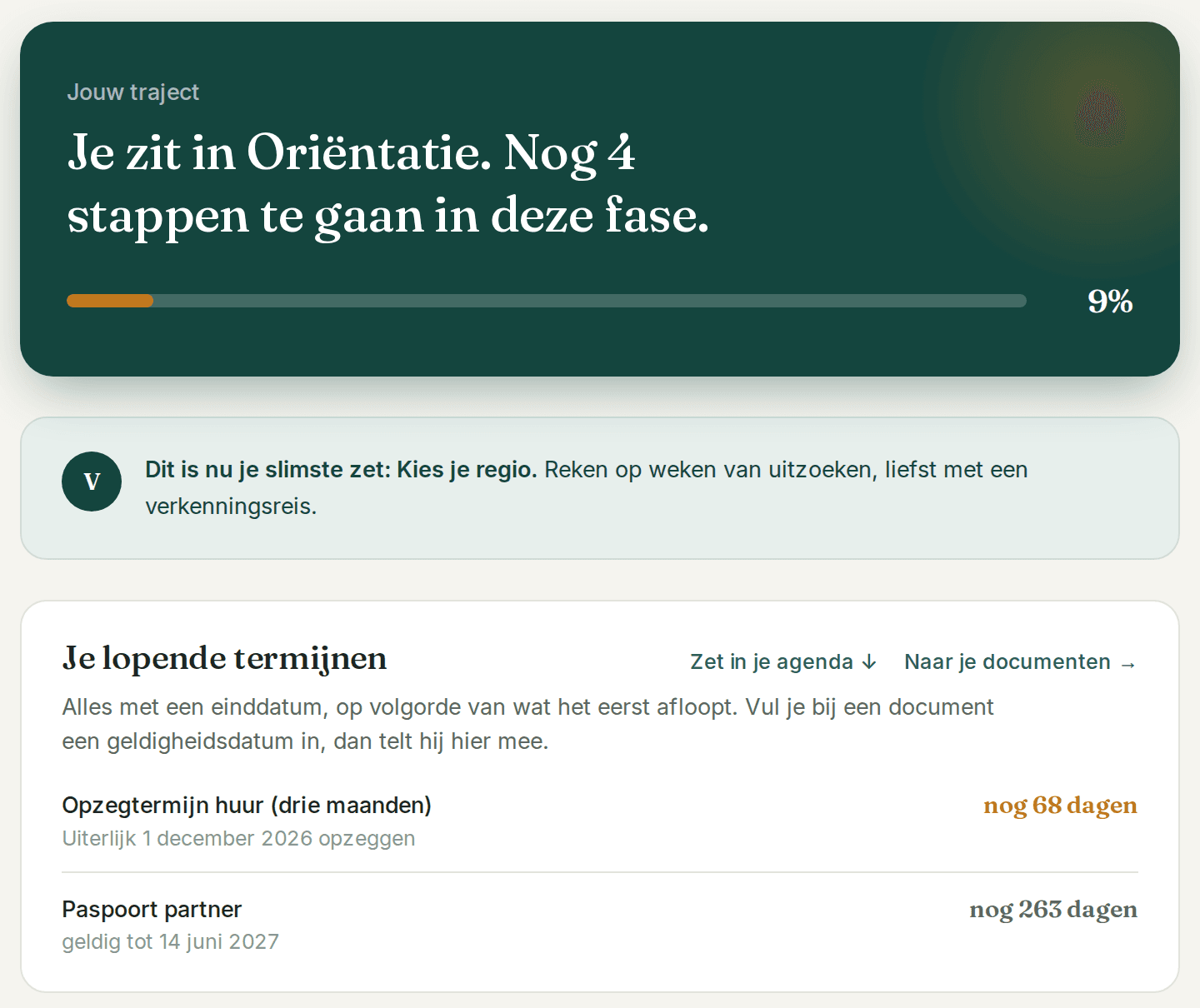
And this is the dashboard that step lives in. The example shows the plan for Spain; your dashboard shows the plan for Scotland.
This is step 5.2 of 48. The other 47 are ready for you, each with the same sources, the same offices and a schedule that keeps track of your dates.
See all 48 steps for ScotlandWhat you get for € 399
All 48 steps to Scotland, for your situation
In order, with the office and the official source at every step. Steps that don't apply to you don't appear.
Your deadlines in one place
For each step you see the latest date to start, and you get a heads-up before something is due or expires. Your documents sit in the vault, with their dates.
A plan that stays right
Twice a month we check the sources. If something changes, it's in your plan and you get a message.
The step-by-step plan for Scotland
€ 399
one-off · 48 steps
- Pay once, no subscription
- Destination changes? Within 30 days I switch your plan to another country free of charge
- Stuck on a step? You get a personal answer within two working days
What will your move to Scotland cost? Work it out →
Know someone moving to Scotland? Give this plan as a gift →
Every step on one list, free
Not ready to start yet? Then you get the departure checklist for Scotland: every step in order, to print and tick off. With it, five mails in a week and a half about the pitfalls and the real costs. If the rules for Scotland change, you'll hear about it. After that we ask once where your plans stand, send one offer, and now and then one thing that fits your moment. No newsletter, and you can switch it off at any time.
That was the move. And once you live there?
Which country may tax your pension once you live in Scotland? Is there a favourable regime, a scheme that lowers your tax? And how do you get insured? That depends on where your income comes from. Tick it and you'll see which rules apply to you, with the source.
See the financial conditionsClosing down the Netherlands: all your letters in one go
Moving to Scotland starts with leaving the Netherlands properly. That's why the plan includes the letter tool: you enter your details once and every cancellation and notification letter is ready.
Just the letters, without the plan? That works too, for € 29
- Health insurance, rent, energy, subscriptions, GP, school, bank and pension fund: 16 kinds of letters. You enter your details only once.
- A sending list that counts back from your departure date and your notice period, even when that's three months.
- Also what you need to ask for as an emigrant: your no-claims years in English, your medical file and the school report (the report on your child for the new school).
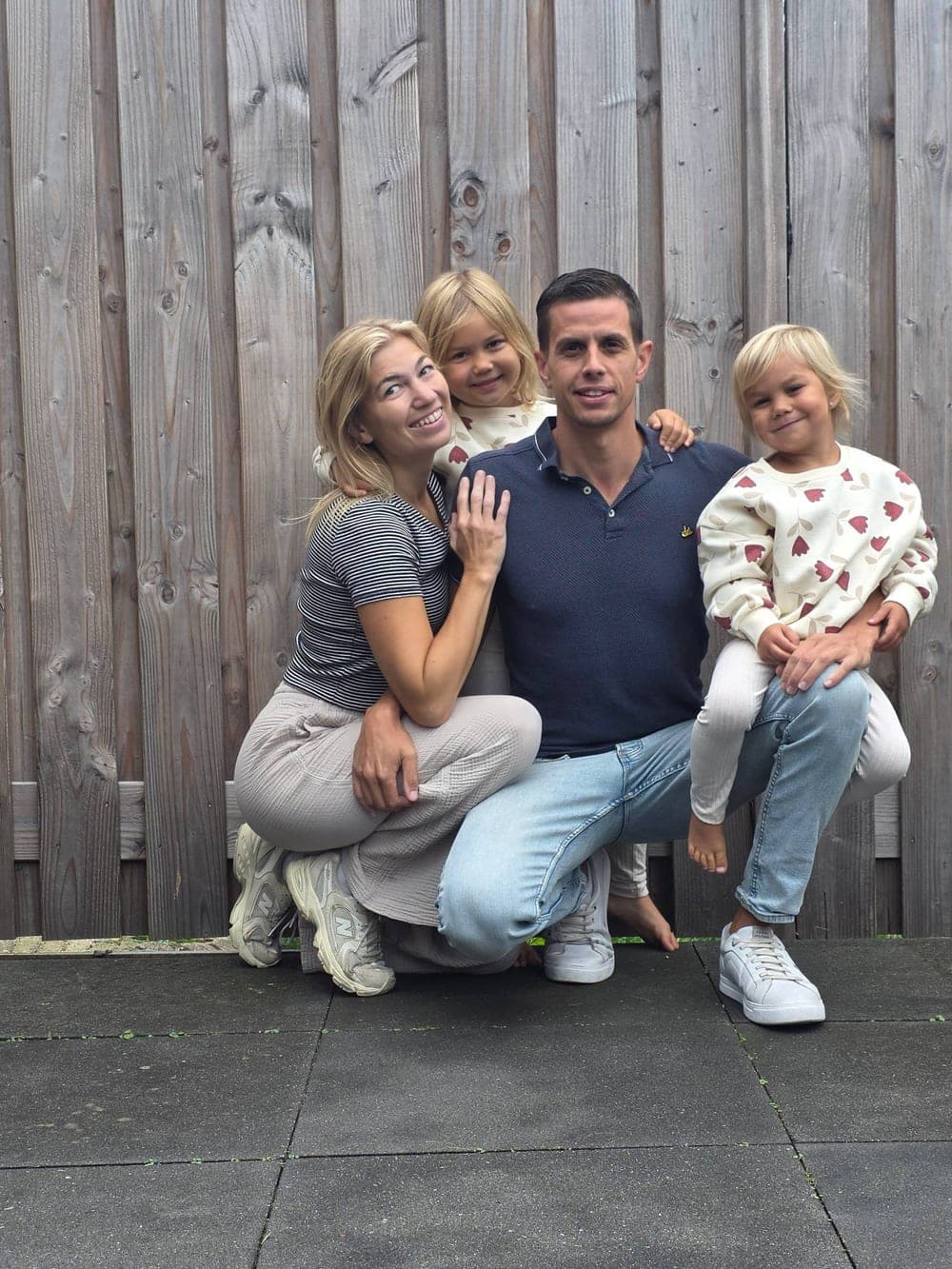

Auke, maker of Vertrekklaar
On 2 January we're leaving ourselves, on a trip around the world with our family. What I put here, I'm arranging for my own family too.
On 20 September 2026 a customer wrote that the CAK rule for early retirement was missing from his plan. He was right. That evening the step was in thirteen plans, with the source attached.
The knowledge base on Scotland
Per phase, the articles that are already there. They're written from the same journey and go deeper than what fits above.
- The visa routes to Scotland: work, your partner, talent or your own business, and why there is no route on a pension or benefitScotland is part of the United Kingdom, and since 2021 a Dutch citizen needs a visa to live there. As a visitor you can usually stay up to six months, without working and without living there. There are four routes: work for an approved employer, a British partner, talent and your own business. A visa for people who want to live on a pension or a benefit does not exist.
- AOW, pension and tax in Scotland: the full AOW, and the UK taxes it with the Scottish bandsFor the AOW state pension the United Kingdom is a treaty country: you get the same amount as in the Netherlands, in pounds. Under the 2008 tax treaty the UK taxes your AOW and your pension, and in Scotland that happens with the Scottish bands of 19 to 48 percent. Newcomers can exempt foreign income for four years. Healthcare runs through the CAK with an S1.
- Moving to Scotland on a Dutch benefit: your WIA goes with you, but it does not give you a visaA WIA disability benefit, including IVA and WGA, can be taken to the United Kingdom, as can the WAO, the WAZ, the AOW state pension and the Anw survivor's benefit. The UWV supplement, unemployment benefit (WW) and the Wajong cannot. But a benefit gives you no right to live in Scotland: for that you need a visa, and a visa based on a benefit does not exist.
- Your car and driving licence in Scotland: NOVA, converting a left-hand-drive car and the low emission zonesYour Dutch driving licence stays valid in Scotland until you are seventy, and exchanging it needs no test. The car may come too, but a left-hand-drive car needs converted headlamps, a speedometer in miles and a British approval. And in Glasgow, Edinburgh, Aberdeen and Dundee an old diesel or petrol car cannot enter the city centre without a fine.
- Taking your pet to Scotland: the EU passport, the tapeworm clock and the boat to NewcastleDogs, cats and ferrets travel to Scotland on the European pet passport, under British rules. Chip before or at the same time as the rabies jab, at least 21 full days' wait, for dogs a tapeworm treatment 24 to 120 hours before arrival, and an approved route. From the Netherlands, IJmuiden–Newcastle is the shortest way north.
- Your household goods to Scotland: tax-free with the ToR1, if you apply in timeSince Brexit your household goods moving to Scotland are formally an import, with duty and VAT on anything not exempt. Transfer of Residence relief removes that. You apply with the ToR1 form at HMRC, before the removal company drives, and give the reference number to your remover.
All 13 articles about Scotland
- Banking and paying in Scotland: the basic bank account, and why your Scottish notes may be refused in England
- Buying a house in Scotland: Home Report, missives and LBTT, and why your Dutch home counts
- Renting in Scotland: a tenancy with no end date, a deposit of at most two months and no letting fees
- Your first weeks in Scotland: home, bank, NIN, GP, council and school in the right order
- School in Scotland: from P1 to S6, enrolling with the council and the school that goes with your address
- Wills and cohabiting in Scotland: legal rights, the weak position of cohabitants and inheritance tax
- Healthcare in Scotland: you pay the IHS upfront, then GP, prescriptions and eye tests are free
Also applies to your move
Ready to begin?
The step-by-step plan for Scotland: 48 steps, with your documents and your costs in one place. For each step you see the latest date to start. You pay once and it's yours.