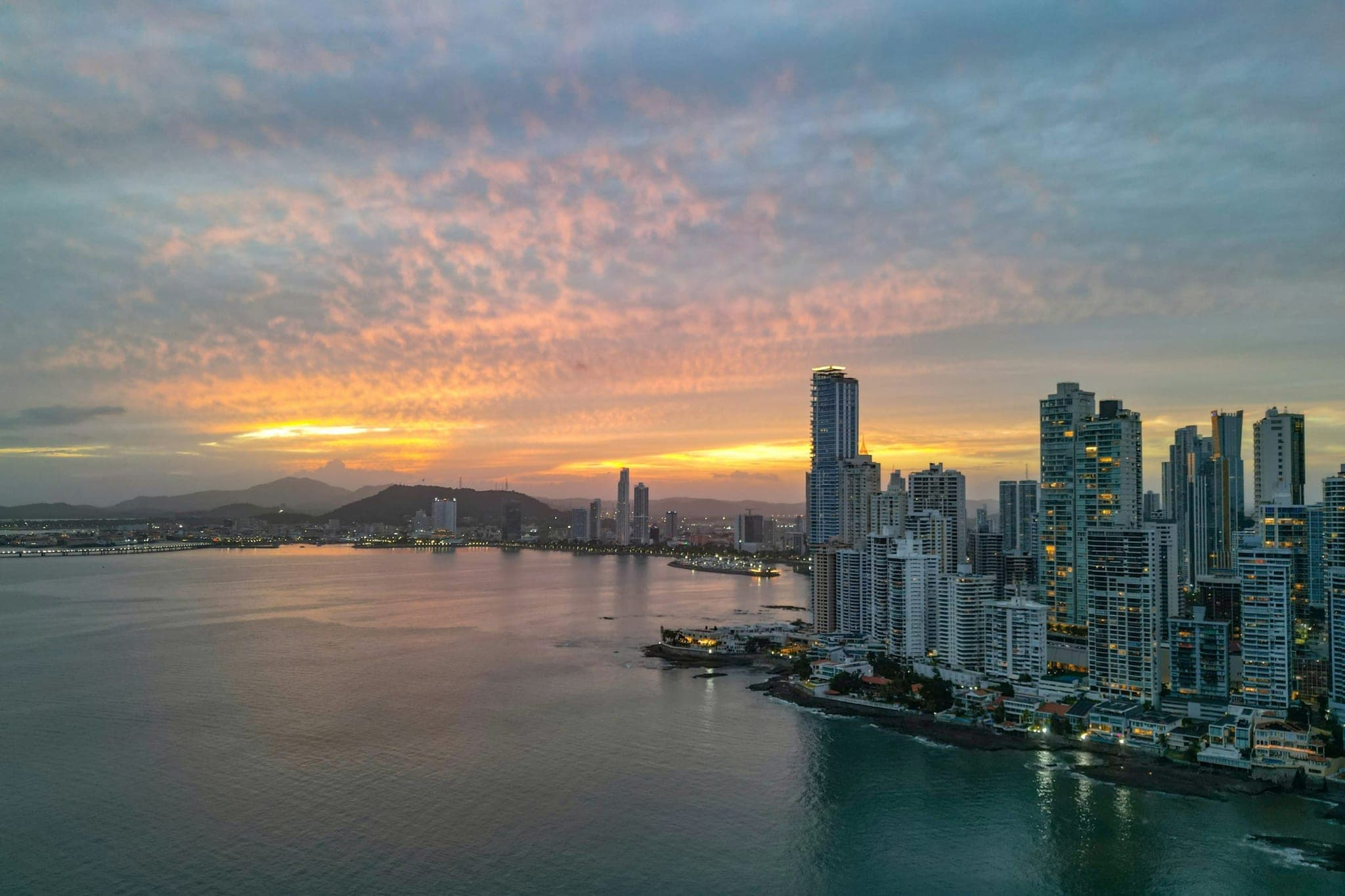
Panama · visa route
Emigrating to Panama
Panama gives pensioners what almost no country gives: permanent residence from day one, against a pension requirement of US$ 1,000 a month, with legal discounts on everything from flights to medicines. The honest story has two sides the internet leaves out: under the treaty the Netherlands simply keeps taxing your AOW and your pension, and the single-person AOW outside a treaty country drops from 70% to 50%. This page shows how it really works.
€ 399 one-off · 29 steps · no subscription
- Kind of journey
- Visa — permanent residence from day one
- The route
- Pensionado: US$ 1,000 a month, via a compulsory lawyer
- Note
- NL keeps taxing — and the single-person AOW drops to 50%
Last updated: August 2026
The journey
Five phases, from the route choice to the discounts
A route whose biggest item isn't the move but the visa journey: the legally compulsory lawyer, the apostilles and the Spanish translations. Against that stands the calmest outcome of all far destinations — permanent residence, for life — plus the sums you have to do honestly up front: the continuing Dutch taxation, the AOW drop for singles and the age trap of the health insurers.
- 1
Orientation
Permanent from day one — and two sums the brochure leaves out
The pensionado visa gives immediate permanent residence with a lifelong pension of US$ 1,000 a month — no annual renewal, no deposit. In this phase you do the two sums that carry the decision: the tax sum (under the treaty the Netherlands keeps taxing AOW and pension; what you gain are the premiums and the legal certainty, not the tax) and the AOW sum (outside a treaty country the single-person AOW drops to the married rate of 50%). And you explore the three Panamas: the city, the highlands of Boquete and the beaches.
- 2
Your visa
The compulsory lawyer, the certificate-of-conduct question and three to six months
Every application legally runs via a Panamanian immigration lawyer — choose them as the most important purchase of the journey, and have it confirmed in writing beforehand that the Dutch certificate of conduct suffices as a criminal record statement: that's the stumbling block for Dutch people. Then: the pension statement from SVB and fund with apostille, sworn Spanish translations, lodging in person, and on average three to six months to approval. The Friendly Nations visa still exists too, but in its post-2021 form — two years temporary, via an employment contract or US$ 200,000 in property.
- 3
Closing the Netherlands
Acceptance first, and the AOW sum becomes final
The familiar list with two hard lessons. Healthcare: no CAK route, and the insurers apply entry limits (local up to about 65, international up to about 74) — ask the acceptance question before any irreversible step. And the AOW: Panama isn't a treaty country, so singles drop from 70% to 50% and the allowance lapses. Plus the ordinary work: deregistration, M form, protective assessment, and activating the DigiD app before departure — the embassy is in Costa Rica.
- 4
The move
The container, the car you buy there and the ten-day window
The household contents go by sea container; the exemption for removal goods hangs on your residence status, so the order of the papers matters more than the sailing. The car you usually buy there — the pensionado does have an exemption from import duties on one car every two years. And the pet has no long lead time here but a tight slot: all papers within ten days before arrival, and after landing forty days of home quarantine, notified in advance.
- 5
Arrival in Panama
Cédula → bank → driving licence — and then the discounts start working
The order is the lesson: first the cédula, then the bank (the reference letter from your Dutch bank is only good for thirty days), then immediately the driving licence — because as soon as you have residency, the validity of your Dutch driving licence lapses right away. After that the legal discounts of Law 6 from 1987 get to work: 25% on flights and restaurants, 50% on hotels on weekdays, 25% on electricity and phone, 10 to 20% on healthcare — enforceable, with your cédula as the key.
Look inside
This is what one step of your plan looks like
Not a brochure but the real thing: this is one of the steps of the Panama journey, exactly as it appears in your personal step-by-step plan — with the deadlines, the counters and the sources.
Step 3.3 of your plan
Deregister — and know the AOW sum
- Lead time
- deregistering is possible from 5 days before departure; the whole takes 4-8 weeks
- Costs
- limited — cancellation costs per contract
Deregistering from the BRP (the municipal population register) you do at your municipality, shortly before departure — and report the move to the SVB. This is where the sum belongs that almost no site mentions: Panama is not a treaty country under the BEU Act. For couples little changes, but single people fall back from 70% to the married rate of 50%, and the AOW supplement lapses. That's not a detail but twenty percentage points of your basic income — it was already in your budget from phase 1, and here it becomes definitive.
Beyond that the ordinary list: benefits stop, AOW accrual stops (apply for voluntary continuation within one year), giving your pension funds your new address, arranging post.
This is step 3.3 of 29. The other 28 are ready for you — each with the same sources, the same counters and a planning that watches your dates.
What it costs
A rough indication for your situation
A few short questions, and you get a range instead of an amount. That's deliberate: an exact figure would suggest a precision nobody has.
Count on a total of
€ 6.400 – € 14.200
Where does that difference come from?
- De eerste maanden€ 3.000 – € 7.000
- Pensionado-visum via de verplichte advocaat€ 2.800 – € 5.800
Open the breakdown below: there you'll find per item where the upper and the lower limit come from.
- Aanvraag en papieren
- € 3.000 – € 6.300
- De verhuizing
- € 400 – € 900
- De eerste maanden
- € 3.000 – € 7.000
View the itemsPer item the amount, the source and whether it's a rate or an estimate
Aanvraag en papieren
- Pensionado-visum via de verplichte advocaat(estimate)€ 2.800 – € 5.800
Elke verblijfsaanvraag loopt wettelijk via een Panamese immigratieadvocaat. De advocaatkosten zijn marktprijzen (US$ 1.000 tot 5.000), de overheidsleges zo'n US$ 250-300 per persoon, en met apostilles, vertalingen en de indieningsreis erbij is US$ 3.000 tot 6.000 per volwassene het realistische totaal. Gezinsleden liften deels mee op hetzelfde dossier, maar tellen elk voor eigen leges en documenten.
- Apostilles en beëdigde Spaanse vertalingen(estimate)€ 200 – € 500
De pensioenverklaring, de VOG en de akten krijgen elk een apostille bij de rechtbank (zo'n € 25-30 per stuk) en daarna een beëdigde vertaling naar het Spaans (€ 50-90 per document). Reken op vier tot zes documenten per persoon, en op de juiste volgorde: eerst het document, dan de apostille, dan de vertaling.
De verhuizing
- Reis(estimate)€ 400 – € 900
Vliegen, enkele reis Amsterdam-Panama-Stad (ruim tien uur, meestal met één overstap) — plus de eerdere indieningsreis die bij het visumtraject hoort en daar is meegerekend.
De eerste maanden
- De eerste maanden(estimate)€ 3.000 – € 7.000
Borg, huur vooruit, tijdelijk gemeubileerd wonen en de inrichting — in dollars. De huren lopen sterk uiteen per regio: een één-slaapkamerappartement kost in Boquete of Coronado US$ 400-800, in Panama-Stad vanaf zo'n US$ 1.100 en in de premium-wijken het dubbele. Reken ook het wisselkoersrisico mee: je inkomen komt in euro's, het leven loopt in dollars.
And if you buy a house?
This calculation assumes renting: the first months include deposit and rent in advance.
If you buy, count on 2 to 5% of the purchase price on top of this amount. On a home of € 250,000 that's € 5.000 to € 12.500.
De overdrachtsbelasting van 2% draagt formeel de verkoper; als koper betaal je vooral de eigen advocaat (de titelcheck is hier geen luxe maar de kern van de koop), de registratie en de notariële afwikkeling — samen doorgaans een paar procent. Koop nooit grond zonder eigendomstitel ("rights of possession"), en weet dat een koopwoning van minstens US$ 100.000 de pensionado-inkomenseis verlaagt naar US$ 750 per maand.
An order of magnitude based on averages, not a quote. The real amounts depend on your occupation, your route, the season and dozens of choices you still have to make.
The rates in this calculation haven't been checked against the official sources yet.
Your complete, personal cost picture — with your route, your documents and your deadlines — you get in Vertrekklaar.
That was the move. And once you live there?
Who may tax your pension once you live in Panama, is there a favourable regime, and how do you become insured? That depends on where your income comes from. Tick it and you see which rules apply to you — with the source.
See the financial conditionsThe departure guide
Five mails, and you see your whole journey
Not ready to start yet? Then we'll send you the departure guide for Panama: five mails in a week and a half, with the order, the pitfalls and the real costs. After that only a short update when something in Panama really changes — at most one a month, no newsletter, and you can switch it off at any time.
Read on
The knowledge base on Panama
Per phase, the articles that are already there. They're written from the same journey and go deeper than what fits above.
Arrival in Panama
- 3 min
Panama's pensionado discounts: law, not marketing — with the conditions attached
25% on air tickets and restaurants, 50% on hotels from Monday to Thursday, 25% on electricity, telephone and water, 20% on medicines and doctor's consultations: the discounts of Law 6 of 1987 are legally enforceable. But every discount has conditions that the lists online leave out — and two percentages doing the rounds are out of date.
Updated 31 August 2026
- 8 min
Living, renting and buying in Panama: first the finca number, then the rest
In Panama two completely different things are sold as property, and the difference costs foreigners money: titled property with a finca number, or a possessory right without title that no bank will finance. Plus the rents per region, the bank account that only works after your residence permit, and the euro-dollar risk that affects your income.
Updated 31 August 2026
Leaving the Netherlands — for every destination
- 2 min
Keeping a bank account and DigiD: the two lines you never cut
After your deregistration you still need the Netherlands for years — for the M return, refunds and your pension. Within the EU your bank account is a right, towards Australia a favour from the bank. And your DigiD you arrange before departure, not after.
Updated 11 August 2026
- 3 min
The protective assessment: the bill that travels with you, and that never expires for one item
On emigration the Netherlands imposes an assessment on your pension, your annuity and your substantial shareholding that you don't have to pay — as long as you do nothing that makes it collectable. For pension and annuity it usually lapses after ten years. For a substantial shareholding it doesn't: that one remains valid indefinitely.
Updated 27 August 2026
- 2 min
Emigrating with children after a divorce: the consent that comes before everything
With joint custody you can't just go abroad with the children — you need the consent of the other parent, or substitute consent from the court. What the court weighs, and why leaving without consent is legally child abduction.
Updated 11 August 2026
- 3 min
Emigrating on early retirement: the CAK route is expected to close as of 1 November 2026
Whoever moves to the EU or Switzerland with a Dutch pension arranges their healthcare via the CAK. That door is closing to a crack: as expected, from 1 November only new applicants with AOW, Anw, WAO, WIA or Wajong will be admitted. Early retirement and RVU fall outside it — whoever is already a customer keeps their rights.
Updated 16 August 2026
- 2 min
The M form: the tax return for the year in which you emigrated
For the year of your departure you lived partly inside and partly outside the Netherlands, and a separate return goes with that. Nowadays it can be done online — but you have to think of it yourself, because an invitation rarely comes by itself.
Updated 9 August 2026
- 2 min
Your AOW accrual stops on departure — and you have one year to repair that
Every year outside the Netherlands costs you 2% AOW (the Dutch state pension), for life. The SVB has a voluntary continuation that closes that gap — but signing up is only possible in the first year after departure, and almost everyone misses that deadline.
Updated 11 August 2026
- 3 min
Your Dutch pension abroad: what comes along, and who levies
The AOW (the Dutch state pension) travels fully to the EU and to Australia — the latter thanks to a treaty from 2001. Your company pension too, but *where* you pay on it depends on the tax treaty, and the exemption you arrange yourself.
Updated 11 August 2026
- 3 min
Cancelling your health insurance without a gap
Your Dutch basic insurance is tied to living or working in the Netherlands and stops being a given on emigration. The art is to have the end date match your new cover — and to know which route belongs to your situation.
Updated 28 August 2026
- 2 min
Taking medicines across the border: certificates, supply and the 90-day ceiling
For medicines under the Opium Act you need a certificate — and the Dutch system only carries you for three months. What you arrange with the CAK, what Australia wants to see at the border, and why finding a local doctor simply belongs to your first weeks.
Updated 11 August 2026
- 9 min
Partner comes along without a job of their own: deregistering, healthcare, AOW and the house
Your partner has a job, a visa or a right of residence there; you come along without a job of your own. Administratively you're then no passenger: the deregistration, the end of your health insurance and your AOW accrual apply to you separately. What you get back if you arrange it well, what it costs if you let it slide — and why "just staying registered" isn't an option.
Updated 7 September 2026
- 2 min
Stopping allowances on emigration: do it yourself, and in time
Housing allowance, healthcare allowance, childcare allowance and child budget don't stop by themselves on the day you leave. Whoever lets them run gets a reclaim months later — this is what you arrange per allowance.
Updated 9 August 2026
- 3 min
Deregistering with the municipality: when exactly, and what stops then
Deregistering from the BRP is only possible from five days before departure, and is compulsory as soon as you're away for more than eight months a year. What stops at that moment, what stays, and which piece of paper you have to ask for right away.
Updated 9 August 2026
- 6 min
When does your pension stay taxed in the Netherlands? The three pots and the three conditions
"Your pension is taxed in your new country of residence" is right by approximation and not in the details. Your AOW, your company pension and your government pension each follow a rule of their own, and with the company pension the Netherlands can still levy if three conditions apply at once. This article explains which three, and which four questions you have to answer for your own situation.
Updated 27 August 2026
Ready to begin?
Thirty-six journeys are fully ready — Austria, Belgium, Croatia, Cyprus, Denmark, England, Estonia, Finland, France, Germany, Greece, Ireland, Italy, Malta, Norway, Portugal, Spain, Sweden, Switzerland, Aruba, Bonaire, Curaçao, Sint Maarten, Canada, Panama, United States, Suriname, China, Dubai, Indonesia, Japan, Thailand, Turkey, South Africa, Australia and New Zealand: your step-by-step plan, your documents and your costs in one place, with the timing watched. Pay once, and it's yours.